← Back to Fantasize Yogyakarta, Indonesia
Cross-Country Getaway

Yogyakarta, Indonesia

Business class roundtrip fares from 10 US hubs · Updated daily
$6,021
Lowest fare
$8,093
Average
10
US hubs
0
Below normal
All fares to Yogyakarta, Indonesia
LAX 15h $6,021 Typical Book Search →
BOS 16h $6,218 Typical Book Search →
JFK 16h $6,488 Typical Book Search →
ORD 15h $6,603 Typical Book Search →
SEA 15h $7,151 Typical Book Search →
SNA 15h $7,994 Typical Book Search →
DFW 15h $8,426 Typical Book Search →
ATL 15h $8,535 Typical Book Search →
SFO 15h $11,287 Typical Book Search →
MIA 15h $12,210 Typical Book Search →
About Yogyakarta, Indonesia

Yogyakarta is the soul of Java — a city where thousand-year-old temples coexist with a thriving contemporary art scene, where sultans still hold court in a living palace, and where the food alone justifies the flight. Most domestic travelers treat it as a quick temple-hopping weekend, but the real Yogya reveals itself when you slow down: private dawn rituals at Borobudur before the crowds descend, dinner in a century-old Javanese mansion, and galleries that rival anything in Jakarta. This is Indonesia's cultural capital, and it rewards those who approach it with depth, not a checklist.

6 Experiences Worth Flying Business Class For
1. Borobudur at First Light — With the Temple to Yourself

Skip the Manohara Resort sunrise package that every travel blog recommends — instead, book a private heritage access through Plataran Borobudur Resort & Spa, ...

where their concierge arranges a pre-dawn guided meditation on the upper stupas before the general sunrise ticket holders flood in. Watching fog lift off the Kedu Plain from the ninth-century monument, with nothing but birdsong and the scent of frangipani, is a genuinely transcendent experience. Stay for breakfast at the resort's Patio restaurant overlooking the temple afterward; the nasi gudeg served on hand-thrown ceramics is worth the early wake-up alone.

2
A Private Evening at the Kraton: Javanese Court Culture, Unfiltered
The Sultan's Palace is a daytime tourist stop for most, but through connections at The Phoenix Hotel Yogyakarta (a beautifully restored 1918 colonial property), you can arrange a private evening of gamelan and classical Javanese dance performed by actual court dancers in the Kraton's pendopo pavilion. This isn't a tourist show — it's the real aristocratic art tradition performed in its original context, with batik-clad attendants serving Javanese sweets. It reframes everything you think you know about Indonesian culture, revealing a courtly refinement that rivals anything in Kyoto or Rajasthan.
3
The Underground Art Crawl of Kotagede and Prawirotaman
Yogyakarta quietly produces more contemporary artists per capita than anywhere else in Southeast Asia, and the scene is concentrated in two neighborhoods most luxury travelers skip entirely. Start in Kotagede, the ancient Mataram capital, where crumbling silver workshops and royal cemeteries share streets with radical installation spaces like Cemeti Art House — Indonesia's first contemporary art space. Then move to Jalan Prawirotaman, where hole-in-the-wall galleries sit between boutique guesthouses, and end the evening at Via Via Café for wine and conversation with actual working artists who will reshape your understanding of Indonesian creative culture.
4
The Javanese Table: A Gudeg Pilgrimage and Beyond
Every visitor eats gudeg, but almost nobody eats the right gudeg — skip the tourist-friendly versions on Malioboro and go directly to Gudeg Yu Djum's original warung on Jalan Wijilan at dawn, where the jackfruit has been slow-cooked overnight in teak-wood smoke and coconut milk until it collapses into something almost meaty. For the luxury counterpoint, book the Javanese rijsttafel tasting menu at Bale Raos, the restaurant inside the Kraton complex that serves royal palace recipes passed down through generations of court cooks. The contrast between street-level and palace cuisine tells you more about Java than any museum could.
5
Prambanan Under Starlight with a Ramayana Ballet
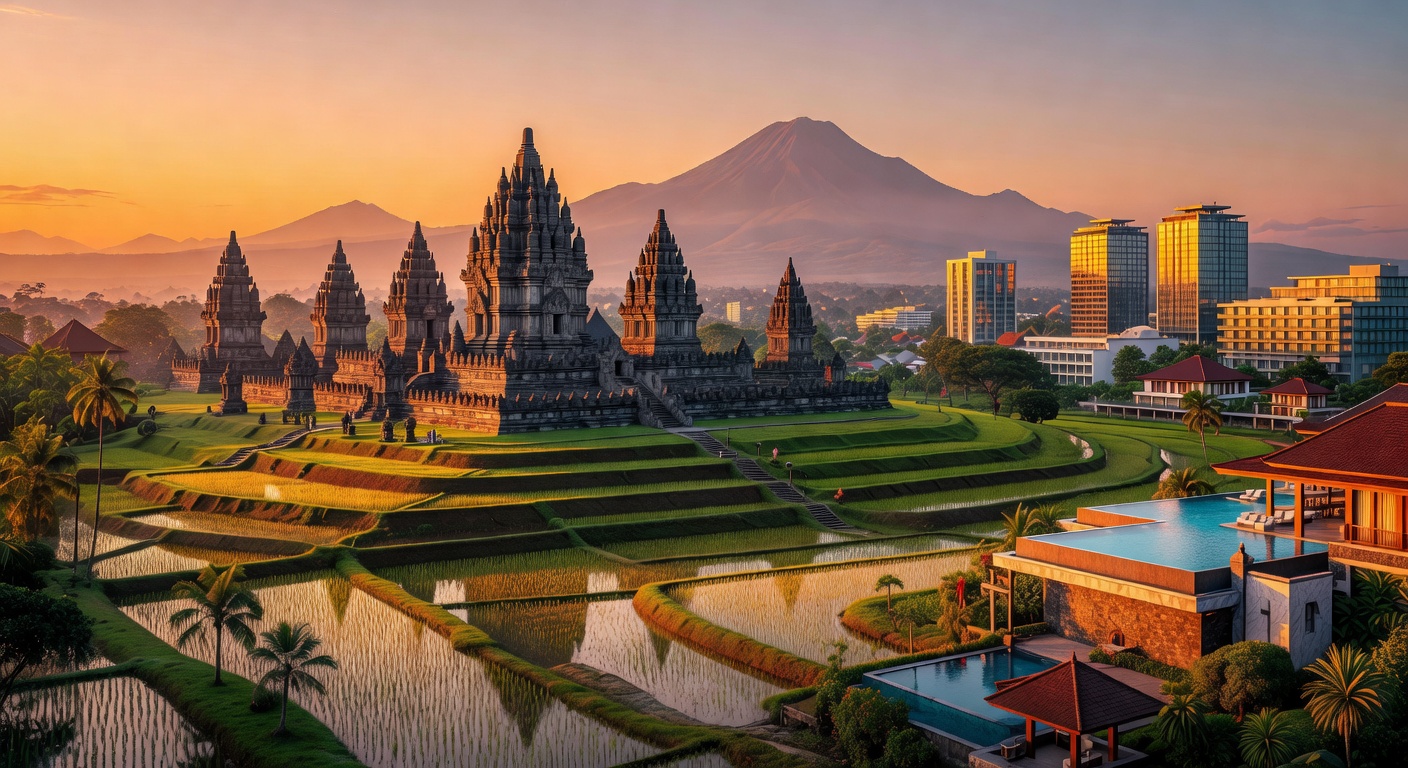
The Prambanan temple complex is Borobudur's Hindu counterpart — arguably more dramatic in its towering, razor-sharp spires — but the real magic happens on full-moon nights between May and October when the open-air Ramayana Ballet performs against the floodlit temples as a backdrop. Book the VIP section and arrive early enough to walk the lesser-visited Sewu and Plaosan temples nearby, which are hauntingly empty at dusk. This is one of the few performances in the world where a UNESCO World Heritage Site becomes a literal stage set, and the effect under a tropical sky is nothing short of cinematic.
6
Jomblang Cave: Rappelling into a Cathedral of Light
About ninety minutes southeast of the city, Goa Jomblang is a collapsed sinkhole that you rappel into — descending through a forest canopy growing inside the cave mouth before walking through an underground river passage to a second chamber where a single shaft of sunlight pierces the darkness like a spotlight from heaven. This is not a polished tourist attraction; you will get muddy, the harnesses are basic, and the timing must be precise (around 10-11 AM for the light beam). But for the adventurous luxury traveler who has seen everything, this is a raw, almost spiritual encounter with geology that no amount of money can manufacture — only well-timed bookings through operators like Jogja Tour Guide can guarantee small-group access.
When to Go Show ↓
Peak Season
June through August, plus late December through early January
Dry season combined with school holidays means Borobudur and Prambanan are genuinely crowded, and domestic tourists from Jakarta flood in for long weekends. Hotel rates at properties like Amanjiwo and Plataran spike by 40-60%, and the Ramayana Ballet sells out weeks in advance. It's still beautiful — the dry weather makes temple exploration comfortable and Jomblang Cave's light beam is most dramatic — but you'll need to book everything months ahead and lean heavily on private access arrangements to avoid the masses.
🌴
Shoulder Season
April through May, and September through October
This is when Yogyakarta belongs to you. The rains have tapered off or haven't yet returned, the rice terraces surrounding Borobudur are impossibly green, and the temples are blissfully uncrowded on weekday mornings. Luxury properties offer meaningful rate reductions and upgrades — Amanjiwo in particular becomes almost private-estate quiet in May and September. The art scene is also more accessible, as gallery openings and studio visits aren't competing with tourist-season programming.
Plan your trip to Yogyakarta, Indonesia