Your cruise
Azamara Quest · 14-night Caribbean cruise, Rio de Janeiro to Bridgetown
Feb 28 – Mar 13 · 14 nights ·
Day 1–2 Rio de Janeiro (board) · Day 3 at sea · Day 4–5 Bahia de Salvador · Day 6 at sea · Day 7 Natal(Rio Grande do Norte) · Day 8–9 at sea · Day 10 Belem · Day 11 at sea · Day 12 Ile Royale · Day 13 at sea · Day 14 Scarborough · Day 15 Bridgetown (step off)
What you do Wander Salvador's golden UNESCO World Heritage heart with a master local storyteller. Cobblestone squares, gilded baroque churches, and living Afro-Brazilian culture — all at your own pace, with zero crowds and total depth.
What to expect Ivan leads you through the labyrinthine cobblestone alleys of Pelourinho, the 17th-century colonial district that is the soul of Afro-Brazilian civilisation. You'll step inside the dazzling Church and Convent of São Francisco, said to hold the largest quantity of gold of any church in the Americas. Expect impromptu encounters: a mestre playing berimbau on a sunny square, a candomblé percussion circle, a local artist with a studio door ajar. The narrative covers the brutal history of slavery alongside the extraordinary cultural resilience that made Salvador what it is today.
Good to know Half-day tours fit comfortably within a port call; confirm your ship's all-aboard time and request a morning start to beat the midday heat. Ivan operates exclusively private and small-group experiences — book at least 2 weeks in advance. The Pelourinho district is a 10-minute taxi ride from the cruise terminal.
Versus the ship tour A fully private, pace-your-own experience with one of Salvador's most celebrated cultural interpreters — intimate access to hidden courtyards, local artists' studios, and capoeira circles that large groups never see.
What you do Step inside what many call the most opulent church in the Americas — walls and ceilings smothered in over 800 kg of hand-carved, gilded jacaranda wood. A private guided visit unlocks every gilded detail and the story behind it.
What to expect The moment the heavy wooden door swings open, the interior hits you like a fever dream of gold — every surface carved with angels, vines, and saints, all leaf-gilded by enslaved artisans in the 18th century. Your guide contextualises the brutal paradox: this breathtaking beauty was financed entirely by colonial wealth and enslaved labour. The adjoining cloister features stunning azulejo tile panels depicting the life of São Francisco. Spend as long as you wish in the sacristy, where precious reliquaries and vestments are displayed.
Good to know Arrive at opening (07:00) for the fewest visitors and the best light streaming through the nave. Smart attire required — shoulders and knees covered. Located in the Pelourinho, 10 minutes by taxi from the port. Book your private guide via Ivan Bahia Guide or ToursByLocals in advance.
Versus the ship tour Entry is limited and timed; a pre-arranged private guide means you move at your own contemplative pace inside the nave — no rushing through in a line, and no competing audio guides drowning out the silence.
What you do The definitive private panoramic of Brazil's first colonial capital — from the clifftop Cidade Alta to the waterfront Cidade Baixa, riding the iconic Elevador Lacerda, visiting Bonfim Church and the Mercado Modelo.
What to expect Your day begins at the cruise terminal, where your guide collects you in a private air-conditioned vehicle. You ride the legendary Elevador Lacerda — the Art Deco cliff elevator linking the upper and lower cities — with your guide narrating 500 years of history from its panoramic platform. Stops include the Basílica do Senhor do Bonfim (Salvador's most beloved pilgrimage church), the Dique do Tororó lake with its towering orixá sculptures, and the Mercado Modelo, where you can taste acarajé — the famous black-eyed pea fritters declared Intangible Cultural Heritage by UNESCO. The afternoon is flexible: Rio Vermelho neighbourhood, Porto da Barra beach, or a final sundowner over the bay.
Good to know Full-day format works for calls of 8+ hours; confirm your all-aboard time so your guide can plan accordingly. Request a morning pickup directly from the cruise pier. Book at least 1–2 weeks ahead as Sayuri's calendar fills quickly.
Versus the ship tour A deeply personal, fully private day with a vetted local expert who tailors every stop to your interests — no fixed group timeline, no unnecessary stops, and insider access to neighbourhood details most visitors never encounter.
book direct with ToursByLocals – Sayuri K. Private Salvador Guide → · the full guide →
What you do Sail the vast, turquoise Baía de Todos os Santos aboard a private catamaran to the emerald islands of Frades and Itaparica — crystalline natural pools, pristine beaches, and fresh seafood, all with live Bahian music on deck.
What to expect Cast off from the historic waterfront of Salvador's lower city and sail into the Baía de Todos os Santos, the largest bay in Brazil and one of the most beautiful in the world. As the city skyline fades, the crew pours caipirinha cocktails while a musician plays samba and forró on deck. On Ilha dos Frades, you'll swim in clear, warm natural pools with colourful fish below your feet. Itaparica offers a charming colonial village, hammock beaches, and a legendary riverside restaurant serving moqueca de peixe — Bahian fish stew — made with fresh catch and coconut milk. The return sail at golden hour, city silhouetted against a burning sky, is unforgettable.
Good to know The full island tour takes 7–8 hours; confirm with Saveiros that it aligns with your all-aboard time. A boarding fee of BRL 20 in Salvador plus a BRL 35 Ilha dos Frades entrance fee applies. The Saveiros dock is a 5-minute taxi from the cruise terminal at the Comércio waterfront.
Versus the ship tour A private charter means your own pace, your own anchorage, and a crew dedicated entirely to your group — you choose when to swim, snorkel, and feast on grilled fish, rather than following a mass-tour schedule.
book direct with Saveiros Tour Salvador (Official Boat Operator) → · the full guide →
What you do Drive the stunning Coconut Coast 80 km north of Salvador to Praia do Forte — a pristine village beach with the TAMAR Project's legendary sea-turtle conservation sanctuary and reef snorkelling in gin-clear water.
What to expect A private air-conditioned vehicle whisks you north along the Estrada do Coco — the Coconut Road — flanked by Atlantic rainforest and palm groves. Arriving in the car-free village of Praia do Forte, you'll visit the TAMAR base, where researchers share the work protecting five endangered sea-turtle species along 1,100 km of Brazilian coastline. Watch hatchlings in nursery pools and, seasonally (November–March), witness nesting or releases on the beach at dusk. After TAMAR, snorkel the natural reef pools, then settle into one of the village's open-air seafood restaurants for a long, languid lunch of grilled lobster and cold Brahma.
Good to know Allow at least 7–8 hours for the round trip; best for port calls with a late all-aboard (19:00 or later). Book your private vehicle via a certified local operator (tourHQ Salvador) to pair with the TAMAR visit. TAMAR is open daily 09:00–17:30; arrive before noon to avoid day-tripper crowds.
Versus the ship tour TAMAR is the world's most important sea-turtle conservation project; seeing nesting tanks, juvenile pools, and rescued loggerhead turtles with a specialist naturalist guide gives you context and access that a generic beach excursion simply cannot.
book direct with Projeto TAMAR (Official Sea Turtle Conservation Centre) → · the full guide →
What you do Learn the sacred Bahian kitchen — acarajé, moqueca, and vatapá — in the home of a Bahian culinary master, paired with an intimate introduction to the living rhythms and ritual of Candomblé, the heartbeat of Afro-Brazilian spirituality.
What to expect Your morning begins at the Mercado São Miguel, selecting fresh ingredients with your host — malagueta chillies, dried shrimp, fresh coconut, and dende palm oil — while she explains their Yoruba origins and ritual significance in Candomblé offerings. Back in her beautifully tiled kitchen, you cook from scratch: crispy acarajé stuffed with vatapá and caruru, a rich moqueca de camarão simmered in coconut milk and tomatoes, and a quindim egg-yolk coconut dessert. The class concludes with a long, convivial lunch at her table, accompanied by stories of the terreiros (Candomblé houses) and the extraordinary survival of West African spiritual traditions in Brazil. Optional afternoon: a respectful, invited visit to a local terreiro to hear the drums.
Good to know Classes run 09:00–13:30 and fit neatly into a standard port call. The market and kitchen are in the Barra/Rio Vermelho area, a 15-minute taxi from the cruise pier. Book at least 1 week ahead as groups are kept intentionally small (max 8 guests). Inform your host of any dietary restrictions at booking.
Versus the ship tour You're not a tourist watching a demonstration — you're at the stove, grinding dendê palm oil, frying acarajé beside the cook, and sitting down to eat what you made. This is as close as a visitor gets to the intimate domestic heart of Bahian culture.
book direct with Cursos de Culinária Bahiana – Casa de Tereza (Official) → · the full guide →
What you do Rio's three crown jewels — Christ the Redeemer, Sugarloaf Mountain, and the Selarón Steps — in a single, seamlessly paced private day. A licensed local expert curates every moment, from sunrise crowds to golden-hour cable car rides.
What to expect Your private air-conditioned vehicle collects you at the cruise terminal and whisks you to the iconic Selarón Steps, where the artist Jorge Selarón's 215 mosaic-tiled risers cascade down Lapa in a blaze of colour. From there, ascend Corcovado by rack railway to stand at the feet of the 38-metre Cristo Redentor as the city unfolds 710 metres below. The afternoon belongs to Sugarloaf, riding two consecutive gondolas to the 396-metre summit for a panorama that takes in Guanabara Bay, Copacabana, and the Atlantic horizon. Lunch at a curated local restaurant is included, and your guide personally adjusts the itinerary around your all-aboard time.
Good to know Pre-book well in advance — private days fill up fast in peak season (Dec–Mar). Confirm your all-aboard time with the guide at booking so the schedule is built around it. Christ the Redeemer tickets should be pre-purchased online to skip the booth queue. Comfortable walking shoes essential; the steps at Corcovado are steep.
Versus the ship tour Entirely private — your guide, your pace, zero queuing with strangers. A licensed cultural expert weaves the history, politics, and art of each site into an unhurried narrative you simply cannot get in a crowd.
What you do Trade the tourist rack railway for a lush 90-minute jungle trail through Tijuca Forest, arriving at Cristo Redentor breathless and triumphant — before the day-trippers arrive. One of Rio's great bucket-list physical experiences.
What to expect Your expert naturalist guide meets you at the port and transfers you to Parque Lage, a neo-romantic 19th-century estate at the forest's edge. The trail climbs steadily through dense canopy — strangler figs, bromeliads, and the calls of toucans accompany your ascent. At the summit, the outstretched arms of Cristo Redentor frame a 360-degree panorama: Guanabara Bay glittering to the east, Ipanema and Copacabana arcing south, and the Tijuca massif rolling away to the west. The descent is by rack railway, so your legs get the reward without the repeat effort.
Good to know Moderate fitness required — ~4 km uphill on uneven forest paths. Departs early morning (07:00 recommended) to beat both heat and crowds; confirm timing against your all-aboard. Wear trail shoes, bring a light rain layer, water, and sunscreen. Trail can be muddy after rain.
Versus the ship tour This is the insider approach — starting from the fairytale Parque Lage mansion and ascending through Atlantic rainforest with capuchin monkeys overhead. Arriving on foot before the cable cars start running means you often have the terrace nearly to yourself.
book direct with Do Brazil Right – Shore Excursions → · the full guide →
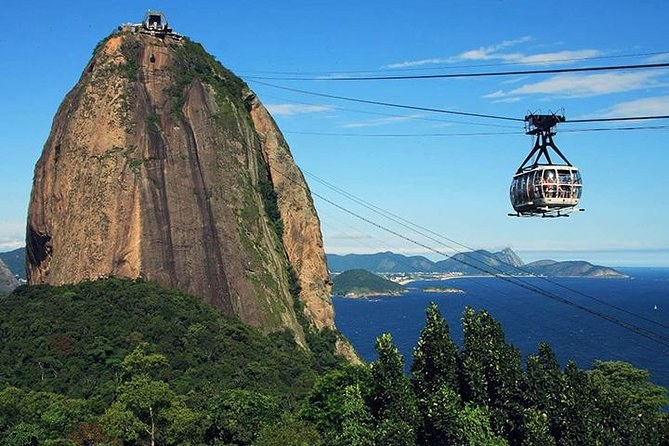
What you do Ascend Sugarloaf by gondola as the sun melts into the Atlantic and Rio's lights begin to glitter below — with a private guide, reserved cable car access, and chilled champagne on the summit. Simply one of the most spectacular sunsets on Earth.
What to expect Your private vehicle collects you from the pier and drives the scenic bayside road to Praia Vermelha, where the cable car base station sits against a dramatic granite wall. The first gondola glides to Morro da Urca (215 m) for cocktails on an open-air terrace with views of Botafogo Bay. The second gondola carries you to the Sugarloaf summit itself, where your guide points out every landmark — the twin humps of the Two Brothers, the long sweep of Ipanema beach, and the Cristo Redentor glowing on Corcovado opposite. As darkness falls, Rio transforms into a carpet of lights stretching to the horizon.
Good to know Sunset timing shifts seasonally — confirm exact departure time with your guide against your all-aboard (typically 17:30–18:30 ascent works for most ships). Pre-purchase cable car tickets online at bondinho.com.br to skip queues. Light jacket recommended at the summit — the Atlantic breeze picks up after dark.
Versus the ship tour A private guide secures your gondola timing to land on the 396-metre summit precisely at golden hour — the moment when the bay turns copper and the city's mosaic of favelas, beaches, and skyscrapers is lit from below. Champagne is waiting.
book direct with Rio Private Guide – Alan Denis → · the full guide →
What you do Plunge into the world's largest urban rainforest on an open-top 4×4 Jeep, hunting hidden waterfalls, rare orchids, and monkeys in the canopy above Rio's skyline. Thrilling, beautiful, and utterly unlike any city tour.
What to expect The Jeep departs the port and within 20 minutes you're deep in Tijuca National Park — 32 square kilometres of restored Atlantic rainforest that once covered the entire city. Your naturalist driver-guide navigates steep cobbled tracks to the Cascatinha Taunay waterfall, where you can swim in a cool natural pool. The trail continues to the Vista Chinesa pagoda, an incongruous 1920s belvedere perched above the south zone with jaw-dropping views of Lagoa Rodrigo de Freitas and the beaches beyond. Look up: squirrel monkeys and toucans are reliable sightings year-round.
Good to know Half-day format (4 hrs) makes it very manageable against an all-aboard. Bring insect repellent, swimwear if you want to dip at the waterfall, and a light layer. Jeep seats are open-air — sunscreen essential. Available year-round but forest is most dramatic and green after rain.
Versus the ship tour An open-sided Jeep lets you lean into the forest rather than observe it through glass — guides stop at unmarked trails, hidden cascades, and viewpoints that only locals know. Small groups of 6 maximum mean the guide is always within earshot.
book direct with Do Brazil Right – Shore Excursions → · the full guide →
What you do Explore the birthplace of samba and the heart of Afro-Brazilian heritage — the Saúde docklands 'Pequena África', the Valongo Wharf UNESCO site, and the bohemian arches of Lapa — with a cultural historian as your guide.
What to expect Your expert cultural guide leads you from the port through the revitalised Saúde neighbourhood — Rio's 'Little Africa' — where the Valongo Wharf, the largest disembarkation point for enslaved Africans in the Americas, is now a haunting and essential UNESCO World Heritage Site. The route winds through Gamboa to the Praça Mauá waterfront plaza, past the Museum of Tomorrow, then south into the Lapa arches district, where the Selarón Steps cascade down in their famous mosaic splendour. At every turn your guide connects architecture, music, and history — from candomblé to capoeira — with the living culture of modern Rio.
Good to know Entirely walkable — flat terrain, approximately 5 km total. Wear comfortable shoes and light, breathable clothing. Best done in the morning before heat peaks. The Selarón Steps are at the end of the route — a natural finale. Confirm all-aboard time with guide; the 4-hour format leaves a comfortable buffer.
Versus the ship tour This is the Rio that doesn't make the postcard — the cobbled alleyways where samba was born, the 19th-century wharf where millions of enslaved Africans arrived, and the street-art-covered neighbourhood of Lapa, all interpreted by a guide with deep academic and community roots.
What you do Walk the hallowed turf, dressing rooms, and players' tunnel of Maracanã — South America's most iconic football cathedral — with a private guide who unlocks areas closed to the public, and a lifetime of stories about the Maracanazo, Pelé, and the 2014 World Cup.
What to expect Your guide meets you at the port and transfers you directly to the Zona Norte neighbourhood where Maracanã rises like a concrete colosseum. Inside, the private route takes you through the players' dressing rooms (still bearing the scent of decades of drama), the athletes' tunnel where legends have walked, and out onto the pitch itself — 78,000 seats surrounding you in silence. Your guide narrates defining moments: the 1950 World Cup 'Maracanazo' defeat, Pelé's 1,000th goal, and the stadium's reinvention for 2014. A visit to the onsite Hall of Fame and the club merchandise boutique rounds out a deeply Rio experience.
Good to know Tours run most mornings when no match is scheduled — verify match schedule before booking as stadium access changes on game days. Allow 2.5–3 hours including transfer from port. The stadium is a 20-minute drive from the cruise terminal. Combine with a lunch stop in the Santa Teresa neighbourhood on the return for a perfect half-day.
Versus the ship tour A private local guide who lives and breathes football takes you beyond the standard visitor path — into the press box, the VIP areas, and pitch-side — bringing the stadium's seismic moments to life with personal storytelling that no group tour can match.
book direct with Tours by Locals – Rio de Janeiro Private Guides → · the full guide →
What you do Wander Salvador's golden UNESCO World Heritage heart with a master local storyteller. Cobblestone squares, gilded baroque churches, and living Afro-Brazilian culture — all at your own pace, with zero crowds and total depth.
What to expect Ivan leads you through the labyrinthine cobblestone alleys of Pelourinho, the 17th-century colonial district that is the soul of Afro-Brazilian civilisation. You'll step inside the dazzling Church and Convent of São Francisco, said to hold the largest quantity of gold of any church in the Americas. Expect impromptu encounters: a mestre playing berimbau on a sunny square, a candomblé percussion circle, a local artist with a studio door ajar. The narrative covers the brutal history of slavery alongside the extraordinary cultural resilience that made Salvador what it is today.
Good to know Half-day tours fit comfortably within a port call; confirm your ship's all-aboard time and request a morning start to beat the midday heat. Ivan operates exclusively private and small-group experiences — book at least 2 weeks in advance. The Pelourinho district is a 10-minute taxi ride from the cruise terminal.
Versus the ship tour A fully private, pace-your-own experience with one of Salvador's most celebrated cultural interpreters — intimate access to hidden courtyards, local artists' studios, and capoeira circles that large groups never see.
What you do Step inside what many call the most opulent church in the Americas — walls and ceilings smothered in over 800 kg of hand-carved, gilded jacaranda wood. A private guided visit unlocks every gilded detail and the story behind it.
What to expect The moment the heavy wooden door swings open, the interior hits you like a fever dream of gold — every surface carved with angels, vines, and saints, all leaf-gilded by enslaved artisans in the 18th century. Your guide contextualises the brutal paradox: this breathtaking beauty was financed entirely by colonial wealth and enslaved labour. The adjoining cloister features stunning azulejo tile panels depicting the life of São Francisco. Spend as long as you wish in the sacristy, where precious reliquaries and vestments are displayed.
Good to know Arrive at opening (07:00) for the fewest visitors and the best light streaming through the nave. Smart attire required — shoulders and knees covered. Located in the Pelourinho, 10 minutes by taxi from the port. Book your private guide via Ivan Bahia Guide or ToursByLocals in advance.
Versus the ship tour Entry is limited and timed; a pre-arranged private guide means you move at your own contemplative pace inside the nave — no rushing through in a line, and no competing audio guides drowning out the silence.
What you do The definitive private panoramic of Brazil's first colonial capital — from the clifftop Cidade Alta to the waterfront Cidade Baixa, riding the iconic Elevador Lacerda, visiting Bonfim Church and the Mercado Modelo.
What to expect Your day begins at the cruise terminal, where your guide collects you in a private air-conditioned vehicle. You ride the legendary Elevador Lacerda — the Art Deco cliff elevator linking the upper and lower cities — with your guide narrating 500 years of history from its panoramic platform. Stops include the Basílica do Senhor do Bonfim (Salvador's most beloved pilgrimage church), the Dique do Tororó lake with its towering orixá sculptures, and the Mercado Modelo, where you can taste acarajé — the famous black-eyed pea fritters declared Intangible Cultural Heritage by UNESCO. The afternoon is flexible: Rio Vermelho neighbourhood, Porto da Barra beach, or a final sundowner over the bay.
Good to know Full-day format works for calls of 8+ hours; confirm your all-aboard time so your guide can plan accordingly. Request a morning pickup directly from the cruise pier. Book at least 1–2 weeks ahead as Sayuri's calendar fills quickly.
Versus the ship tour A deeply personal, fully private day with a vetted local expert who tailors every stop to your interests — no fixed group timeline, no unnecessary stops, and insider access to neighbourhood details most visitors never encounter.
book direct with ToursByLocals – Sayuri K. Private Salvador Guide → · the full guide →
What you do Sail the vast, turquoise Baía de Todos os Santos aboard a private catamaran to the emerald islands of Frades and Itaparica — crystalline natural pools, pristine beaches, and fresh seafood, all with live Bahian music on deck.
What to expect Cast off from the historic waterfront of Salvador's lower city and sail into the Baía de Todos os Santos, the largest bay in Brazil and one of the most beautiful in the world. As the city skyline fades, the crew pours caipirinha cocktails while a musician plays samba and forró on deck. On Ilha dos Frades, you'll swim in clear, warm natural pools with colourful fish below your feet. Itaparica offers a charming colonial village, hammock beaches, and a legendary riverside restaurant serving moqueca de peixe — Bahian fish stew — made with fresh catch and coconut milk. The return sail at golden hour, city silhouetted against a burning sky, is unforgettable.
Good to know The full island tour takes 7–8 hours; confirm with Saveiros that it aligns with your all-aboard time. A boarding fee of BRL 20 in Salvador plus a BRL 35 Ilha dos Frades entrance fee applies. The Saveiros dock is a 5-minute taxi from the cruise terminal at the Comércio waterfront.
Versus the ship tour A private charter means your own pace, your own anchorage, and a crew dedicated entirely to your group — you choose when to swim, snorkel, and feast on grilled fish, rather than following a mass-tour schedule.
book direct with Saveiros Tour Salvador (Official Boat Operator) → · the full guide →
What you do Drive the stunning Coconut Coast 80 km north of Salvador to Praia do Forte — a pristine village beach with the TAMAR Project's legendary sea-turtle conservation sanctuary and reef snorkelling in gin-clear water.
What to expect A private air-conditioned vehicle whisks you north along the Estrada do Coco — the Coconut Road — flanked by Atlantic rainforest and palm groves. Arriving in the car-free village of Praia do Forte, you'll visit the TAMAR base, where researchers share the work protecting five endangered sea-turtle species along 1,100 km of Brazilian coastline. Watch hatchlings in nursery pools and, seasonally (November–March), witness nesting or releases on the beach at dusk. After TAMAR, snorkel the natural reef pools, then settle into one of the village's open-air seafood restaurants for a long, languid lunch of grilled lobster and cold Brahma.
Good to know Allow at least 7–8 hours for the round trip; best for port calls with a late all-aboard (19:00 or later). Book your private vehicle via a certified local operator (tourHQ Salvador) to pair with the TAMAR visit. TAMAR is open daily 09:00–17:30; arrive before noon to avoid day-tripper crowds.
Versus the ship tour TAMAR is the world's most important sea-turtle conservation project; seeing nesting tanks, juvenile pools, and rescued loggerhead turtles with a specialist naturalist guide gives you context and access that a generic beach excursion simply cannot.
book direct with Projeto TAMAR (Official Sea Turtle Conservation Centre) → · the full guide →
What you do Learn the sacred Bahian kitchen — acarajé, moqueca, and vatapá — in the home of a Bahian culinary master, paired with an intimate introduction to the living rhythms and ritual of Candomblé, the heartbeat of Afro-Brazilian spirituality.
What to expect Your morning begins at the Mercado São Miguel, selecting fresh ingredients with your host — malagueta chillies, dried shrimp, fresh coconut, and dende palm oil — while she explains their Yoruba origins and ritual significance in Candomblé offerings. Back in her beautifully tiled kitchen, you cook from scratch: crispy acarajé stuffed with vatapá and caruru, a rich moqueca de camarão simmered in coconut milk and tomatoes, and a quindim egg-yolk coconut dessert. The class concludes with a long, convivial lunch at her table, accompanied by stories of the terreiros (Candomblé houses) and the extraordinary survival of West African spiritual traditions in Brazil. Optional afternoon: a respectful, invited visit to a local terreiro to hear the drums.
Good to know Classes run 09:00–13:30 and fit neatly into a standard port call. The market and kitchen are in the Barra/Rio Vermelho area, a 15-minute taxi from the cruise pier. Book at least 1 week ahead as groups are kept intentionally small (max 8 guests). Inform your host of any dietary restrictions at booking.
Versus the ship tour You're not a tourist watching a demonstration — you're at the stove, grinding dendê palm oil, frying acarajé beside the cook, and sitting down to eat what you made. This is as close as a visitor gets to the intimate domestic heart of Bahian culture.
book direct with Cursos de Culinária Bahiana – Casa de Tereza (Official) → · the full guide →
What you do Thunder across the monumental golden dunes of Genipabu in a private open buggy, then ride a dromedary at the water's edge. Brazil's most iconic coastal dune landscape — raw, cinematic, and completely unforgettable.
What to expect Your private buggy departs directly from the port transfer point and speeds north along the coast to the vast Genipabu dune field, where drifts soar up to 30 metres above the Atlantic. You'll choose between 'with emotion' (steep descents, airtime) or the more leisurely scenic route — both are spectacular. A stop at the freshwater lagoon for a swim, plus the legendary dromedary ride along the shoreline, complete the morning. A chilled caipirinha awaits at a dune-top bar with panoramic ocean views.
Good to know Genipabu is approximately 30 km north of the port — allow 25 minutes transfer each way. Full-day format comfortably fits within a standard all-aboard window. Book the private option (not shared) well in advance in high season. Sunscreen, sunglasses and a hat are essential — the dune glare is intense.
Versus the ship tour A fully private buggy for your group only — no convoy, no strangers. Your driver chooses the best dune runs and hidden lagoon stops at your pace, with cold drinks and full commentary on the region's extraordinary coastal geology.
book direct with Brazil Nature Tours (Natal) → · the full guide →
What you do Plunge into the Parrachos de Maracajaú, Brazil's finest nearshore reef system, teeming with sea turtles, rays and technicolour reef fish. A private guided dive just 7 km offshore — one of South America's great underwater bucket-list moments.
What to expect A private transfer whisks you 65 km north of Natal to the coastal village of Maracajaú, where your certified dive guide briefs you aboard a nimble speedboat. The Parrachos reef rises to just 1–3 metres below the surface at low tide, producing startling visibility and warmth (28 °C year-round). You'll drift over gardens of brain coral, finger coral and sea fans while green sea turtles graze beneath you. Two dives are typically included; a fresh coconut and light seafood snack on the return journey seal the experience.
Good to know Conditions are best at low tide — confirm tidal times with the operator when booking. Non-divers can snorkel the same site. The drive from port is approximately 1 hour; plan for a full-day outing to be comfortable. Dive certification required; the operator can arrange a certified discovery dive (baptism) for beginners.
Versus the ship tour Small-group, expert-led dives with certified PADI guides who know every coral head and cleaning station on the reef. Snorkellers are accommodated on the same boat, making it ideal for mixed-ability groups who want the very best access — not a crowded day-tripper pontoon.
book direct with Brazil Nature Tours (Natal) → · the full guide →
What you do Stand at the base of Natal's most iconic landmark — the 120-metre Morro do Careca sand dune plunging directly into the Atlantic — then explore the elegant promenade and artisan market of Ponta Negra Beach at your own refined pace.
What to expect Your private guide meets you at the pier and transfers you directly to Ponta Negra, Natal's most photogenic and socially vibrant beach neighbourhood. The walk along the esplanade delivers sweeping views of the Morro do Careca, a protected dune formation that is no longer climbed — making the vista itself the spectacle. Your guide narrates the formation of Rio Grande do Norte's extraordinary coastal dune belt and points out the artisan stalls selling lace (Natal's famous rendeiras craft). The morning ends with a cold tapioca crepe at a beachside café.
Good to know Ponta Negra is approximately 12 km from the Natal cruise terminal — a short transfer. The walk is mostly flat and paved, suitable for all mobility levels. Morro do Careca is a protected environmental area; climbing is prohibited. Book your private guide at least 2 weeks ahead — top-rated local guides fill quickly on port days.
Versus the ship tour A one-on-one or small-party private guide — a local expert who grew up in Natal — means the itinerary is shaped entirely around your interests. Linger over the dune panorama, skip the tourist traps, and discover the Ponta Negra neighbourhood's best açaí bar and seafood kiosk on your guide's personal recommendation.
book direct with ToursByLocals – Natal Private Guides → · the full guide →
What you do Walk the star-shaped ramparts of Brazil's oldest surviving Portuguese fort, then immerse yourself in the priceless anthropological collections of the Câmara Cascudo — a two-stop private tour that reveals 500 years of Brazilian civilisation in one morning.
What to expect The Forte dos Reis Magos (Fort of the Three Wise Men), completed in 1598, occupies its own coral reef island at the mouth of the Potengi River — your guide narrates the fort's role in Dutch and Portuguese colonial rivalry as you walk its five-pointed bastion walls above the crashing Atlantic. From there, the private car transfers you to the Museu Câmara Cascudo, one of Brazil's great anthropological museums, housing Amerindian ceremonial objects, palaeontological finds and a spellbinding collection of Northeastern popular culture. Lunch at a private table at a traditional Natal restaurant follows, on your guide's personal recommendation.
Good to know The fort is walking distance from the cruise pier — under 2 km. The museum is a 10-minute drive inland. Allow a full morning: 3–4 hours for both sites plus lunch. The fort is exposed to the sun; wear a hat and sunscreen. Pre-book your private guide to secure the best historians on port-call days.
Versus the ship tour Your private guide — typically an art historian or cultural specialist — unlocks the narrative behind each cannon, each indigenous artefact, and each colonial-era map in a way that a group tour simply cannot. This is deep, personalised cultural immersion at an unhurried luxury pace.
book direct with ToursByLocals – Natal Private Guides → · the full guide →
What you do Journey to the mythical iron-rich lagoon whose amber-red waters genuinely resemble the famous soft drink, then follow the wild south coast to secluded Love Beach (Praia do Amor) — one of Brazil's most photographed surf coves. Utterly otherworldly.
What to expect Your private air-conditioned vehicle heads south from Natal, passing the dune-fringed coast to Lagoa de Jacumã, where the water's extraordinary tea-red hue — caused by naturally high concentrations of iron and iodine from the surrounding vegetation — makes every photograph look filtered. A zipline over the lagoon is optional (highly recommended). The route continues to Praia do Amor near Pipa, where dramatic red-ochre cliffs frame a perfect horseshoe of surf; the viewpoint at sunset (or mid-afternoon light) is breathtaking. A seafood lunch at a clifftop restaurant overlooking the Atlantic is included in premium itineraries.
Good to know This is a full-day excursion — allow 8–9 hours. Jacumã is approximately 70 km south of Natal; Pipa is a further 20 km. Confirm your all-aboard time and build in 90 minutes' return buffer. Zipline over the lagoon is operated on-site; book the private tour in advance and mention you want it included. Bring reef-safe sunscreen — the lagoon ecosystem is fragile.
Versus the ship tour A private vehicle and guide for your party only, covering the most visually spectacular stretch of Rio Grande do Norte's coastline south of Natal — including the Cola-coloured lagoon and the clifftop Love Beach viewpoint that appear on every Brazilian travel bucket list. No large groups, no rushed schedule.
book direct with GetYourGuide – Natal: Pipa, Cacimbinhas & Love Beach Full-Day Tour → · the full guide →
What you do Sit down to a bespoke private dining experience curated by one of Natal's leading culinary guides — shrimp moqueca, sun-dried carne de sol, tapioca in all its forms, and rare Northeastern cachaças paired and explained course by course. The ultimate taste of Brazil's north.
What to expect Your guide Leandro — a Rio Grande do Norte native and food specialist — meets you at the pier and walks you through the flavour DNA of Northeastern Brazil over a two-hour leisurely lunch or early dinner at a hand-picked restaurant (typically a refined regional kitchen in Ponta Negra or the historic centre). Dishes are chosen to reflect the state's extraordinary larder: Atlantic shrimp, sun-cured meats from the sertão (hinterland), cassava in a dozen guises, and tropical fruits you may never have encountered. A guided tasting of artisanal cachaça and Northeastern craft beer rounds out the table. Between courses, Leandro narrates the cultural and geographic stories behind each dish.
Good to know This experience runs approximately 3–4 hours and can be scheduled for lunch (ideal for port days) or early evening if your all-aboard time permits. Dietary requirements (vegetarian, shellfish allergy) should be communicated at booking — Leandro will customise accordingly. Ponta Negra restaurants are 12 km from the pier; the historic centre options are walkable. Pre-book at least 2 weeks ahead as Leandro's calendar fills on port days.
Versus the ship tour Guided by a local culinary expert who personally selects the restaurant, negotiates the private table, and narrates every ingredient's provenance — from artisanal Mossoró salt to wild-caught lagosta (lobster) — this is a genuine insider's table that independent travellers rarely discover. Small, private, and deeply personal.
book direct with ToursByLocals – Leandro B., Rio Grande do Norte Fine Dining Guide → · the full guide →
What you do Enter Belém's breathtaking neoclassical opera house — a rival to Manaus's Teatro Amazonas — on a private guided tour of its gilded halls, painted ceilings, and storied rubber-boom stage. One of the Amazon's most dazzling monuments to 19th-century wealth.
What to expect Your guide meets you beneath the grand neoclassical portico and leads you through the foyer adorned with Italian marble and hand-painted allegories of the Amazon. The main auditorium reveals tiered balconies, a cast-iron stage, and a ceiling fresco depicting the four continents. Backstage, original rigging and dressing rooms evoke the era when European opera stars performed here for rubber barons. The surrounding Praça da República is equally grand — a shaded square perfect for reflection.
Good to know Teatro da Paz is open Tuesday–Friday 09:00–17:00, Saturday–Sunday 09:00–13:00. Located in the historic centre, a 10–15 min taxi from the port. Book private visits directly by phone or email in advance. Allow 1.5 hours. Check performance schedules — an evening concert is the ultimate upgrade if your ship overnights.
Versus the ship tour A private or expert-led visit grants access to backstage areas, the original royal box, and curatorial insight into Belém's extraordinary rubber-boom history that shaped this entire building — context that transforms a pretty room into a revelation.
What you do Explore the Museu Paraense Emílio Goeldi — one of the world's great Amazonian scientific institutions — with a private naturalist guide decoding 160 years of rainforest discovery. A living zoo, botanical garden, and world-class museum in one extraordinary compound.
What to expect Walk through a fragment of genuine Amazon rainforest in the heart of Belém, where free-roaming scarlet macaws share the canopy with capuchin monkeys. Your naturalist guide explains the museum's globally significant ethnobotanical and archaeological collections, then takes you through the aquatic area where Amazonian manatees glide beneath lily pads. The on-site anthropology museum houses extraordinary indigenous artefacts and pre-Columbian ceramics from the Marajó island culture. Unhurried, scholarly, and genuinely moving.
Good to know Open Tuesday–Sunday 09:00–17:00. Located in the Nazaré district, about 15 min by taxi from the port. Allow 2.5–3 hours with a private guide. Lightweight, breathable clothing and insect repellent are essential. Pre-arrange your naturalist guide via ToursByLocals at least 2 weeks before sailing.
Versus the ship tour A credentialed naturalist guide transforms the museum's Amazonian zoological park — home to manatees, giant river otters, harpy eagles, and anacondas — into a masterclass in Amazonian ecology, with scientific depth unavailable on a standard group visit.
What you do Discover Belém's most beloved landmark — the magnificent Basílica de Nossa Senhora de Nazaré — with a private cultural guide who unlocks its stunning Italian marble interior, golden altars, and its role as the heart of the Amazon's greatest festival. Rated 4.8 stars by thousands of visitors.
What to expect Arrive at the sweeping neoclassical façade of this 1909 basilica, modelled on St. Peter's in Rome, as morning light floods its twin bell towers. Inside, your guide navigates gilded chapels, Byzantine mosaics, and the sacred image of Nossa Senhora de Nazaré, the focus of two million pilgrims each October. The adjacent Museu do Círio displays the enormous rope used in the procession and centuries of votive offerings — miniature silver body parts, paintings, and written miracles — that form one of Brazil's most extraordinary folk-art collections. Serene, opulent, and profoundly human.
Good to know Open daily; best visited 08:00–11:00 before tour buses arrive. A 15-minute taxi from the pier. Dress modestly (shoulders and knees covered). The surrounding Praça Justo Chermont is a lovely post-visit coffee stop. Pre-book your private guide 2 weeks ahead.
Versus the ship tour A private guide reveals the extraordinary narrative of Círio de Nazaré — the world's largest Catholic procession — and interprets the ex-voto room (miraculous offering room), a deeply moving collection of offerings left by the faithful, that group visitors simply walk past.
book direct with Basílica Santuário de Nazaré (official) + private guide via ToursByLocals → · the full guide →
What you do Dine in style at Belém's iconic restored 19th-century iron dock warehouses on the Amazon River — a UNESCO-listed cultural space where Amazonian gastronomy meets art, music, and spectacular river views. The essential luxury Belém experience.
What to expect Three 19th-century iron-framed dock warehouses have been transformed into an airy riverside complex of restaurants, craft boutiques, and a microbrewery. At Lá em Casa, the landmark regional restaurant, you'll taste maniçoba (slow-cooked manioc-leaf stew), pato no tucupi (duck in Amazonian yellow broth), and Brazil's finest açaí-based desserts. The riverside promenade offers unobstructed views of river traffic, pink dolphins occasionally surfacing, and the distant green wall of the Amazon basin. A craft and cultural market runs through the complex most days.
Good to know Open daily from midday; busiest at lunch (12:30–14:30). A 5-minute walk or short taxi from the pier — one of the most port-convenient options on this list. Reserve a riverside table at Lá em Casa in advance via their website. Allow 2–2.5 hours. Ideal for those who want an exceptional, unhurried experience close to the ship.
Versus the ship tour The open-air riverside terrace at dusk — with the vast mouth of the Amazon stretching to the horizon and live choro or jazz playing in the dock — is one of South America's great dining moments, at a pace entirely your own.
What you do Wander Belém's exquisite riverside ecological park — a lush sanctuary of Amazonian birds, butterflies, and manatees at the confluence of the Guamá and Pará rivers — then climb the colonial lighthouse for one of the great panoramic views of the Amazon estuary.
What to expect Enter through gardens bursting with heliconias and Victoria amazonica water lilies as egrets and ibis stalk the banks. The walk-through bird sanctuary places you among free-flying macaws, toucans, and Amazon kingfishers with no barrier between you and the wildlife. A manatee rehabilitation pool lets you observe these gentle giants up close. Climb the 1867 Mangal lighthouse for a sweeping panorama of the Amazon estuary at its widest — an unforgettable geographical spectacle. The riverside restaurant serves cold fresh coconut water and regional snacks in a beautifully shaded setting.
Good to know Open Tuesday–Sunday 10:00–18:00. Located along the Estrada Nova waterfront, 15 minutes by taxi from the pier. Mornings are cooler and bird activity is highest before noon — aim to arrive at opening. Lightweight clothing, sun hat, and binoculars strongly recommended. Allow 2–2.5 hours. Pre-arrange a private naturalist guide via ToursByLocals for maximum wildlife insight.
Versus the ship tour The aviary houses over 30 species of Amazonian birds in a walk-through enclosure — scarlet macaws, herons, and roseate spoonbills at arm's length — while the butterfly house immerses you in iridescent species found nowhere else on Earth. Unhurried, intimate, and breathtakingly beautiful.
What you do Step inside the haunting ruins of Devil's Island's notorious prison colony — solitary cells, guard towers, and the condemned men's chapel — with a knowledgeable private guide who brings Dreyfus, Papillon, and the Bagne to vivid life.
What to expect Your expert guide leads you through the preserved cell blocks where Dreyfus was kept, the guards' village, and the island's remarkable Art Nouveau chapel. You'll hear first-hand stories of legendary escapes and the colony's brutal daily life. The jungle-draped ruins create an atmosphere that no photograph can capture. Allow two to three hours to absorb every layer of this UNESCO-listed heritage site.
Good to know Book your private guide directly through the island administration in advance; spaces are limited. The tender/boat from Kourou takes about 45 minutes each way — confirm the all-aboard time and build in a 90-minute buffer. Wear closed shoes; the ruins involve uneven ground.
Versus the ship tour A private guide grants you unhurried, interpretive access to the most evocative ruins — the solitary-confinement cells, the Sisters' hospital, the coconut-palm cemetery — at your own pace, far from the crowd.
What you do Cruise all three Salvation Islands — Île Royale, Île Saint-Joseph, and the fabled Île du Diable — aboard a private crewed catamaran, combining snorkeling in crystalline Caribbean-Atlantic waters with exclusive shoreside exploration.
What to expect Cast off from Kourou Marina on a sleek catamaran with a bilingual crew; dolphins frequently escort you on the crossing. Snorkel above vibrant coral heads teeming with parrotfish and sergeant majors, then step ashore on each island for a guided walk through the ruins. A Creole lunch with ti-punch is served on deck under the shade of the sails. The return passage at golden hour is simply spectacular.
Good to know Book the private charter well in advance for cruise-ship dates; the operator will time departure to align with your all-aboard. Bring reef-safe sunscreen, a hat, and water shoes. Seas can be lively June–December.
Versus the ship tour The private charter format means you set the itinerary, linger at the snorkel sites you love, and reach Île du Diable — accessible only by boat — at exactly the right light for photography.
What you do Île Royale harbours one of the Caribbean's most accessible free-roaming scarlet macaw colonies alongside agoutis, coatis, and sea turtle nesting beaches — explore them with a naturalist guide in the cool of the morning.
What to expect Your naturalist guide leads a gentle 90-minute circuit through the island's forested interior and coastal paths, pausing to identify the island's remarkable residents: free-ranging scarlet macaws that land within metres of you, agoutis scuttling through the ruins, and magnificent frigatebirds wheeling overhead. Between April and August, the guide may reveal fresh sea-turtle tracks or even a nesting leatherback. The juxtaposition of prison ruins draped in jungle and thriving wildlife is utterly extraordinary.
Good to know Morning departures from Kourou (around 06:00) are essential for the best wildlife sightings. Pre-book the naturalist through the island administration. Bring binoculars, insect repellent, and a light rain layer.
Versus the ship tour Early-morning access with a trained naturalist — before the island fills — gives you the best chance of watching scarlet macaws at their roosting trees and, seasonally, leatherback turtles on the beach at dawn.
What you do Gain rare privileged access to the Guiana Space Centre — Europe's spaceport — including the Ariane 5/6 launch complex, the Jupiter control room, and the rocket assembly hall, guided by a space-industry insider.
What to expect A credentialed space-industry guide collects your small group and leads you through security into the heart of the world's most commercially active spaceport. You'll stand at the base of the Ariane launch table, tour the cavernous integration building where rockets are assembled horizontally, and visit the Jupiter control room from which launches are commanded. The scale — and the knowledge that this facility has launched more than half of all commercial satellites in orbit — is genuinely awe-inspiring.
Good to know Visits must be reserved in advance through CSG; bring a valid passport as security clearance is required. Photography rules are strict inside restricted zones. The spaceport is 20 minutes from the Kourou tender dock by taxi (approx. EUR 20 each way). Allow 3–4 hours minimum.
Versus the ship tour The VIP format takes you beyond the visitor gallery to the actual launch pads, the massive rocket assembly building, and restricted technical zones rarely seen by the public — a once-in-a-lifetime engineering spectacle.
What you do Paddle deep into the primeval Amazon-edge rainforest and mangrove labyrinth of the Kourou River estuary, spotting caimans, tropical birds, and river dolphins on a small-group guided kayak with a certified wilderness guide.
What to expect Stable sea kayaks glide through cathedral-like mangrove tunnels as your certified guide points out spectacled caimans basking on muddy banks and troops of red howler monkeys in the canopy above. The estuary opens into open water channels alive with pink river dolphins. You'll pull up on a remote sandbar for a freshly prepared Creole snack before paddling back. The biodiversity here rivals any lodge-based Amazon experience.
Good to know No kayaking experience needed; the guide provides full instruction. Departs from Kourou waterfront, 10 minutes from the tender pier. Morning departures (07:00–08:00) are cooler and offer the best wildlife activity. Bring insect repellent and a change of clothes.
Versus the ship tour A small-group paddle places you silently at water level in a world of scarlet ibis, anaconda-friendly waterways, and prehistoric-looking black caimans — an intimacy with Amazonian wilderness that no vehicle tour can replicate.
What you do Sit down to a private, market-to-table Creole feast prepared by a local chef in Kourou — cassava, court-bouillon of fresh river fish, plantain, and aged rhum arrangé — paired with a guided tasting of artisan French Guiana rums.
What to expect Your morning begins at Kourou's vibrant Marché de Kourou, where the chef selects her ingredients — smoked arapaima, fresh piment végétarien, and exotic Amazonian fruits. Back in her home kitchen you learn to prepare the classic court-bouillon and a silky plantain gratin before sitting down to a leisurely four-course lunch. The rhum arrangé tasting — bottles infused with vanilla, passion fruit, and falernum — caps a deeply personal culinary experience. You'll leave with the chef's handwritten recipes.
Good to know Runs on market days (Tuesday, Thursday, Saturday mornings). The chef's home is a 15-minute taxi from the tender pier. Dietary requirements must be given at booking. Allow 4 hours for the full experience; ideal for a morning call with a late all-aboard.
Versus the ship tour This is a genuinely private, home-style table — not a restaurant — where a Creole chef opens her kitchen and her family recipes, giving you flavours and stories you will not find anywhere else in the Caribbean cruise circuit.
What you do Circumnavigate all of Tobago in a private, bespoke vehicle with a master local guide — Caribbean coast, Atlantic shore, rainforest villages, and hidden viewpoints in one seamless day.
What to expect Your guide collects you directly at the Scarborough cruise pier and traces both coastlines — the turquoise Caribbean side and the wild Atlantic Windward Road — pausing at scenic lookouts, fishing villages, and off-map rainforest clearings most visitors never see. Lunch is at a hand-picked local spot famed with discerning travellers. The itinerary bends entirely to your interests: wildlife, history, beaches, or all three. You return to the ship with time to spare, relaxed rather than rushed.
Good to know Book well in advance — David's private slots fill quickly on cruise days. Pick-up is directly at the port gate. All-aboard is typically 5–6 pm; the tour is designed to have you back 90 minutes early. Confirm your ship's all-aboard time when booking.
Versus the ship tour Fully private vehicle and itinerary crafted around your pace — no set stops, no crowds, just you and a deeply knowledgeable local who has spent decades curating the island's most revealing moments.
book direct with David's Grand Circle Island Tour (local expert, Tobago) → · the full guide →
What you do Glide over living coral reefs to Little Tobago — the 'Bird of Paradise Island' — a protected sanctuary hosting one of the Caribbean's largest red-billed tropicbird colonies and breathtaking Atlantic panoramas.
What to expect The glass-bottom crossing from Speyside reveals technicolour brain corals, eagle rays, and reef fish in water so clear it barely looks real. On Little Tobago, a ranger-led trail winds through dry forest to cliff-edge viewpoints where red-billed tropicbirds wheel overhead and boobies nest at arm's reach. The Atlantic stretches away to Venezuela — one of the Caribbean's most dramatic vistas. The return crossing often yields flying fish and, in season, dolphins.
Good to know Speyside is about 40 minutes by road from Scarborough; arrange a private taxi or rental for the transfer. Morning departures (8–9 am) offer calmest seas and best bird activity. Wear closed shoes for the forest trail. Pre-book the boat directly — spaces are limited and cruise-day demand is high.
Versus the ship tour Small open boats carry just 6–10 passengers over world-class reefs, and the island walk is led by a naturalist guide who knows every nesting ledge — an intimate wildlife encounter impossible to replicate at scale.
book direct with Frank's Glass Bottom Boat Tours (Speyside, Tobago) → · the full guide →
What you do Trek through old-growth rainforest to Tobago's tallest and most spectacular waterfall — three shimmering tiers dropping into natural swimming pools, framed by heliconias and hummingbirds.
What to expect The guided trail through Tobago's UNESCO-protected rainforest delivers immediate payoffs: enormous silk-cotton trees, iridescent morpho butterflies, and the sound of the falls building to a roar before the cascade comes into view. Your guide points out medicinal plants and bird species en route. At the base, cool natural pools are perfect for a swim; the adventurous can scramble with guide assistance to the upper two tiers for views down the entire drop. The return hike takes 20–30 minutes.
Good to know Located on the Windward Road, roughly 25 minutes from Scarborough — hire a private taxi for the return so you control timing. Wear water shoes or sturdy sandals with grip. Go early (before 10 am) to beat day-trippers and enjoy cooler temperatures. Allow 2.5–3 hours total including transfer.
Versus the ship tour An official on-site guide takes you off the main path to the upper tiers — pools most visitors never reach — for a genuinely wild, uncrowded rainforest experience.
book direct with Argyle Waterfall (official site / on-site guided tours) → · the full guide →
What you do Spend a glorious half-day at Tobago's most photographed beach — powdery white sand, a thatched jetty over jewel-blue water, and world-class snorkelling on the Buccoo Reef approach.
What to expect The iconic thatched jetty stretching into translucent Caribbean water is every bit as postcard-perfect in person. Calm, shallow water makes it ideal for snorkelling over sea fans and parrotfish just offshore. Chic beach bars serve fresh coconut water and rum punches; the facilities are impeccable by Caribbean standards. The western light in the afternoon turns the water a surreal shade of aquamarine — pure luxury with no effort required.
Good to know Pigeon Point is just 10–12 minutes by taxi from Scarborough port — one of the closest premium beaches to the pier. Taxis wait at the port gate; negotiate a return pick-up time. The beach can get busy midday; arrive by 9 am for the best experience. Bring reef-safe sunscreen.
Versus the ship tour Arrive independently in a private taxi, choose your own beach chair, and linger at exactly your own pace — no group assembly, no time pressure until you decide to leave.
book direct with Pigeon Point Heritage Park (official site) → · the full guide →
What you do Explore the finest restored fort in the Caribbean — a 18th-century British citadel perched above Scarborough with panoramic harbour views, historic cannons, and a world-class museum of Tobago's layered colonial past.
What to expect The cobblestone paths of Fort King George wind past immaculately preserved 18th-century barracks, a lighthouse, and rows of iron cannons still trained over the harbour. The museum inside the old officers' mess houses Amerindian artefacts, colonial documents, and the moving story of Tobago's nine changes of colonial hands — the most of any island in the Caribbean. Views from the ramparts encompass the entire harbour, Scarborough's colourful rooftops, and the hazy outline of Trinidad on clear days. Knowledgeable on-site guides bring the military history vividly to life.
Good to know A 10-minute taxi ride or a brisk 20-minute uphill walk from the cruise pier — ideal as a first stop before beaches. Open daily 9 am–5 pm. Allow 1.5–2 hours. Combine with a visit to the Scarborough Botanical Garden immediately below the fort walls for a complete half-day of culture.
Versus the ship tour The fort is walkable from the cruise pier — a rare chance to absorb genuine Caribbean history without a vehicle or group, at your own contemplative pace.
book direct with Tobago Museum at Fort King George (official) → · the full guide →
What you do Journey into Tobago's UNESCO-listed Main Ridge Reserve — the oldest protected rainforest in the Western Hemisphere — with an expert naturalist guide revealing rare orchids, poison-dart frogs, and endemic birds.
What to expect The Main Ridge Reserve, protected since 1776, is a cathedral of 100-foot silk-cotton trees, festooned with bromeliads and orchids. Your naturalist guide calls in motmots and jacamars by sound, identifies strangler figs and lianas, and pauses at every extraordinary detail — the reserve rewards curiosity at every turn. A picnic stop in a riverside clearing feels worlds removed from the cruise pier just 45 minutes away. On the return, many guides detour through a traditional cocoa estate for a tasting of authentic Tobago chocolate.
Good to know The reserve is located in the island's interior, accessible from Roxborough — about 35–40 minutes from Scarborough. Arrange a private taxi with a set return time. Wear lightweight long sleeves and insect repellent. Morning tours (depart 8 am) yield the best wildlife activity. Pre-book your guide — certified naturalists are in limited supply on cruise days.
Versus the ship tour Small-group or private naturalist-led walks follow trails closed to independent visitors, offering unhurried, deeply informed encounters with endemic species that reward the genuinely curious traveller.
book direct with Tobago Eco & Nature Tours (local expert operator) → · the full guide →
What you do Sail out of Carlisle Bay on a sleek 60-foot schooner capped at just 36 guests, then slip into glass-clear water where wild green and hawksbill turtles glide up beneath you, unbothered and close enough to touch the same current. Two protected shipwrecks lie in the same bay, their hulls now reefs swarming with sergeant majors and trumpetfish. This is the single most photographed thing people do in Barbados, and doing it from a small, uncrowded boat instead of a 100-person party barge is what separates a magical morning from a chaotic one.
What to expect You will be met dockside in the Careenage or picked up near the port, handed coconut bread and a breakfast drink, then sailed about 20 minutes down the calm west coast. Crew anchor over the turtle feeding ground first, hand out gear, and stay in the water with weaker swimmers — turtles usually appear within minutes. After the wrecks you cruise back with rum punch flowing and Bajan music on deck. Seas inside the bay are flat and beginner-friendly.
Good to know Pre-book online directly; popular dates sell out in cruise season. Confirm pickup at the Shallow Draught / cruise terminal rather than a hotel so timing is anchored to the ship. The 5-hour sail returns by mid-afternoon — comfortable against a typical 4:30-5:00pm all-aboard, but verify your ship's time and choose the 3-hour option if you are in port only a half day. Bring reef-safe sunscreen, a dry bag, and small USD bills for the crew tip.
Versus the ship tour Cruise lines sell the near-identical Tiami catamaran-and-turtle tour at roughly USD 100-140 per adult, often on a larger, fuller boat. Booking El Tigre direct gives you a smaller 36-guest vessel and a full open bar for USD 110 (or USD 85 for the shorter sail) — direct wins clearly on both price and exclusivity. Carlisle Bay is a 5-minute ride from the pier, so there is no remote-port timing penalty that would justify the ship markup.
book direct with El Tigre Cruises (official) → · the full guide →
What you do Board an electric tram and ride deep into the heart of a vast active limestone cavern, where underground streams tumble over terraces, crystal pools mirror the lights, and stalactites meet stalagmites in 40-foot columns still slowly growing. It is the Caribbean's most spectacular show cave and the one inland sight every first-time visitor to Barbados is told not to miss. The scale of the Great Hall — a domed chamber the size of a cathedral — genuinely stops people mid-sentence.
What to expect After a short orientation film you ride the tram about a mile underground over roughly 45-60 minutes, stopping for the major formations and the waterfall pool. Temperatures inside are cool and humid; the paths are accessible and the tram does the work, so it suits all fitness levels. Above ground there is a nature trail, aviary, rum tasting and grill if you upgrade. Hard hats are provided.
Good to know Pre-book a timed slot online — walk-ups can wait hours on busy ship days. The cave is in St Thomas parish, about 40-45 minutes from the pier; agree a round-trip fare with a licensed 'Z'/'ZM' taxi (roughly USD 60-80 round trip for the car) or book a direct package that includes pickup so your return is guaranteed against all-aboard. Bring a light layer for the cave chill.
Versus the ship tour Ship tours bundling Harrison's Cave with island sightseeing typically run USD 90-130 per person and lock you to a fixed bus schedule. If you only want the cave, booking the Signature Tram direct at USD 57 and taking a taxi up wins decisively on price. Be honest, though: the cave is 40 minutes inland, so if you have no plan for transport and want a guaranteed return before all-aboard, a ship transfer or a combo direct package that includes pickup earns its convenience.
book direct with Harrison's Cave Eco-Adventure Park (official) → · the full guide →
What you do Stand on the ground where rum has been made continuously since 1703 — the oldest running rum distillery on earth — and walk the original great house, well house, fermentation and distillation rooms before tasting four signature blends with a master guide. This is not the in-town gift-shop tasting; it is the real working estate in the rolling north of the island, and for anyone who cares about rum it is a genuine pilgrimage. You taste the same spirit that defined the entire category, in the place it was born.
What to expect At the St Lucy estate you tour open-air grounds and working buildings over about two hours, finishing with a guided tasting of four rums and time to buy bottles unavailable at home. Dress code is enforced: tops must cover the arms and closed protective footwear is required, and you must be 18+. The Bridgetown Visitor Centre version is a tighter, polished hour with a welcome cocktail and film. Both end in a well-stocked shop.
Good to know Book online directly and pick your site deliberately — St Lucy distillery (USD 60, ~45 min north) vs Bridgetown Visitor Centre (USD 27.50, ~10 min from pier). Arrange a round-trip 'Z'-plate taxi for the distillery and confirm a hard return time against all-aboard. Do not drive yourself after tasting. Wear sneakers and a sleeved top for the distillery or you will be turned away.
Versus the ship tour Cruise rum tours generally sell at USD 60-100 per person and most go only to the in-town Visitor Centre, not the historic distillery. Booking direct lets you choose the real St Lucy estate experience for USD 60, or the quick Bridgetown tasting for USD 27.50 — either way direct is cheaper and you control which site you see. The distillery is ~45 minutes north, so if time is tight the Visitor Centre tasting (walkable-distance + short taxi) is the honest pick.
book direct with Mount Gay Rum Distillery (official, Remy Cointreau) → · the full guide →
What you do Climb into an open Land Rover and head off the tourist west coast to wild, windswept Bathsheba, where house-sized mushroom boulders sit in the surf and the Atlantic crashes against a coastline most cruise passengers never see. You crawl up Hackleton's Cliff and Gun Hill for sweeping island views, rumble through cane fields and back-country villages, and stop where the locals eat. It is the antidote to the beach-bar day — the Barbados of dramatic scenery, not just sand.
What to expect Expect a bumpy, fun, dusty ride in an open vehicle with an entertaining local driver-guide who knows the back roads. You photograph Bathsheba's boulders and Soup Bowl surf break, take in cliff-top panoramas, and stop for a Bajan lunch at a local spot before the run home. It is active but not strenuous — you are riding, not hiking. Wind and sun exposure are real, so the open jeep is the whole point.
Good to know Pre-book and specify pickup at the cruise terminal so your return is tied to the ship. The 5.5-hour tour returns by early-to-mid afternoon, comfortable against a standard all-aboard but confirm against your exact time. Wear sunscreen, a hat that won't blow off, sunglasses against dust, and bring a light layer for the breezy east coast. The east coast Atlantic is for looking, not swimming — currents there are dangerous.
Versus the ship tour Cruise-line 4x4 island adventures run very close to this — roughly USD 90-120 per person — for an essentially equivalent product, since the ships often resell the same local operators. Booking Island Safari direct at USD 98 with lunch included is a wash-to-slight-win on price, and you keep the small-group open-jeep experience. This is one case where the ship version is fairly priced if it is more convenient for your timing.
book direct with Island Safari Barbados (official) → · the full guide →
What you do Descend in a real 48-passenger submarine to over 130 feet — deeper than any scuba diver on a recreational dive — and watch the lights of a coral reef and a sunken wreck slide past your own porthole, no swimming, no getting wet. It is one of only a handful of places on the planet where an ordinary traveler can do this, and the sensation of the sub tilting down into the blue is unlike anything a snorkel or glass-bottom boat delivers. Pure bucket-list, and ideal for anyone who can't or won't snorkel.
What to expect You board a surface ferry at the Shallow Draught near the port, ride out to the dive site, then transfer onto the submarine and descend smoothly along the reef wall and a wreck while a pilot narrates the marine life. The cabin is air-conditioned and pressurized — you feel no pressure change. Children love it and it is fully accessible for non-swimmers. You receive a dive certificate at the end.
Good to know Pre-book a specific departure time online; the sub runs limited daily slots and sells out on heavy cruise days. The departure pier is at the Shallow Draught, a short walk or 5-minute taxi from the cruise terminal — very low all-aboard risk. Minimum height/age limits apply for small children; check when booking. Bring a light layer, as the cabin runs cool.
Versus the ship tour Ship excursions for the Atlantis sub usually land around USD 120-150 per adult. Booking direct typically saves USD 10-30 per person and gives you flexibility on departure time — direct wins, and the boarding pier is minutes from the cruise terminal so there is no transport risk that favors the ship. Watch for Atlantis's own seasonal web promo codes that can drop the direct price further.
book direct with Atlantis Submarines Barbados (official) → · the full guide →
What you do Trade the midday crowds for a golden-hour sail along the platinum west coast, swim with the same wild turtles in softer light, and toast the sunset with canapes and tropical cocktails from the deck of one of the island's best-known catamarans. If your ship overnights or has a late departure, this is the most romantic, least crowded way to do the signature turtle swim — fewer boats on the water, warm low light for photos, and an unhurried, genuinely luxurious mood.
What to expect Round-trip transfers are included, so you are collected and returned without logistics stress. The boat makes swim/snorkel stops for turtles and a shipwreck, with gear, guidance and an open bar throughout; the lunch cruise adds a Bajan buffet, the sunset version swaps in canapes and cocktails. Crew are attentive and help nervous swimmers. Carlisle Bay water is calm and clear.
Good to know Book the specific departure directly and confirm transfer pickup at the cruise terminal so timing is locked to your ship. The daytime lunch sail (9:30am-2:30pm) suits a standard port day; only choose the sunset cruise if your ship has a late or overnight departure, and double-check that against all-aboard before booking. Bring reef-safe sunscreen, a towel and small USD bills for tips.
Versus the ship tour Royal Caribbean, Carnival and NCL all resell Tiami's daytime catamaran-and-turtle tour at roughly USD 100-140 per adult. Booking Tiami direct gets you the same boat and crew, usually at the lower end of that range, plus access to the sunset departure the ships rarely sell. Direct wins on price and on the better, quieter sunset slot — only worth the ship version if your in-port window forces a fixed daytime schedule.
book direct with Tiami Catamaran Cruises (official) → · the full guide →
Before you sail · near Rio de Janeiro
Fly in at least a day early — every seasoned cruiser does, so a delay never costs you the ship. This is what is worth that day within reach of the port.