Your cruise
Star Legend · 8-night Caribbean cruise, Port of Oranjestad to Balboa
Dec 12 – Dec 20 · 8 nights ·
Day 1 Port of Oranjestad (board) · Day 2 at sea · Day 3–4 Cartagena · Day 5 at sea · Day 6 Bocas Del Toro · Day 7 San Blas Islands · Day 8 Panama Canal · Day 9 Balboa (step off)
What you do Cartagena's first-century-BC Roman theatre lay hidden under the old town until 1988, and the only way in is a brilliant architectural sequence designed by Pritzker laureate Rafael Moneo: you pass through the Palacio Pascual de Riquelme, descend past Carthaginian and Roman strata, then emerge into the vast tiered cavea that once seated 6,000. It is the single most unmissable thing in the city and a five-minute walk from the pier. Few Roman theatres in the world are entered through a museum that tells the full layered story of the stone before you stand in it.
What to expect Allow 60-90 minutes for the full route through the museum's two buildings, the connecting tunnel under Calle Comedias, and out into the theatre itself. Interpretation is excellent and bilingual, with recovered marble, statuary and the reconstructed scaenae frons columns. The cavea is open-air and the pale stone throws heat, so morning light is kinder and better for photos. Wear proper shoes for the worn steps.
Good to know From the cruise terminal walk to Plaza del Ayuntamiento at the foot of Calle Mayor; the museum entrance is right there, about 400 m. Buy online or at the desk; queues are short outside July-August. Easily done independently with hours to spare against any all-aboard. Official tourist guides enter free, so a private guide adds no ticket cost.
Versus the ship tour Cruise lines fold the theatre into a guided 'Roman Cartagena' walking tour at roughly EUR 50-80 per person. The site itself is EUR 7 and a five-minute stroll from the ship, so booking direct is the clear winner; the only thing the ship adds is a guide's narration, which a EUR 7 audio guide or a private guide (below) replaces for a fraction of the group-tour price.
book direct with Museo del Teatro Romano de Cartagena (official) → · the full guide →
What you do Beyond the theatre, Cartagena hides one of Europe's largest urban Roman archaeological parks at Cerro del Molinete, 26,000 sq m where you walk original Roman streets past the Forum, the thermal baths, the banqueting Atrium with surviving wall paintings, and a rare Sanctuary of Isis. Paired with the Punic Wall, this is the only place in Spain telling the Carthaginian-to-Roman story on its own ground. A licensed local guide turns scattered ruins into the living capital of Hannibal's Iberia and Augustus's Carthago Nova.
What to expect The Molinete museum's three floors of 300-plus artefacts set up the open-air park, where elevated walkways let you look down on streets, mosaics and the baths. It is genuinely atmospheric and far quieter than the theatre. A good guide ties Molinete, the Punic Wall and the Decumanus together into one walk of about two hours, mostly flat with some ramps. Shade is limited, so carry water in summer.
Good to know All sites are within the compact old town, 5-10 minutes on foot from the pier. Pre-book a licensed guide in advance (Cartagena's official guide association or a reputable operator such as Mediterranean Cartagena Tours); confirm they hold the regional guide licence so they enter the monuments free. Comfortably finished within a half-day port call.
Versus the ship tour The ship's archaeology-focused walking tours run about EUR 60-80 per person. For a couple or a family a privately hired licensed guide at ~EUR 130 plus EUR 10 of tickets each often costs less per head and is infinitely more flexible on pace and depth; book direct. The ship only earns its markup here for solo travellers who want company.
book direct with Cartagena Puerto de Culturas (official site & ticketing) + a licensed private guide → · the full guide →
What you do Cartagena is one of the Mediterranean's great natural war harbours, ringed by coastal batteries, and the most evocative way to feel that is the official harbour boat out to the Fuerte de Navidad, a beautifully restored 1860s casemated fort guarding the harbour mouth. You cruise past the Spanish Navy arsenal and the gun batteries on the headlands, then disembark to walk the bunkers, handle a period cannon and stand on the terrace where the whole bay opens beneath you. It is the city's military soul, reachable only by water.
What to expect The boat moves at an easy 2.5 knots with multilingual narration, passing castles, lighthouses, the Navy arsenal and the cruise terminal itself from the water. At the fort you get roughly 45 minutes to explore casemates, an interactive artillery display and the panoramic terrace before the return leg. The whole round trip with the fort visit runs about 1.5-2 hours. Sea conditions inside the sheltered bay are usually calm.
Good to know The departure quay on Gisbert Street is a 3-4 minute walk from the cruise terminal. Sailings are roughly hourly in summer (11:00-19:30) and reduced off-season, so check the day's timetable on arrival and reserve via reservas@puertoculturas.com or +34 968 500 093 if your call is short. Confirm a return slot that clears your all-aboard with margin.
Versus the ship tour Cruise-line 'panoramic harbour cruise' excursions are typically EUR 50-70 per person for essentially this same bay loop with commentary. The official boat at EUR 10 including fort entry is one of the best-value bucket-list experiences in any Spanish port; book direct without hesitation.
book direct with Cartagena Puerto de Culturas - Barco Turístico (official) → · the full guide →
What you do When Cartagena's mining wealth peaked around 1900, architect Víctor Beltrí lined Calle Mayor with riotous Art Nouveau facades, and walking it is like strolling a small Barcelona: the Gran Hotel, the Casino, Casa Cervantes, Casa Maestre and the Palacio Aguirre. Pair the architecture with a guided tapas crawl through the historic bars for the region's catch and the famed huerta de Europa produce, and you have the city's living present rather than only its Roman past. This is the elegant, sensory side of Cartagena most cruisers miss.
What to expect Calle Mayor is pedestrianised and flat, an easy 1-2 hour amble past the showpiece facades, with the Gran Hotel's corner dome the standout. A good tapas tour threads emblematic bars near San Francisco square for things like local prawns, marinated fish and the Murcian michirones, paired with Jumilla or Bullas wines. Pace is leisurely and social. Midday is liveliest; some bars rest mid-afternoon.
Good to know Everything is within the old town, a few minutes from the pier; no transport needed. Pick up the free modernista route map at the City Hall tourist office on arrival. Pre-book the tapas tour as small-group slots sell out on cruise days, and confirm the finish time against all-aboard. Cartagena lunches start late by northern standards, so an early-afternoon slot suits a port call best.
Versus the ship tour The ship's 'Taste of Tapas' style tours run roughly EUR 70-90 per person. A direct-booked local gastronomy walk at EUR 45-60 covers the same modernista landmarks with better food stops and smaller groups; book direct. If you only want the architecture, do it free and self-guided and spend the savings on a long lunch.
book direct with Local licensed gastronomy operator (e.g. the Cartagena guided tapas & modernista walk) - book the official tour direct → · the full guide →
What you do The hill above the old town has been fortified since Roman times, and the medieval Castillo de la Concepción crowns it inside the green Parque Torres. A glass-fronted panoramic lift saves the 45-metre climb and delivers you to the single best viewpoint in Cartagena: the Roman theatre below, the modernista rooftops, the Navy arsenal and the whole amphitheatre of the bay laid out at once. It is the photograph that explains why every empire wanted this harbour.
What to expect The panoramic lift rises in a minute from Gisbert Street to a footbridge into Parque Torres, where peacocks roam the gardens. The castle keep houses a compact Interpretation Centre on the city's 13-century military story, with preserved Roman cisterns and capitals. Most visitors spend 45-60 minutes including time on the ramparts for the views. The terraces are open and breezy, ideal near sunset if your ship sails late.
Good to know The lift's lower station on Gisbert Street is a few minutes from the cruise terminal and sits right beside the harbour-boat quay, so the two pair perfectly in one outing. Buy the combined lift-plus-castle ticket. The walk down through the park back to the old town is pleasant and downhill if you'd rather not lift both ways.
Versus the ship tour This is rarely sold as a standalone ship excursion; when bundled into a city tour the lift and castle are a minor add-on to a EUR 50-80 package. Independently it is EUR 6 and a short walk, so there is no reason not to do it direct. No remote-access or timing argument favours the ship here.
book direct with Cartagena Puerto de Culturas - Castillo de la Concepción & Ascensor Panorámico (official) → · the full guide →
What you do Forty minutes north-east of the port lies the Mar Menor, the largest saltwater lagoon in Europe, a warm shallow inland sea fringed by the La Manga sandbar and the wetlands of San Pedro del Pinatar, where for centuries people have coated themselves in the mineral-rich mud said to ease aches and skin. Floating in water so dense and calm it feels otherworldly, with flamingos in the nearby salt pans, is a genuinely different Spanish coast from the cruise-port bustle. It is the one bucket-list experience here that the distance makes worth a ship excursion.
What to expect Expect about 40 minutes each way by road, then time at La Manga's twin seafronts or at the Lo Pagán / San Pedro del Pinatar salt-marsh boardwalks for the mud baths and birdlife. The lagoon water is bath-warm, very shallow and extraordinarily buoyant; the grey mud is smeared on, dried in the sun, then rinsed in the sea. Bring a swimsuit you don't mind staining and water shoes for the muddy shallows. Note the lagoon has faced ecological stress in recent years, so conditions vary by season.
Good to know Because of the drive and tight cruise timing, this is the one excursion to pre-book rather than improvise. If going independent, arrange a private driver-guide in advance and build in a generous return buffer; do not attempt it by taxi-and-hope on a short call. Pack a towel, sun protection and a change of clothes, and combine with the Roman theatre on the way back as the ship itinerary does.
Versus the ship tour This is the honest exception to the book-direct rule. The Mar Menor is 40 minutes out with no quick public-transport link from the pier, so the ship's coach handles the distance and, crucially, guarantees you are back before all-aboard. Take the ship tour for peace of mind, or hire a private licensed driver-guide direct if you want flexibility and there are 3-4 of you to share the car. Either way the transport markup is genuinely earned here.
book direct with Norwegian Cruise Line (and most lines) - 'La Manga & Roman Theatre' shore excursion, or a private licensed driver-guide → · the full guide →
What you do Glide over the ghostly Antilla — the Caribbean's largest WW2 shipwreck — then snorkel with wild sea turtles before a torchlit sunset BBQ on the beach. Aruba's clearest waters, rarest marine life, and a golden-hour feast: utterly unmissable.
What to expect Board a nimble dive boat at the pier and cross to the Antilla, where 400 feet of sunken steel teem with parrotfish, barracuda, and resident turtles. A certified marine guide leads you through the shallowest, most dramatic sections of the wreck before cruising to a turtle hotspot at Aruba's northwestern tip. As the sun dips, you're welcomed ashore for a catered BBQ with fresh catch, cold Balashi beer, and Aruban keshi yena — all while the sky turns tangerine.
Good to know Pre-book at least 2 weeks ahead — small-group spots sell out fast in high season. Tour runs ~5 hours; well within all-aboard windows for most Oranjestad calls. Snorkel gear, wetsuit rash guard, and towels included. Non-swimmers can join the BBQ portion only.
Versus the ship tour Small-group departures (max 12 guests) guarantee intimate encounters with turtles and unobstructed access to the Antilla wreck; the sunset BBQ on a private stretch of beach is a true local ritual, unhurried and beautifully staged.
book direct with Aruba Watersports Center → · the full guide →
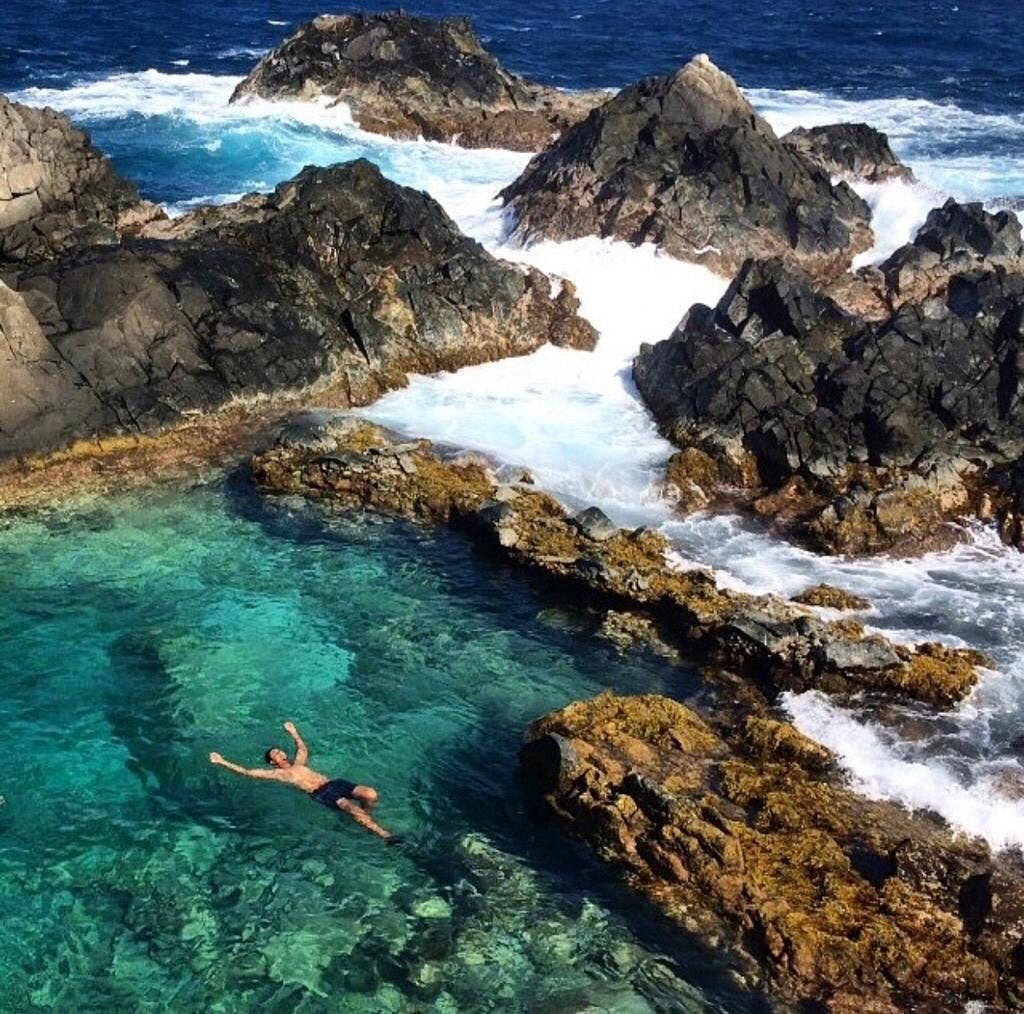
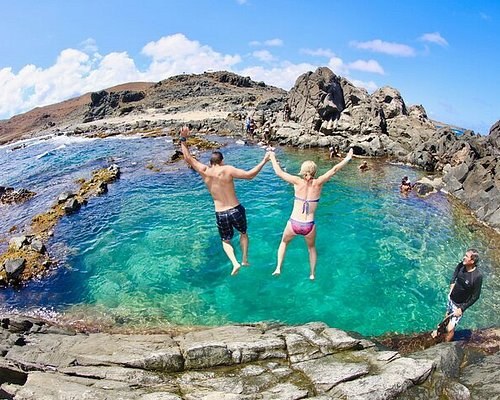
What you do Tear across Aruba's wild, wind-sculpted north coast in a side-by-side UTV, plunging into a hidden freshwater cave pool and launching off sea cliffs into turquoise surf. This is Aruba beyond the beach — raw, exhilarating, and completely photogenic.
What to expect Your convoy rolls out of Oranjestad through the cunucu countryside, passing towering cacti and centuries-old divi-divi trees before hitting the rugged north-shore track. Guides point out Aruba's geological wonders — ancient coral formations, the Ayo rock garden — before arriving at the cave pool, a cool, crystalline grotto perfect for a refreshing dip. The afternoon's highlight is the sea-cliff platform: step to the edge, take a breath, and leap into the crashing Caribbean below. The return route hugs the dramatic coastline.
Good to know Minimum age 18 to drive, 12 to ride. Closed-toe shoes required; bring a swimsuit and a change of clothes. Tours depart 8 am and 1 pm — the morning slot is best for light and cooler temperatures. Book direct via Aruba Active Vacations at least 1 week in advance.
Versus the ship tour Expert local guides lead groups of no more than 8 UTVs, ensuring personalized attention, insider stops, and freedom to linger at the cave pool and cliff-jump ledge for as long as you wish — a pace impossible in a large convoy.
What you do Drift along Aruba's glittering leeward coast aboard a sleek catamaran as the sun melts into the Caribbean — cocktail in hand, warm trade winds in your hair, and the Oranjestad skyline glowing behind you. The definitive Aruban sunset experience.
What to expect Step aboard a classic wooden sailing vessel at the palm-fringed dock and settle into the nets at the bow as the crew sets sail along Palm Beach. The two-hour sail is unhurried: swim stop in calm, turtle-rich waters, then back on deck for a spread of fresh Aruban appetizers — empanadas, ceviche, fruit — as a blazing sunset unfolds directly ahead. The crew is festive, attentive, and deeply proud of their island.
Good to know Sunset sails depart at 5 pm; confirm all-aboard time with your ship — most Oranjestad calls allow it comfortably. Private charter requires 2-week advance notice. Shared sail books up quickly December–April; reserve online the moment your itinerary is confirmed.
Versus the ship tour Jolly Pirates is the island's iconic tall-ship operator with decades of local expertise; their open-bar policy is genuinely unlimited (premium rum punches, local Balashi, wine), and the rope-swing off the mast is a legendary Aruba ritual that sets this sailing firmly apart.
What you do A legendary full-island 4x4 adventure that connects Aruba's most dramatic natural wonders in a single day: the thundering Natural Pool, eerie limestone caves, and the idyllic turquoise lagoon of Baby Beach. Aruba's greatest hits, done properly.
What to expect Depart Oranjestad in a rugged 4x4 and head north through the cunucu to Arikok National Park, where your guide narrates the island's geology, flora, and Arawak heritage. The Natural Pool — a volcanic rock basin where Atlantic surf explodes around you — is the undisputed showstopper. Cool, freshwater Fontein Cave comes next, its walls etched with ancient petroglyphs. The finale is Baby Beach: a still, luminous lagoon at Aruba's southern tip, shallow enough to wade and calm enough to snorkel.
Good to know Full-day tours run approximately 7–8 hours; confirm departure time against your all-aboard. Wear reef-safe sunscreen, a hat, and bring a dry bag. The Natural Pool requires a short, rocky hike — sturdy sandals or sneakers essential. Private vehicle bookings via AAA TripCanvas from USD 528 for groups.
Versus the ship tour Ports of Call Tours is one of Aruba's most respected local operators, running true small groups in air-conditioned 4x4s with knowledgeable naturalist guides — not megabus convoys. Private vehicle upgrades mean the day runs entirely on your schedule.
What you do Ride sure-footed Paso Fino horses through the rugged, cactus-dotted cunucu and onto the windswept sands of Wariruri Beach — a remote, undeveloped stretch the cruise crowds never reach. A serene, deeply authentic Aruban encounter.
What to expect Your gentle Paso Fino — prized for its uniquely smooth gait — carries you west from the ranch through a landscape of towering candelabra cacti, wild orchids, and native fauna, with views of the crashing north coast. Wranglers point out indigenous birds and medicinal plants along the trail. Wariruri Beach appears like a revelation: a wild, golden crescent where Atlantic rollers crash against black volcanic rocks and sea turtles nest. There's time to dismount, wade, and take in the solitude before the return canter.
Good to know Maximum weight 240 lbs. Riders of all levels welcome; beginners are matched with the gentlest horses. Wear long trousers and closed shoes. Tours depart mornings only — ideal for ships with a late all-aboard. Book at least 1 week ahead; private rides available on request.
Versus the ship tour Rancho Notorious keeps groups to a maximum of 10 riders and uses locally bred horses with expert wranglers who share deep knowledge of Aruba's fragile desert ecosystem — creating a naturalist journey as much as a ride, with a beach finale that feels entirely private.
book direct with Rancho Notorious Aruba → · the full guide →
What you do Step into a local Aruban kitchen for an intimate hands-on class crafting keshi yena, fresh pan bati flatbread, and island rum cocktails — guided by a chef who grew up eating these recipes. The most delicious two hours you'll spend in the Caribbean.
What to expect Arrive at Screaming Eagle's iconic, design-forward venue just outside Oranjestad and be greeted with a welcome cocktail before donning your apron. The chef walks you through the cultural history of Aruba's cuisine — African, Dutch, and indigenous Arawak threads — as you prepare keshi yena (Gouda stuffed with spiced chicken), pan bati cornbread, and a dessert of Aruba-style coconut flan. The cocktail segment pairs each dish with a rum or local spirit blend you'll mix yourself. Sit down, feast, and take home a recipe card.
Good to know Classes run 10 am–12:30 pm and 2–4:30 pm. The venue is a 10-minute taxi from the cruise pier (AWG 10–15 one way). Vegetarian and allergen-friendly menus available on request at booking. Reserve at least 2 weeks ahead — this class has become one of Aruba's most talked-about port-day experiences.
Versus the ship tour An intimate, chef-led class capped at 12 guests that goes far beyond a cooking demonstration — you roll, stuff, and plate every dish yourself, learning the Dutch-Caribbean fusion story behind each recipe directly from an island native, then eat what you make.
book direct with Screaming Eagle Aruba (Culinary Experience) → · the full guide →
What you do Streak across the Caribbean by private speedboat to the Zapatillas — two uninhabited coral-fringed islands inside Bastimentos Marine Park. Swim over technicolour reefs, walk powdery white sand, and feel the world fall away in one of Central America's most pristine marine sanctuaries.
What to expect Your expert local captain navigates through the archipelago's turquoise channels, arriving at Isla Zapatilla's barrier reef while it's still glassy and calm. Snorkel gear is provided and your guide points out eagle rays, parrotfish, and sponge gardens few visitors ever see. After snorkelling, you have the beach almost entirely to yourself — hammock-ready palm shade, silence, and the kind of water colour that belongs on a painting. The return journey weaves past mangrove tunnels and Bird Island for a final wildlife flourish.
Good to know Tours run approximately 7 hours — confirm your ship's all-aboard time and allow 30 mins buffer. Pre-book at least 48 hours ahead as small-group boats fill quickly. Bring reef-safe sunscreen, a dry bag, and USD cash for the national park entrance fee (approx. USD 10 pp, paid on arrival).
Versus the ship tour Small-group private speedboat access means you reach Zapatillas before the crowds, with a dedicated guide who reads the tides and currents — giving you first pick of the snorkel sites and unhurried time on the sand.
book direct with Bocas del Toro Island Hopping (via Viator direct operator) → · the full guide →
What you do Plunge into the Parque Nacional Marino Isla Bastimentos, Panama's first marine park, guided by a certified naturalist who knows every coral head. Nurse sharks, hawksbill turtles, and psychedelic reef fish are the supporting cast for one of the Caribbean's great snorkel experiences.
What to expect The morning briefing at the dock covers marine-park etiquette and what to look for — the guide's enthusiasm is infectious before you've even hit the water. Snorkellers float over shallow gardens of brain coral and sea fans alive with damselfish and angelfish, while scuba divers descend to swim-throughs draped in soft coral at around 15 metres. The park's protected status means visibility routinely exceeds 20 metres. Surface intervals are spent drifting in the turquoise shallows between dive sites with cold water and fresh fruit on the boat.
Good to know The dive centre is a short water-taxi ride from the cruise pier — transfers are typically included. Book scuba in advance if you need equipment rental; bring your dive certification card. Snorkel tours require no experience. All-aboard timing: the full snorkel tour is 4–5 hours, scuba is 5–6 hours.
Versus the ship tour A PADI-certified dive centre running groups of no more than 8 means your guide spends real time with you underwater — pointing out cryptic critters, explaining the reef ecology, and ensuring you surface with stories rather than just selfies.
book direct with Bocas Dive Center (official operator, Isla Colón) → · the full guide →
What you do Step inside a working cacao farm and nature preserve rated 4.9 stars — arguably the finest agri-tourism experience in the Bocas archipelago. Follow your expert guide from cacao pod to finished chocolate in the shade of old-growth rainforest, meeting sloths and poison-dart frogs along the way.
What to expect You walk barefoot-optional jungle paths between towering cacao trees as your guide explains fermentation, drying racks, and the alchemy of roasting. Snap open a fresh pod and taste the sweet white pulp before watching chocolate ground the traditional way. The tasting table at the end is the centrepiece — layers of dark chocolate paired with tropical fruit, with the farm's own cacao nibs to take home. Wildlife sightings — sloths, toucans, dart frogs — are woven naturally into the narrative.
Good to know Located on Isla Colón, roughly 20 minutes by taxi from Bocas Town. Book directly via the farm's website or email — tours fill up fast. Comfortable walking shoes and insect repellent are essential. Allow 3.5 hours total including transfer, comfortably within a typical port day.
Versus the ship tour The family owners lead tours personally, sharing the full story of their heritage cacao varieties and sustainable farming philosophy — an intimate, unhurried encounter with Panamanian flavour culture that no group bus tour can replicate.
What you do Trade the water taxi for two wheels and glide across Isla Colón by e-bike to Playa Estrella (Starfish Beach) and the wild arc of Boca del Drago — two of Bocas's most photogenic beaches — at your own luxurious pace with a local guide who knows every shortcut and secret.
What to expect The ride begins in Bocas Town, quickly trading waterfront bustle for jungle-lined roads scented with ylang-ylang. At Playa Estrella the shallows are carpeted in red cushion sea stars — your guide explains the ecosystem and the importance of leaving them in place while you wade in warm, glass-clear water. The route continues to the remote, driftwood-scattered sands of Boca del Drago, where frigate birds wheel overhead and the Caribbean meets the Caribbean in blissful quiet. Lunch at a local beachside spot is included in most itineraries.
Good to know No cycling experience required — the electric assist handles any island hills. Departures are typically morning from Bocas Town, returning well before all-aboard. Confirm the tour includes hotel/pier pick-up, and wear light layers; the jungle sections can feel humid even on two wheels.
Versus the ship tour Helmets, premium e-bikes, and a local guide who sets the pace entirely around your group — you stop for wildlife, wade out to hold a living starfish, and linger over a coconut at Drago with no coach schedule to chase.
book direct with Bocas del Toro E-Bike Tours (local operator, Isla Colón) → · the full guide →
What you do After dark, the lagoons near Bocas Town ignite with one of nature's most surreal light shows — dinoflagellates turning every paddle stroke electric blue. Kayak through the phosphorescent mangroves on a small-group guided night tour that belongs on every traveller's bucket list.
What to expect As the boat transfers you to the lagoon mouth, the first sign is a faint glow in the wake — then the kayaks hit the water and the magic begins. Every dip of the paddle sends blue-white sparks cascading beneath the surface; trail your fingers and leave a comet tail of cold light. Your guide navigates through cathedral-like mangrove tunnels where the bioluminescence glows brightest, explaining the science and folklore of the phenomenon. The journey back across the bay, with stars reflected in the water and the town glittering on the horizon, is a memory you will carry for decades.
Good to know This evening departure works perfectly on cruise days with a late all-aboard (typically 10 pm or midnight). Confirm your ship's departure time before booking. No kayaking experience needed — tandem kayaks are available. Bring a waterproof phone case; flash photography diminishes the effect for everyone, so embrace the darkness.
Versus the ship tour Paddle in a group of no more than 10 with a naturalist guide who times the departure to moonless skies and peak dinoflagellate activity — the difference between a faint shimmer and an all-enveloping blue fire is entirely in the expertise of your guide.
book direct with Bocas del Toro Bioluminescence Tour (GetYourGuide direct operator) → · the full guide →
What you do Water-taxi to Isla Bastimentos, walk the jungle trail to legendary Red Frog Beach, then explore the Afro-Caribbean fishing village of Old Bank — one of the most authentic communities in Panama, where calypso rhythms, Ngöbe crafts, and coconut-rice kitchens tell a story no resort can manufacture.
What to expect The speedboat crosses Almirante Bay to dock at Old Bank, where painted wooden houses on stilts lean over the water and the smell of coconut bread drifts from open kitchens. A short jungle trail — alive with poison-dart frogs in their vivid warning livery — leads to Red Frog Beach's wild, black-rock-framed shoreline. Depending on swell, you can swim, bodysurf, or simply sit under a palm watching pelicans dive. The return passes the mangrove lagoons where three-toed sloths drape themselves in the canopy, spotted by your sharp-eyed guide.
Good to know Red Frog Beach charges a small private-land access fee (approx. USD 5 pp) payable on entry — bring small USD bills. The jungle trail takes about 15 minutes each way; wear closed shoes or sturdy sandals. Full-day tours run 7 hours — check all-aboard time and confirm with your operator on departure flexibility.
Versus the ship tour A small private boat means your guide tailors the Bastimentos stop to your group's interests — more time in the village with a local contact, a longer linger at Red Frog if the surf is pumping, or a detour to the Nivida Bat Cave if the tide allows.
book direct with Bocas del Toro Full-Day Speedboat & Wildlife Tour (Viator direct operator) → · the full guide →
What you do A private panga boat threads you through the Cartí archipelago at your own pace, hopping between three uncrowded islets and a coral reef for snorkeling before the day-trip crowds arrive.
What to expect A private vehicle collects you for the roughly 2-hour drive over the mountains to the Cartí port, where your own panga and Guna boat captain are waiting. You'll visit two or three islands chosen with your guide — one for snorkeling over a reef, one a near-empty sandbar for swimming and lunch. A private beach lunch of fresh fish, coconut rice, and fruit is included, eaten under a palm shelter you won't be sharing with fifty other visitors.
Good to know Land transfer alone runs 2–2.5 hours each way; confirm your ship's all-aboard time leaves enough margin — this is realistically only feasible on a long port day. Bring cash for island entry fees and Guna-made molas if you want to buy directly from the women who make them.
Versus the ship tour You choose which islands, how long to linger on each, and skip the fixed multi-bus, multi-boat convoy that group tours run on — this is your own guide, your own boat, your own schedule.
What you do A shallow, glass-clear 'natural pool' between islets where a small plane wreck and coral heads sit in waist-to-shoulder-deep water — one of the most photographed but genuinely worthwhile stops in San Blas.
What to expect You wade and float in impossibly clear, warm shallow water over sand and coral, with the rusted skeleton of a small plane visible just beneath the surface — an easy, unhurried swim rather than a deep dive. Your captain times the visit to avoid the midday convergence of tour boats. Lunch is grilled fish and patacones served on a nearby island, eaten with your feet in the sand.
Good to know Water shoes help on the coral-sand bottom; bring reef-safe sunscreen since this is a fragile, shallow ecosystem. Best done in the morning for both light and lower crowds.
Versus the ship tour A Guna boat captain who grew up navigating these reefs takes you at a slower pace and to a quieter pool than the standard afternoon rush of day-boats.
What you do A visit to one of the small inhabited islands where Guna families still live by fishing and mola-making — a real look at a self-governed indigenous nation, not a staged stop.
What to expect You'll walk narrow sand paths between thatched cane houses, meet women stitching intricate reverse-appliqué molas they'll sell directly to you, and hear from your guide how the Guna Yala comarca governs itself autonomously within Panama. It's modest, lived-in, and unpolished — chickens, fishing nets drying, kids running between houses — which is exactly the point.
Good to know Ask permission before photographing people; a small tip or purchase is appreciated and customary. This works best paired with an island-hopping/snorkel stop earlier in the day since the village visit itself is short.
Versus the ship tour A local Guna guide who is from the community — not an outside operator — walks you through and translates, so conversations with mola-makers and elders happen directly rather than through a scripted stop.
What you do Charter a private sailboat for the day and drift between dozens of postcard cays without the road transfer or the day-tripper crowds that define the standard boat-and-bus circuit.
What to expect You board at a small marina or beach launch point, and the crew handles everything — sailing, anchoring, snorkel gear, and a fresh seafood lunch served on deck. You'll stop at two or three islands based on conditions and your preference, with long stretches of open water in between for swimming off the boat itself, away from any other vessel.
Good to know This needs advance booking given limited boat availability and works only if your port call allows a full day; factor in the transfer time to the marina from your ship's dock.
Versus the ship tour A private captain and crew move you silently between islands under sail rather than by outboard motor, anchoring wherever looks best that day instead of a fixed island itinerary.
book direct with Gunayala Explorer (sailboat charters) → · the full guide →
What you do A quiet, guided sea-kayak paddle between islets at first light, before the day-boats arrive, with the water at its calmest and clearest.
What to expect You launch from a beach in the half-light, paddling in tandem or solo kayaks with a local guide leading the way between mangrove-fringed islets. The water is glass-still at that hour, and you'll likely have an entire sandbar to yourselves for a swim before heading back for breakfast. It's a quieter, more physical counterpoint to a day spent on a boat.
Good to know Requires an early start from your ship or overnight stay nearby to make sunrise timing work — genuinely only for those overnighting in the islands or on a very early port call.
Versus the ship tour Paddling yourself, guided by someone who knows the currents and the best light, gets you to a sandbar or reef edge before any group tour boat is even on the water.
What you do A small, personal morning spent with a Guna family on the mainland side — buying fish straight off the boats and learning to prepare it the way locals do.
What to expect You'll meet fishing pangas as they return with the morning's catch, watch the informal market negotiations in Guna and Spanish, then head to a family kitchen to help prepare and eat what was just bought — usually fish ceviche, coconut rice, and fried plantain. It's unscripted and conversational, with your host translating and explaining Guna customs as you go.
Good to know Group sizes are kept small and timing depends on fishing boats' return, so exact schedule is flexible — confirm departure timing carefully against your ship's all-aboard given the mainland transfer.
Versus the ship tour Víctor works directly with families rather than running a fixed tour, so the morning shapes around whichever boats come in and whoever's cooking that day — an actual window into daily Guna commerce and food.
What you do Board a private yacht and lock through all six chambers of the canal — from the Pacific Miraflores Locks to Gatun on the Atlantic side. Watching 50,000-ton vessels rise and fall beside you is one of the great engineering spectacles on Earth.
What to expect You'll cruise through the Miraflores and Pedro Miguel Locks, across the lush Culebra Cut, and into the vast Gatun Lake before locking down to the Caribbean. Expert English-speaking guides narrate every stage — the engineering triumphs, the human cost, and the geopolitical drama that shaped the canal. Lunch is served on board as you glide through the jungle-flanked waterway. Frigate birds and pelicans escort the boat as Panamax vessels loom just metres away.
Good to know Full transit runs roughly 8–10 hours; departs early morning from Balboa pier. Pre-book well in advance — departures are limited and sell out months ahead. Confirm the all-aboard time with your ship and choose the partial transit if docking time is tight.
Versus the ship tour A full transit places you inside the locks — not watching from a visitor centre — sailing the same route as the world's largest container ships. The intimate scale of a tour vessel next to the Panamax giants is jaw-dropping and simply cannot be replicated from land.
book direct with Canal & Bay Tours (official Panama Canal boat transit operator) → · the full guide →
What you do Soar above the rainforest canopy in an open gondola inside Soberanía National Park — one of the most biodiverse patches of jungle on the planet. Toucans, sloths, howler monkeys, and 400 bird species inhabit the treetops around you.
What to expect The gondola rises through four distinct forest layers, from the leaf-litter floor to the emergent canopy, with sweeping views of the Chagres River and Gatun Lake shimmering below. Your naturalist guide uses binoculars and a scope to pin down toucans, mot-mots, and troops of Geoffrey's tamarins on the wing. After the tram, a guided nature trail leads through orchid-draped trees to a butterfly garden with 40 native species. The resort's open-air restaurant serves a superb jungle-view lunch before you return to port.
Good to know Gamboa is 45 minutes from Fuerte Amador by private transfer. Wear lightweight long sleeves and closed shoes; bring insect repellent and a zoom lens. Tram seats are limited — reserve your slot and private guide directly via the resort's website.
Versus the ship tour The tram glides silently over eight towers of untouched primary forest — you're eye-level with harpy eagle territory. A resident naturalist guide reads the jungle in real time, pointing out camouflaged species most visitors walk straight past.
book direct with Gamboa Rainforest Resort (official aerial tram operator) → · the full guide →
What you do Stroll the cobbled streets of Casco Viejo — Panama City's UNESCO World Heritage old town — with a private local historian. Colonial churches, Art Deco balconies, and rooftop views over the Pacific skyline make this the most photogenic morning in Central America.
What to expect Your guide leads you through the Arco Chato arch, the gold-laden altar of the Iglesia de San José, and the Plaza Bolívar where Simón Bolívar dreamed of a united Latin America. The narrative weaves pirates, canal diplomacy, and the neighbourhood's remarkable modern renaissance. The tour ends with a tasting of Panamanian coffee and fresh ceviche at a chef-owned café tucked behind a 17th-century façade. The contrast of crumbling colonial ruins against gleaming glass towers is endlessly photogenic.
Good to know Casco Viejo is 20 minutes from Fuerte Amador by taxi or private car (approx. USD 15–20 each way). Morning tours are cooler and have better light for photography. Book your private guide directly; allow 3–4 hours including the café stop, well within typical all-aboard windows.
Versus the ship tour A private guide opens doors that group tours never reach — a hidden convent courtyard, a chef's family kitchen, a rooftop terrace above the Plaza de Francia with unobstructed Pacific views. The pace is entirely yours.
What you do Stand at the best vantage point on Earth to watch Panamax and New Panamax ships squeeze through the Miraflores Locks — then explore the world-class four-storey museum that tells the full story of the canal's creation. The definitive land-based canal encounter.
What to expect Four observation platforms overlook the locks at different heights; the top deck is level with a Panamax ship's bridge. The museum traces everything from the French failure of the 1880s to the Panamanian handover of 1999 and the USD 5.4 billion expansion completed in 2016. A scale model of the entire 80 km waterway lets you trace the exact route ships travel. The on-site Miraflores Restaurant serves a buffet lunch with lock views — reserve the window table for a front-row seat to passing vessels.
Good to know Miraflores is 10 minutes from Fuerte Amador by taxi or private car (approx. USD 10 each way). Check the ACP ship schedule at micanaldepanama.com for optimal lock-transit times — aim to arrive when large container ships or LNG tankers are scheduled. Allow 2.5–3 hours total.
Versus the ship tour The upper observation deck puts you just metres from the lock walls as ships lock through — you feel the rumble of 80,000 tonnes of steel and the surge of millions of litres of water. A specialist guide decodes what you're seeing in real time, turning spectacle into deep understanding.
book direct with Autoridad del Canal de Panamá – Miraflores Visitor Center (official) → · the full guide →
What you do Dugout canoe up the Chagres River into Soberanía jungle to visit an authentic Emberá village. This is the Panama that existed long before the canal — a living culture of handwoven baskets, plant medicine, and extraordinary craftsmanship.
What to expect A 4x4 transfer brings you to the Chagres riverbank where carved dugout canoes wait. The 30-minute upriver journey passes kingfishers, herons, and the occasional caiman before the village appears on the bank, adorned with hand-painted faces and traditional dress. Village elders demonstrate the use of jungle plants for medicine and dye; artisans create intricate tagua-nut carvings and woven baskets you can purchase direct. A lunch of fresh fish, plantain, and heart-of-palm is served communally in the open-air meeting house. The return journey at golden hour is quietly magical.
Good to know Transfer to the Chagres trailhead is approx. 45–60 minutes from Fuerte Amador. Wear quick-dry clothing and waterproof sandals; bring sunscreen and a small daypack. The full experience runs 5–6 hours — verify your ship's all-aboard time and book with buffer. Confirm availability directly with the village operator.
Versus the ship tour Community-operated and led exclusively by Emberá hosts — every dollar funds the village directly. The experience is unhurried and genuinely reciprocal: elders share plant knowledge, women teach traditional weaving, and the welcome meal is cooked from the forest itself.
book direct with Emberá Drua Village Tours (official community-operated tourism) → · the full guide →
What you do Ride the historic Panama Canal Railway in a private dome car from Panama City to Colón — 77 km across the isthmus in 60 minutes, flanked by jungle and Gatun Lake. One of the world's great short rail journeys, virtually unchanged since 1855.
What to expect The train departs Panama City's Corozal station and almost immediately plunges into lush rainforest, crossing trestle bridges above Gatun Lake's island-studded expanse. The dome car's 270-degree glass ceiling floods the carriage with soft green light as spider monkeys work the canopy above. A local historian-guide aboard the private car narrates the railway's extraordinary role in both the Gold Rush and the canal construction. In Colón, a waiting private vehicle returns you to Fuerte Amador — you've crossed an entire continent in an hour.
Good to know The train departs Corozal at 07:15 and arrives Colón by 08:15; the return departs Colón at 17:15. For cruise passengers, the one-way dome charter with a private return transfer is ideal. Book the dome car directly with Panama Canal Railway Company at least 4–6 weeks ahead. Private car transfers Fuerte Amador–Corozal approx. USD 25 each way.
Versus the ship tour The private dome car is pure Golden Age of Travel — panoramic glass ceiling, white-glove service, and champagne as jungle gives way to glassy Gatun Lake. It's a journey that predates the canal itself; you're retracing the route that sparked the whole trans-oceanic dream.
What you do Glide through the engineering marvel of the century on a private partial transit of the Panama Canal — watching colossal lock gates close around your vessel is a moment that stops time. Few experiences on earth rival this up-close communion with one of humanity's greatest feats.
What to expect Board a boutique expedition vessel at Amador Causeway and pass through the Miraflores and Pedro Miguel Locks, rising and falling as 26 million gallons of freshwater do the work. A specialist guide narrates the canal's construction history, the lives lost, and the engineering breakthroughs. A gourmet Panamanian lunch is served as you cruise Gatun Lake, ringed by rainforest. Disembarkation is on the Atlantic side with a scenic road transfer back.
Good to know Transit days sell out months in advance — pre-book the moment your itinerary is confirmed. The full journey runs ~8 hours; confirm all-aboard time with your ship and allow buffer. Transfers back to Balboa are included.
Versus the ship tour Small-vessel transits of under 30 guests mean you're on deck for every lock chamber, with a bilingual canal historian narrating each step — intimate access that large group tours simply cannot replicate.
book direct with Canal & Bay Tours Panama → · the full guide →
What you do Pipeline Road in Soberanía National Park is regularly ranked the world's single best birding road, with over 500 species recorded. A private expert naturalist turns a morning rainforest walk into a living David Attenborough documentary.
What to expect Your guide meets you dockside at Balboa and transfers you 30 minutes to the park entrance. The forest closes in immediately: motmots, toucans, mantled howler monkeys, and Geoffrey's tamarin are routine sightings. Optics — professional Swarovski binoculars and a spotting scope — are provided. Midway through, a cooler of chilled local fruits and sparkling water appears for a trailside pause. The walk runs 3–4 hours at a leisurely, observational pace.
Good to know Morning departures (6–7 am) are essential for peak wildlife activity. Wear neutral-coloured, lightweight long sleeves and closed shoes. Book directly and request a bilingual ornithologist. Allow 5–6 hours total including transfers.
Versus the ship tour A dedicated ornithologist/naturalist guide is assigned exclusively to your group, setting pace entirely around your interests — whether you spend 20 minutes on a single resplendent quetzal or push deeper for a harpy eagle sighting.
What you do Discover two of Panama City's most photogenic worlds — the wind-swept Amador Causeway with its Pacific panoramas, and UNESCO-listed Casco Viejo, a labyrinth of colonial grandeur and vibrant street art. A private guide makes each cobblestone tell a story.
What to expect Begin on the Amador Causeway, built from canal excavation spoil, where the Pacific entrance to the waterway unfolds before you. Transfer to Casco Viejo, where your guide navigates Spanish colonial churches, the ruins of Panama Viejo, and the elegantly restored Plaza de Francia. A curated stop at a specialty coffee roaster introduces you to Geisha beans from the Chiriquí highlands — among the world's most sought-after. The tour concludes with a cold seco-and-tonic at a boutique rooftop bar.
Good to know Casco Viejo is walkable but warm — light linen clothing and comfortable shoes are essential. The district is safe with a guide; book a certified operator. Half-day format (4–5 hours) fits comfortably before all-aboard.
Versus the ship tour Exclusive private vehicle and a certified local historian guide mean you move at your own rhythm, ducking into hidden courtyards, rooftop bars with canal views, and artisan studios that group tours never reach.
What you do Paddle a sea-kayak through the flooded rainforest of Gatun Lake — the world's largest man-made lake at its creation — and glide past Barro Colorado Island, where capuchins and howler monkeys peer down from the canopy.
What to expect Transfer to Gamboa (45 min from Balboa), where kayaks and full safety briefing await on the lakeshore. You paddle through partially submerged trees that now form the lake's skeleton, emerging into open channels dotted with tropical birds. Your naturalist guide identifies species from the kayak with minimal noise. A mid-paddle snack of fresh tropical fruit and coconut water is served on a floating dock. The return paddle is downstream with the gentle current.
Good to know Suitable for all fitness levels — no kayaking experience required. Departures at 7 am capture the coolest part of the day and peak wildlife activity. Total time including transfers: ~5 hours. Book well ahead as group cap is strict.
Versus the ship tour A maximum of 8 paddlers means silence on the water and wildlife that doesn't flee — the stillness of a kayak lets you drift to within metres of iguanas, caiman, and three-toed sloths in a way no motorised tour allows.
book direct with Xtrop Panama Eco Adventures → · the full guide →
What you do The Miraflores Visitor Center's exclusive VIP terrace puts you at eye level with Panamax container ships squeezing through the lock chambers — a visceral, cinematic encounter with the world's greatest shortcut. Pair it with a private curator-led session at the Canal Museum.
What to expect Arrive early for the first lock cycle of the day when light is golden and ships are queued. From the VIP terrace you feel the rumble as lock gates seal and water begins its controlled rush. A resident ACP guide explains the lock mechanics, the 2016 expansion, and the geopolitics that shaped the canal's return to Panamanian sovereignty. Inside, the four-floor museum houses original construction artefacts, historical photography, and interactive lock models. The rooftop restaurant serves excellent Panamanian fare with a lock-side view for a post-tour lunch.
Good to know Miraflores is 10 minutes from Balboa pier by taxi (USD 5–8). Ship transits peak between 8–10 am and 2–4 pm — time your visit accordingly. Advance online tickets recommended to skip queues. Pre-book the private guide via the visitor centre.
Versus the ship tour The VIP terrace is above the crowd level, giving unobstructed sight lines and the full sensory impact of a 300-metre vessel rising 9 metres in minutes — paired with a private guide for context that turns spectacle into understanding.
book direct with Panama Canal Authority (ACP) – Miraflores Visitor Center → · the full guide →
What you do Descend into the sensory riot of the Mercado de Mariscos with a chef-guide, hand-pick Pacific corvina and Caribbean lobster, then cook alongside a Panamanian chef in a private kitchen — culminating in a ceviche ritual with local beers and seco cocktails.
What to expect Your chef-guide meets you at the Mercado de Mariscos, Panama City's legendary seafood market on the Cinta Costera waterfront, and walks you through selecting the day's catch. Back in a beautifully appointed private kitchen, you learn the architecture of Panamanian ceviche — leche de tigre, ají chombo, culantro — before moving to corvina al ajillo and patacones. The meal is eaten together at a communal table, with a rotating flight of local craft beers and a classic seco con pipa cocktail. Recipes are sent digitally after.
Good to know The market is at its best and freshest before 10 am — request a morning session. The class runs ~3.5 hours; combine with a Casco Viejo stroll after for a full day. Allergies and dietary restrictions are accommodated with advance notice.
Versus the ship tour An entirely private kitchen session means the chef tailors the menu to your group, explains Afro-Caribbean and Indigenous flavour traditions in depth, and shares the city's food culture in a way that a restaurant meal or group demonstration never touches.
book direct with Cevicheria La Nueva Paloma (Private Culinary Experiences) → · the full guide →
Before you sail · near Port of Oranjestad
Fly in at least a day early — every seasoned cruiser does, so a delay never costs you the ship. This is what is worth that day within reach of the port.