Your cruise
Azamara Onward · 27-night Australia & South Pacific cruise, Callao (Lima) to Auckland
Jan 19 – Feb 15 · 27 nights ·
Day 1 Callao (Lima) (board) · Day 2–6 at sea · Day 7–8 Easter Island · Day 9–10 at sea · Day 11 Pitcairn Island · Day 12–13 at sea · Day 14 Fakarava · Day 15–16 Moorea · Day 16–17 Papeete · Day 18–19 Bora Bora · Day 20–26 at sea · Day 27 Bay of Islands (Paihia) · Day 28 Auckland (step off)
What you do A private, accredited-guide journey through Easter Island's most legendary moai platforms — Ahu Tongariki, Rano Raraku, Anakena & more — at your own pace, with no crowds and deep Rapa Nui context.
What to expect Your accredited guide meets you at the tender pier and whisks you off in a private 4x4 to the 15-moai platform of Ahu Tongariki, then up the volcanic slopes of Rano Raraku where nearly 400 half-carved giants still rise from the earth. Anakena Beach — the island's only white-sand cove backed by swaying palms and a standing ahu — follows, with time to swim if you wish. The guide weaves oral history, Polynesian navigation lore, and Ma'u Henua conservation context throughout, making every stone feel alive.
Good to know The USD 80 Rapa Nui National Park ticket (rising to USD 100 from 1 Oct 2025) is mandatory for all non-Chilean visitors and must be purchased in advance or at the park booth. Confirm tender schedule with your ship; all-aboard times are tight on Easter Island — a private guide is expert at managing this. Pre-book directly via the Green Island Tours website.
What you do Watch the 15 colossal moai of Ahu Tongariki glow in early-morning gold, then descend into the volcanic quarry where the ancestors were born — a small-group experience that is genuinely once-in-a-lifetime.
What to expect Arriving at Ahu Tongariki as the sun crests the horizon transforms the 15 re-erected moai into towering silhouettes — one of the great photographic moments on Earth. You then walk the crater slopes of Rano Raraku, where nearly 400 moai in various stages of carving rest exactly where the sculptors left them centuries ago. The guide contextualises the catastrophic social collapse that halted all work, making the scene profoundly moving. The volcanic lake shimmering inside the crater adds a surreal, Eden-like counterpoint.
Good to know Cruise passengers tendering ashore should prioritise this as a morning excursion to catch optimal light at Tongariki and avoid the midday heat. The operator specialises in cruise-ship shore excursions and is expert at timing runs back to the tender. National Park ticket purchase in advance is strongly recommended.
book direct with Easter Island Travel (easterisland.travel) → · the full guide →
What you do Hike the rim of Easter Island's most dramatic volcano to the cliff-edge village of Orongo — birthplace of the Birdman cult — with a private guide who brings the petroglyphs and the sheer 300-metre ocean drop to life.
What to expect The trail climbs steadily from Hanga Roa to the crater rim, where the scale of Rano Kau — arguably the most beautiful volcanic lake in the Pacific — stops every visitor cold. Orongo sits at the very edge: 54 stone houses perched between the crater and a 300-metre cliff plunging into the Pacific, with the sacred islets of Motu Nui just visible below. Your guide decodes the annual Tangata Manu (Birdman) competition petroglyphs — a ritual that replaced the moai era with something equally dramatic. On clear days the views stretch to infinity.
Good to know This is a moderate hike on uneven volcanic terrain; wear sturdy shoes and sun protection. Allow 3–4 hours; well-suited to late-morning departures that allow time for Hanga Roa exploration afterwards. Pre-book directly with Green Island Tours and confirm tender-return logistics.
What you do Sit down to an authentic umu (Polynesian earth oven) feast prepared by a Rapa Nui family, pairing fresh tuna ceviche, taro, and sweet potato with storytelling about the living culture that the moai were built to honour.
What to expect You arrive to the smell of stones heating underground — the umu has been preparing for hours. Dishes of fresh Pacific tuna, sweet potato (kumara), taro, and banana emerge wrapped in leaves, accompanied by homemade passion-fruit drinks. Your hosts narrate the deep Polynesian connections between food, land, and ancestor worship, weaving in the island's remarkable settlement story. The meal closes with a short traditional music performance, giving you a felt sense of living Rapa Nui culture.
Good to know Best scheduled for midday, fitting neatly between morning archaeological sites and an afternoon at Anakena Beach. Dietary requirements can be accommodated with advance notice. Book directly via the Easter Island Travel cruise-ship portal; group sizes are kept intimate.
book direct with Easter Island Travel (easterisland.travel) → · the full guide →
What you do Easter Island's only palm-fringed white-sand beach doubles as an elite archaeological site — swim the crystalline Pacific beside restored red-topknotted moai in one of the world's most surreal beach afternoons.
What to expect The drive north along Easter Island's rugged coast is itself a spectacle, culminating in the sudden appearance of turquoise water and white sand framed by towering Ahu Nau Nau — seven moai, six still wearing their red pukao topknots, their detail extraordinarily well preserved by the sand that buried them. Slip into the water and the world goes quiet; the snorkelling reveals colourful reef fish and volcanic rock formations in visibility that regularly exceeds 30 metres. Back on the beach, fresh fruit and cold drinks complete the scene.
Good to know Ideal as an afternoon excursion after morning moai sites; the light is golden and the day-trippers have thinned. Note it is a 45-minute drive from Hanga Roa — factor this into your all-aboard window. Bring reef-safe sunscreen; no single-use plastics are permitted in the National Park.
What you do Easter Island sits among the darkest skies on Earth — a private astronomer-led stargazing session connects the Polynesian star-navigation that found this impossible dot in the Pacific to the Milky Way blazing overhead.
What to expect As the last tender window closes and the island exhales, a local astronomer-guide leads you to a dark-sky plateau with high-powered telescopes already trained on the Southern Cross, Magellanic Clouds, and Saturn's rings. The guide weaves the Rapa Nui ancestral understanding of the stars — used for navigation, planting, and ceremony — into the scientific narrative, so the sky becomes both map and mythology. Hot drinks and local snacks are served under the stars; the silence and the scale are profound.
Good to know This excursion is best suited to passengers on an overnight anchor or late all-aboard; confirm your ship's departure schedule carefully. New moon periods yield the most spectacular skies — worth coordinating with your voyage dates. Pre-book directly via Easter Island Travel's cruise-ship concierge service.
book direct with Easter Island Travel (easterisland.travel) → · the full guide →
What you do Boat out to the wild Palomino Islands just off Callao and slip into the Pacific alongside a colony of 8,000 sea lions. This intimate, small-group marine encounter is one of the most extraordinary wildlife moments in all of South America.
What to expect A swift motorboat whisks you from Callao harbor out to four rugged Pacific islands, alive with barking sea lions. After briefing, you don a wetsuit and slide into crystal-cold water as curious sea lions spiral around you — bumping, twirling and staring you down. On the crossing you'll also spot Humboldt penguins and seabirds on the guano-white rocks. The entire outing lasts roughly four hours, returning you to port in good time.
Good to know Departs from the Callao fishing dock, less than 10 minutes from the cruise terminal — no transfer needed. Pre-book directly as space on small vessels fills weeks in advance. All-aboard times are typically respected with a 4-hour total run time. Bring a dry bag for your valuables and a warm layer for the boat ride back.
What you do Journey four hours south of Lima into a landscape of flamingo-fringed bays, prehistoric Nazca-era history and a turquoise desert oasis ringed by towering sand dunes. One of Peru's most visually astonishing day trips, bookable from the port.
What to expect Depart Callao early and drive south through Peru's coastal desert to Paracas, where wind-sculpted red cliffs plunge into an azure bay thick with flamingos and pelicans. Board a speedboat to the Ballestas Islands ('the poor man's Galápagos') to witness sea lions, Peruvian boobies and penguins on volcanic arches. After lunch in Paracas, continue inland to Huacachina — a true desert oasis — where you board a dune buggy for the breathtaking ride up towering dunes before sandboarding back down at sunset.
Good to know This is a 17–18 hour excursion; confirm your ship's all-aboard time carefully — best suited to ships with a late-night or overnight Callao call. Departs 06:00–07:00 from the port. Bring sunscreen, a windbreaker and sea-sickness tablets for the Ballestas boat. Pre-booking essential; spaces extremely limited on private departures.
What you do Step inside a Miraflores culinary studio and master Peru's three most iconic dishes under the tutelage of a professional Lima chef. Peruvian cuisine is ranked among the world's best — this is the most direct way to own a piece of it.
What to expect The class opens at a local market where your chef narrates the kaleidoscopic world of Peruvian chillies, purple corn and exotic fruits — then you head to a beautifully equipped kitchen in Miraflores. You'll cure fresh corvina for leche de tigre ceviche, layer causa limeña with avocado and ají amarillo, and shake the city's most celebrated cocktail. The meal you've cooked becomes your lunch, served with Peruvian wine. A recipe booklet and a new passport-stamp skill go home with you.
Good to know Miraflores is approximately 30 minutes from Callao by taxi or Uber (approx. USD 8–12 each way). Classes typically run 3–3.5 hours, leaving comfortable time before all-aboard. Vegetarian adaptations available on request. Book at least two weeks ahead as this is Lima's most reviewed culinary experience.
book direct with Peruvian Cooking Classes Lima (La Floresta Culinary Studio) → · the full guide →
What you do Explore the grandest Spanish colonial fortress in South America, then step into Monumental Callao — a once-derelict neighbourhood reborn as Peru's most extraordinary open-air street-art district. History and living culture, minutes from the pier.
What to expect Begin at the Real Felipe Fortress, whose star-shaped walls once guarded Lima's silver trade against pirate fleets and independence armies. Your historian guide walks you through cannon-lined bastions, the eerie 'room of bones' and sweeping views of the Pacific. From there, enter Monumental Callao's labyrinthine patios splashed with floor-to-ceiling murals by international and Peruvian artists — boutique shops, artisan coffee and a rooftop lookout complete the picture. The tour finishes a short walk from the cruise terminal.
Good to know Real Felipe is open Tuesday–Sunday; confirm your port day falls on an open day. The fortress entry fee (approx. PEN 15 / USD 4) is typically separate. Monumental Callao is walkable from the fortress. Total duration 3–4 hours. Flat, paved surfaces throughout; suitable for all mobility levels.
What you do Glide through Lima's most beautiful clifftop neighbourhoods and into the world's finest private collection of pre-Columbian gold, textiles and erotic pottery. A half-day that distils 5,000 years of Andean civilisation into one elegant arc.
What to expect Your private guide collects you from the terminal and drives south to Miraflores, stopping at the clifftop Larcomar complex for Pacific views before descending to bohemian Barranco — its painted bridges, colonial mansions and vibrant café scene feel like a Peruvian Montmartre. The centrepiece is the Larco Museum, a converted 18th-century vice-regal mansion housing the world's most important collection of pre-Columbian gold and ceramics, including the famous 'erotic gallery'. Lunch is optionally taken at the museum's garden restaurant.
Good to know Museo Larco is open daily 09:00–22:00; book timed entry at larcomuseum.org (USD 25 adult). Combined private guide + transport via ToursByLocals from approx. USD 83 pp. Miraflores is 30 min from port. Allow 5–6 hours total. The Larco garden restaurant is one of Lima's most acclaimed — reserve ahead for lunch.
book direct with Museo Larco (official entry) + ToursByLocals private guide → · the full guide →
What you do Pedal Lima's dramatic Pacific Rim coastline on a curated small-group cycling tour, weaving from the clifftop promenades of Miraflores past a genuine pre-Inca adobe pyramid to the art-gallery lanes of Barranco. The city's most exhilarating half-day.
What to expect High-quality hybrid bikes are fitted to you in Miraflores before you roll onto the Malecón — Lima's Corniche — with the Pacific glittering hundreds of feet below the cliffs. The route threads past Parque del Amor's mosaic lover sculpture, descends to Barranco's coloured bridges and street-art alleyways, and detours through the grounds of Huaca Pucllana, an archaeological pyramid from 400 AD still being excavated. Guides share neighbourhood stories, stop for freshly squeezed lucuma juice and pace everything to ensure you never feel rushed.
Good to know Departs Miraflores (30 min taxi from port, approx. USD 8–12). Tour runs 3–3.5 hours; comfortable timing before most all-aboard calls. Helmets, locks and safety briefing included. The route is largely flat to gently rolling along the cliff edge — suitable for confident recreational cyclists. Wear comfortable clothing and bring a light layer for the coastal breeze.
What you do A private, accredited-guide journey through Easter Island's most legendary moai platforms — Ahu Tongariki, Rano Raraku, Anakena & more — at your own pace, with no crowds and deep Rapa Nui context.
What to expect Your accredited guide meets you at the tender pier and whisks you off in a private 4x4 to the 15-moai platform of Ahu Tongariki, then up the volcanic slopes of Rano Raraku where nearly 400 half-carved giants still rise from the earth. Anakena Beach — the island's only white-sand cove backed by swaying palms and a standing ahu — follows, with time to swim if you wish. The guide weaves oral history, Polynesian navigation lore, and Ma'u Henua conservation context throughout, making every stone feel alive.
Good to know The USD 80 Rapa Nui National Park ticket (rising to USD 100 from 1 Oct 2025) is mandatory for all non-Chilean visitors and must be purchased in advance or at the park booth. Confirm tender schedule with your ship; all-aboard times are tight on Easter Island — a private guide is expert at managing this. Pre-book directly via the Green Island Tours website.
What you do Watch the 15 colossal moai of Ahu Tongariki glow in early-morning gold, then descend into the volcanic quarry where the ancestors were born — a small-group experience that is genuinely once-in-a-lifetime.
What to expect Arriving at Ahu Tongariki as the sun crests the horizon transforms the 15 re-erected moai into towering silhouettes — one of the great photographic moments on Earth. You then walk the crater slopes of Rano Raraku, where nearly 400 moai in various stages of carving rest exactly where the sculptors left them centuries ago. The guide contextualises the catastrophic social collapse that halted all work, making the scene profoundly moving. The volcanic lake shimmering inside the crater adds a surreal, Eden-like counterpoint.
Good to know Cruise passengers tendering ashore should prioritise this as a morning excursion to catch optimal light at Tongariki and avoid the midday heat. The operator specialises in cruise-ship shore excursions and is expert at timing runs back to the tender. National Park ticket purchase in advance is strongly recommended.
book direct with Easter Island Travel (easterisland.travel) → · the full guide →
What you do Hike the rim of Easter Island's most dramatic volcano to the cliff-edge village of Orongo — birthplace of the Birdman cult — with a private guide who brings the petroglyphs and the sheer 300-metre ocean drop to life.
What to expect The trail climbs steadily from Hanga Roa to the crater rim, where the scale of Rano Kau — arguably the most beautiful volcanic lake in the Pacific — stops every visitor cold. Orongo sits at the very edge: 54 stone houses perched between the crater and a 300-metre cliff plunging into the Pacific, with the sacred islets of Motu Nui just visible below. Your guide decodes the annual Tangata Manu (Birdman) competition petroglyphs — a ritual that replaced the moai era with something equally dramatic. On clear days the views stretch to infinity.
Good to know This is a moderate hike on uneven volcanic terrain; wear sturdy shoes and sun protection. Allow 3–4 hours; well-suited to late-morning departures that allow time for Hanga Roa exploration afterwards. Pre-book directly with Green Island Tours and confirm tender-return logistics.
What you do Sit down to an authentic umu (Polynesian earth oven) feast prepared by a Rapa Nui family, pairing fresh tuna ceviche, taro, and sweet potato with storytelling about the living culture that the moai were built to honour.
What to expect You arrive to the smell of stones heating underground — the umu has been preparing for hours. Dishes of fresh Pacific tuna, sweet potato (kumara), taro, and banana emerge wrapped in leaves, accompanied by homemade passion-fruit drinks. Your hosts narrate the deep Polynesian connections between food, land, and ancestor worship, weaving in the island's remarkable settlement story. The meal closes with a short traditional music performance, giving you a felt sense of living Rapa Nui culture.
Good to know Best scheduled for midday, fitting neatly between morning archaeological sites and an afternoon at Anakena Beach. Dietary requirements can be accommodated with advance notice. Book directly via the Easter Island Travel cruise-ship portal; group sizes are kept intimate.
book direct with Easter Island Travel (easterisland.travel) → · the full guide →
What you do Easter Island's only palm-fringed white-sand beach doubles as an elite archaeological site — swim the crystalline Pacific beside restored red-topknotted moai in one of the world's most surreal beach afternoons.
What to expect The drive north along Easter Island's rugged coast is itself a spectacle, culminating in the sudden appearance of turquoise water and white sand framed by towering Ahu Nau Nau — seven moai, six still wearing their red pukao topknots, their detail extraordinarily well preserved by the sand that buried them. Slip into the water and the world goes quiet; the snorkelling reveals colourful reef fish and volcanic rock formations in visibility that regularly exceeds 30 metres. Back on the beach, fresh fruit and cold drinks complete the scene.
Good to know Ideal as an afternoon excursion after morning moai sites; the light is golden and the day-trippers have thinned. Note it is a 45-minute drive from Hanga Roa — factor this into your all-aboard window. Bring reef-safe sunscreen; no single-use plastics are permitted in the National Park.
What you do Easter Island sits among the darkest skies on Earth — a private astronomer-led stargazing session connects the Polynesian star-navigation that found this impossible dot in the Pacific to the Milky Way blazing overhead.
What to expect As the last tender window closes and the island exhales, a local astronomer-guide leads you to a dark-sky plateau with high-powered telescopes already trained on the Southern Cross, Magellanic Clouds, and Saturn's rings. The guide weaves the Rapa Nui ancestral understanding of the stars — used for navigation, planting, and ceremony — into the scientific narrative, so the sky becomes both map and mythology. Hot drinks and local snacks are served under the stars; the silence and the scale are profound.
Good to know This excursion is best suited to passengers on an overnight anchor or late all-aboard; confirm your ship's departure schedule carefully. New moon periods yield the most spectacular skies — worth coordinating with your voyage dates. Pre-book directly via Easter Island Travel's cruise-ship concierge service.
book direct with Easter Island Travel (easterisland.travel) → · the full guide →
What you do Step ashore at one of the world's most remote inhabited islands via longboat at Bounty Bay, then climb The Hill to Adamstown — a living village descended from HMS Bounty's mutineers. Fewer than 50 people on Earth call this home, making every moment here profoundly rare.
What to expect A traditional longboat ferries you through the dramatic surf at Bounty Bay — the same waters where Fletcher Christian scuttled the Bounty in 1790. The steep, unpaved Hill Road leads up to Adamstown, where islanders greet you by first name. Wander the tiny square, see the church, the courthouse, and the communal bell that still governs daily life. Your local guide weaves the unfiltered, sometimes dark, always extraordinary story of the island's founding.
Good to know Pitcairn landings are weather- and swell-dependent; the island's own longboat crew makes the final call on safety. All-aboard times are strict — confirm your window the night before with the ship's port lecturer. Wear sturdy shoes for the steep hill climb. No ATM exists on island; carry NZD or USD cash.
book direct with Visit Pitcairn – Pitcairn Island Tourism → · the full guide →
What you do Enter the Pitcairn Museum in the heart of Adamstown and come face-to-face with authentic artefacts salvaged from HMS Bounty — the world's most storied mutiny ship. Original Bounty timbers, navigational instruments, and the personal effects of Fletcher Christian's descendants make this a one-of-a-kind archive.
What to expect The modest but meticulously curated museum holds genuine Bounty artefacts: the ship's anchor (raised from Bounty Bay), a Bible carried ashore in 1790, hand-forged tools, and genealogical records spanning over 230 years. Your guide contextualises each piece with family memory rather than academic distance. You're invited to ask questions freely — conversations routinely run long because the stories are simply astonishing. Expect to leave with a profound sense of historical weight.
Good to know The museum is a short walk from the longboat landing at Bounty Bay — combine with the Adamstown village walk for an efficient half-day. Opening hours align with cruise ship calls; confirm the day's schedule with island authorities via visitpitcairn.pn before arrival. Photography is generally permitted but ask your guide.
book direct with Visit Pitcairn – Pitcairn Island Tourism → · the full guide →
What you do Pay respects at the grave of John Adams — the sole surviving mutineer of the Bounty, patriarch of Pitcairn, and one of history's most unlikely founding fathers. His hillside tomb, shaded by centuries-old trees just outside Adamstown, is a profoundly moving and utterly remote pilgrimage.
What to expect A short walk from Adamstown through dense tropical vegetation leads to the modest but dignified tomb. Your island guide recounts Adams' extraordinary arc: mutineer, fugitive, and ultimately the beloved 'father' who taught the island's children to read using only a Bible. The surrounding cemetery holds generations of Pitcairners — Quintals, Christians, Youngs — each headstone a chapter of an improbable dynasty. The site is quiet, shaded, and deeply contemplative.
Good to know Wear comfortable walking shoes; the path can be uneven and muddy after rain. Best combined with the Pitcairn Museum and Adamstown village walk as part of a full morning ashore. Bring water — the tropical humidity is significant. The site is always open and requires no advance booking beyond your island landing.
book direct with Visit Pitcairn – Pitcairn Island Tourism → · the full guide →
What you do Hike to St. Paul's Pool, a breathtaking natural tidal pool carved into Pitcairn's volcanic coastline, filled with crystal-clear Pacific water and ringed by dramatic black lava rock. One of the South Pacific's most beautiful natural formations — and almost no one has ever seen it.
What to expect The hike traverses rugged coastal terrain past ancient rock formations and native flora found nowhere else on Earth. Arriving at St. Paul's Pool, you're greeted by a luminous basin of turquoise Pacific water, perfectly still when the tide permits. The surrounding lava shelves make extraordinary natural seating for taking it all in. Snorkelling within the pool (at low tide, with guide approval) reveals vibrant marine life in gin-clear water. The scene is genuinely otherworldly.
Good to know Tide timing is critical — visit only at low to mid tide; incoming tides make the pool dangerous. Your island guide will advise on the day's safe window. Sturdy, closed-toe shoes with grip are essential. The hike is moderately challenging; allow 90 minutes return from Adamstown. Bring sun protection and water.
book direct with Visit Pitcairn – Pitcairn Island Tourism → · the full guide →
What you do Trek Pitcairn's legendary Eco Trail through lush subtropical forest to Christian's Cave — the clifftop lookout where Fletcher Christian himself retreated to watch for Royal Navy ships — and Sailors' Hide, a dramatic vantage point used by the mutineers as a secret refuge. History and wilderness in one extraordinary walk.
What to expect The trail plunges into Pitcairn's interior forest — dense, green, and alive with endemic birdlife and botanical rarities. Your guide names every plant by its Pitcairn-English name and explains its historical use by the original settlers. Reaching Christian's Cave, the clifftop opens to a sweeping 270-degree view of the Pacific — utterly vast and humbling. Sailors' Hide, nearby, is a natural rock shelter used as a concealed lookout. The silence up here is total.
Good to know The Eco Trail requires a local guide — do not attempt independently. Wear long trousers (vegetation can scratch), sturdy hiking shoes, and bring at least 1.5 litres of water per person. Allow 2–3 hours for the full trail. Factor this against your all-aboard time carefully — it is the most time-intensive excursion on island. Best undertaken in the morning before midday heat.
book direct with Visit Pitcairn – Pitcairn Island Tourism → · the full guide →
What you do Pitcairn holds certification as one of the world's finest International Dark Sky Sanctuaries — with zero light pollution across its 47 sq km and 5,000 km of open ocean in every direction, the night sky here is a sight most humans will never witness. An evening stargazing experience here is genuinely life-altering.
What to expect As darkness falls over Pitcairn — swiftly and completely — the sky ignites with a density of stars that overwhelms the senses. The Milky Way arcs from horizon to horizon; the Magellanic Clouds hang like luminous companions; the Southern Cross burns with clarity. An island guide with astronomy knowledge points out navigational stars the Polynesian settlers and the Bounty crew would have used. The utter silence, the warm Pacific air, and the immensity of the cosmos above this tiny speck of land is an experience that permanently recalibrates your sense of scale.
Good to know Stargazing is best suited for passengers with an overnight island permit or for ships with a late-evening all-aboard. Confirm your ship's schedule carefully — most cruise calls are daytime only. New moon phases offer optimal conditions; check lunar calendar when booking. No artificial light sources; bring a red-light torch only. Mosquito repellent recommended.
book direct with Visit Pitcairn – Pitcairn Island Tourism → · the full guide →
What you do Slip into the legendary Garuae or Tumakohua Pass and drift alongside a wall of 700+ gray reef sharks in one of the world's most extraordinary dives. This UNESCO Biosphere Reserve pass dive is the single most iconic thing you can do in all of French Polynesia.
What to expect You drop into turquoise water and within minutes a living curtain of gray reef sharks appears, flowing effortlessly through the current. Your dive master signals the group to hover neutrally at depth as Napoleon wrasse, grouper, and tuna weave through the spectacle. The drift carries you gently through the pass as blacktip sharks circle below and coral gardens flash past. Surface with your heart pounding and a story you'll tell for the rest of your life.
Good to know Book directly with TopDive at least 2–3 weeks in advance — spaces fill fast when cruise ships call. Certifications required; discover-dive option available for beginners at extra cost. Dives typically run 2–3 hours including boat transfer, comfortably within most port windows. Confirm all-aboard time before booking your slot.
What you do Sail across Fakarava's impossibly turquoise lagoon — one of the largest in the Pacific — to the remote Blue Lagoon and Green Lagoon (Teahatea), pristine, crowd-free sandbars where the water runs knee-deep and electric-clear.
What to expect Step aboard a sleek catamaran as the village of Rotoava disappears behind you and nothing but blue stretches ahead. The captain anchors at a sandbar where the lagoon floor is visible 15 metres down and the colour defies description. Snorkel through coral gardens thick with parrotfish and blue tang, then dry off over a fresh Polynesian picnic of poisson cru, grilled fish, and tropical fruit on the sand. The return sail catches the trade winds perfectly.
Good to know Departures typically at 08:00–08:30; return by 15:00–15:30, leaving plenty of buffer for all-aboard. Bring reef-safe sunscreen, a hat, and an underwater camera. Book directly via the website or WhatsApp (+689 87 72 XX XX listed on site) well in advance of your port date.
What you do No scuba cert? No problem. Drift-snorkel the world's widest atoll pass, Garuae, on an incoming tide and glide effortlessly over cathedral coral formations, manta rays, and dense schools of barracuda — absolutely no swimming required.
What to expect Your guide briefs you on the surface, then the current takes you on a weightless, effortless fly-over of Garuae Pass. Lemon sharks cruise beneath your fins, eagle rays glide past at arm's length, and enormous grouper hold station in the coral. The pass opens into the lagoon in a blaze of light and colour. Back on the boat, your guide identifies every species you encountered using illustrated marine-life cards — a satisfying, educational close to an electrifying experience.
Good to know Suitable for confident swimmers; no snorkel experience needed — the current does the work. Morning departures align best with tidal windows. Confirm current tide schedule and all-aboard time before booking. Groups capped at roughly 8–10 snorkellers.
What you do Race across the lagoon by private speedboat to Fakarava's famed pink sand beach — a blush-rose shoreline tinted by crushed coral and red algae — for a secluded, castaway afternoon that feels like the end of the world in the best possible way.
What to expect Your captain threads the boat through coral-studded channels and beaches on a sliver of pink-tinged sand fringed by coconut palms. Wade into the shallows — the water is so clear it looks empty despite the tropical fish at your feet. Snorkel the fringing reef, then settle into a beach chair as your guide grills fresh reef fish and prepares coconut-marinated poisson cru. The return trip skims the glassy lagoon at sunset, the light turning everything gold.
Good to know Best visited in the afternoon when the low sun intensifies the pink hue of the sand — discuss timing with the operator when booking. Reef shoes recommended as the shoreline has coral rubble. Advance booking essential; private charters require 48-hour notice minimum.
What you do Explore Fakarava's narrow motu strip by quad bike — the most exhilarating way to discover the coral-paved lanes of Rotoava, the century-old Topaka Lighthouse, and the island's extraordinary church built entirely from coral blocks.
What to expect Helmet on and throttle open, you follow your guide along the atoll's sole road, the lagoon shimmering to one side and the open Pacific to the other. The 19th-century Topaka Lighthouse rises above the palms — climb it for a vertiginous 360° view of the atoll. Duck inside the coral church, its walls hewn entirely from brain coral and staghorn, and feel the cool silence inside. The tour ends at a secluded beach where you park the quads, strip off, and swim.
Good to know No prior quad-riding experience required — a 10-minute briefing covers everything. Half-day tour fits comfortably within a typical port call; confirm all-aboard before booking. Book via the Tahiti Excursions website and specify the Fakarava North departure point.
book direct with Tahiti Excursions (Fakarava North Quad Tour) → · the full guide →
What you do Greet sunrise from a stand-up paddleboard on Fakarava's glassy inner lagoon, the water so clear you can see reef sharks and rays gliding beneath your board — a meditative, soul-restoring experience of rare natural stillness.
What to expect You push off the white-sand beach as the sky turns tangerine and the lagoon mirrors every colour perfectly. The water is 28°C and so transparent your shadow falls on the coral 4 metres beneath. Blacktip reef sharks investigate your board from below — beautiful, not alarming. Your guide points out starfish, sea cucumbers, and parrotfish going about their morning routines undisturbed. Finish with a fresh coconut on the beach as the island wakes up around you.
Good to know Dawn sessions (06:30–08:30) offer the calmest water and best light — ideal if your ship arrives early. SUP experience helpful but not required; single kayaks available for beginners. Raimiti is located in South Fakarava; confirm transfer logistics from the Rotoava tender pier when booking, as a short boat ride may be required.
What you do Glide across Moorea's impossibly turquoise lagoon on a private boat, feeding wild stingrays and blacktip reef sharks in their natural habitat before snorkelling over technicolour coral gardens. This is French Polynesia at its most iconic — and utterly bucket-list.
What to expect Your private outrigger or motorised pirogue departs from the lagoon-side dock and cuts through channels of electric blue water to the stingray station, where guides coax dozens of silky rays to the surface. Next, blacktip reef sharks circle your knees in knee-deep water — thrilling but perfectly safe with expert guides. The final stop is a pristine coral garden where parrotfish, moray eels, and Moorea's signature coral bommies dazzle beneath your snorkel mask. Cold Hinano beer and fresh pineapple are served on the boat on the way back.
Good to know Half-day tours run 3–4 hours; confirm departure time leaves at least 2 hours before all-aboard. Pre-book directly via the operator's Facebook/website as slots fill fast on port days. Water shoes recommended; reef-safe sunscreen essential. Tender port — allow 20 min each way.
What you do Conquer Moorea's most celebrated viewpoint — a breathtaking ridgeline perch overlooking both Cook's Bay and Opunohu Bay, the twin jewels of the island. The 360° panorama at the top is one of the South Pacific's great vistas, best savoured in the golden morning light.
What to expect The ascent begins in lush tropical forest, with your guide pointing out wild hibiscus, vanilla vines, and ancient Polynesian agricultural terraces en route. The final scramble up the volcanic ridge demands hands and feet on rock, rewarded by a summit panorama that stops every first-timer cold. Both Cook's Bay and Opunohu Bay fan out below in shades of jade and sapphire, ringed by reef and open ocean. Guides carry water and fresh local fruit for a summit picnic.
Good to know Allow 3–4 hours round trip; depart no later than 8 am to beat heat and return comfortably before all-aboard. Wear closed-toe trail shoes — flip-flops are dangerous on this trail. Pre-book a guide; the trail is not well-signed for solo hikers. Tender port — factor in 20-min water transfer each way.
book direct with Tahiti Tourisme – Moorea Private Tours → · the full guide →
What you do Ride through Moorea's lush interior in a private 4×4, climbing to the iconic Belvedere Lookout for spine-tingling views over twin bays, then descending into the sacred Opunohu Valley's ancient marae temples and pineapple plantations. The island's soul, all in one morning.
What to expect Your open-sided 4×4 winds up into Moorea's volcanic interior, passing vanilla and coffee plantations before cresting at Belvedere, where Cook's Bay and Opunohu Bay stretch out in a panorama unchanged since Captain Cook himself anchored below. In the valley, a guide leads you around Marae Titiroa, one of French Polynesia's best-preserved sacred stone platforms, explaining the chiefly rites once performed here. A pineapple plantation stop yields the island's signature snack — freshly cut Moorea pineapple, the sweetest you'll ever taste — before a scenic coastal return. The whole loop is typically 3–4 hours.
Good to know Morning departures (8–9 am) hit the lookout in the best light and before tour coaches arrive. Confirm the tour returns at least 90 minutes before all-aboard. Book the private vehicle option for the most flexible experience. Tender port — arrive at the pier early on busy port days.
What you do Slip into the open ocean alongside humpback whales as they nurse their calves in Moorea's warm waters — a once-in-a-lifetime encounter available only between July and October. This is arguably the most extraordinary wildlife experience in all of French Polynesia.
What to expect A rigid inflatable research vessel departs the lagoon and heads into open water where humpbacks congregate to breed and calve each austral winter. When a whale is located, the guide enters the water first to assess behaviour, then signals guests to slip in quietly. You may find yourself floating 10 metres from a 40-tonne mother and calf, the whale's song vibrating through your chest. Encounters average 45–90 minutes of active in-water time across multiple whales. The captain and biologist narrate behaviour in real time from the boat. Hot drinks and a full briefing are included.
Good to know Strictly seasonal: July–October only — confirm your cruise dates align. Group sizes are capped at 4–6 for minimum whale disturbance. Pre-book weeks in advance; this sells out fast on port days. Not suitable for non-swimmers. Full-day tour — verify all-aboard time before booking and discuss with operator.
What you do Graze your way through Moorea's vibrant roadside food culture with a local guide — tasting poisson cru, grilled mahi-mahi, Tahitian vanilla ice cream, and fresh-pressed coconut alongside storytelling about Polynesian food traditions. The island's flavours are as vivid as its colours.
What to expect The tour winds through Moorea's village market and roadside roulottes, where cast-iron griddles sizzle with fresh catches and coconut cream bubbles in pots. Your guide narrates each dish's cultural lineage — the French influence on Tahitian baking, the ancient Polynesian reverence for the coconut palm, the ceremony behind a proper poisson cru preparation. Standout stops include a Tahitian vanilla grower who lets you slice open a cured pod and inhale the world's finest vanilla at source. The finale is a fresh coconut opened tableside on the beach. Tour runs approximately 3 hours.
Good to know Morning departure recommended to catch the market at its busiest and return before afternoon all-aboard. Inform the operator of any dietary restrictions at booking — the menu is very fish-forward. Comfortable walking shoes required; distances are gentle. Tender port — allow time for the water transfer.
book direct with Moorea Street Food Tour (via Tripadvisor Experiences) → · the full guide →
What you do Trek through Moorea's verdant eastern interior to the stunning Afareaitu Waterfall, a hidden cascade tumbling into a cool jungle pool, guided by a local expert who reveals the valley's ancient marae sites and Polynesian mythology. The road less taken on this very well-trodden island.
What to expect The trail begins in a taro plantation at the valley floor, climbing gently through dense tropical foliage draped in mosses and giant ferns, with the guide identifying edible and medicinal plants at every turn. At the Afareaitu Waterfall — a double-tiered cascade roughly 20 metres high — guests swim in a natural jungle pool beneath the falls, one of Moorea's most serene moments. On the descent, the guide leads a short detour to a little-visited marae, explaining the sacred significance of the coral-stone platforms in pre-European Polynesian society. Fresh tropical fruit is served streamside. Total hiking time is approximately 2–3 hours.
Good to know Moderate difficulty; suitable for most fitness levels — no technical climbing required. Wear swimwear under hiking clothes and bring a dry bag for valuables. Depart by 8 am to complete comfortably before all-aboard. Insect repellent and reef-safe sunscreen essential. Tender port — allow 20 min water transfer each way.
book direct with Tahiti Tourisme – Moorea Private Tours → · the full guide →
What you do Witness the world's most powerful wave at Teahupo'o — the sacred break that defines Polynesian surf culture and hosts the Olympic Games surfing. A bucket-list spectacle whether or not the swell is pumping.
What to expect Board a boat from the southeast coast and glide across the turquoise lagoon toward the legendary Teahupo'o pass, where emerald water funnels into a jaw-dropping barrel. Your guide narrates the history and mythology of this sacred spot, revered by Polynesians long before surfers arrived. On shore, you'll stop at local villages framed by black-sand beaches and volcanic peaks. The return journey offers open-ocean views of Tahiti Iti's rugged southern coastline — utterly untouched.
Good to know Teahupo'o is approximately 1.5 hours by road from Papeete pier — pre-book well in advance, especially if your port call coincides with swell season (May–October). Confirm all-aboard time and allow a 30-minute buffer; the drive back can be slow. Wear reef-safe sunscreen and bring a dry bag for cameras on the boat.
What you do Circumnavigate the full 'island of love' with one of Tahiti's most celebrated private guides — waterfalls, black-sand beaches, sacred marae temples, and the lush Papenoo Valley, all at your pace.
What to expect Your morning begins at the Papeete waterfront before heading clockwise along the coast, stopping at the iconic Vaimahutu (Fautaua) Falls hidden behind a jungle trail. Continue past the Arahoho Blowhole and the sacred Marae Mahaiatea to Taravao plateau for sweeping views across both Tahiti Nui and Tahiti Iti. Lydia weaves Polynesian legend and contemporary life into every stop — you leave feeling you truly know the island, not just photographed it.
Good to know Book directly via TripAdvisor message or email well ahead — Lydia's tours fill quickly on cruise days. The full circle is ~120 km; half-day tours cover either the west or east coast. Wear comfortable walking shoes for waterfall trails. Departure is from the cruise pier — confirm exact pick-up point when booking.
book direct with Private Tours of Tahiti by Lydia → · the full guide →
What you do Plunge into Tahiti's volcanic interior on a private 4×4 expedition through the dramatic Papenoo Valley — ancient crater, wild rivers, and cascading falls in the island's untouched highland core.
What to expect Your 4×4 departs Papeete and immediately trades the coast road for a rough jungle track climbing into Tahiti's ancient volcanic caldera. River crossings, towering basalt cliffs, and a series of remote waterfalls punctuate the journey — your driver-guide narrates the geological and mythological story of the island's dramatic interior. A stop at a mountain lake or highland plateau rewards you with silence and a panorama that stretches to the sea. Lunch (often included) features fresh Tahitian produce in a setting of extraordinary natural beauty.
Good to know Allow a full day — the interior circuit takes 5–7 hours. Wear long trousers and sturdy shoes; river crossings can make lower limbs wet. Pre-book and confirm all-aboard time; the valley interior has no phone signal. Best enjoyed during the drier months (May–October) when tracks are more accessible.
What you do Dive into Polynesian gastronomy on a guided walking food tour through Papeete's legendary roulottes (food trucks), Marché de Papeete, and hidden eateries — minimum 10 tastings, maximum flavour.
What to expect Start inside the two-storey Marché de Papeete, where flower-crowned women weave tiare garlands and fishmongers display the morning's tuna catch. Sample poisson cru — Tahiti's iconic raw fish marinated in coconut milk and lime — alongside firi firi (coconut doughnuts), breadfruit chips, and house-made vanilla ice cream. The tour winds to the legendary roulottes on the waterfront, where you sit at a plastic stool beside locals and tuck into a full Polynesian plate. Finish with a Hinano beer or fresh coconut at the harbour.
Good to know The Marché de Papeete is a short 10-minute walk from the pier — ideal if your port call is brief. Book directly and confirm the departure time matches your ship's arrival. The market is at its most vibrant on Sunday mornings. Wear comfortable walking shoes; the tour covers 2–3 km over 3 hours.
What you do Trek through a lush jungle canyon minutes from Papeete to reach the breathtaking 982-foot Fautaua Falls — Tahiti's most dramatic cascade, hidden inside a protected valley reserve.
What to expect The trailhead begins just above Papeete, making this remarkably accessible from the pier. The 4 km trail climbs through dense fern forest, bamboo groves, and past the ruins of a 19th-century French fort before arriving at the base of the thundering Fautaua Falls. Your guide points out wild vanilla, giant ferns, and the bird species unique to Tahiti Nui along the way. At the falls, a natural plunge pool invites a refreshing swim beneath the spray — a genuinely magical moment.
Good to know The round trip takes approximately 3.5–4 hours; a moderate level of fitness is required. An official entry permit (reservation required) must be obtained in advance from the Papeete municipal office or via your guide. Bring water, reef-safe insect repellent, and trail shoes. Perfectly timed for a morning port call with return well before all-aboard.
book direct with Tahiti Tourisme (Official Entry Permit & Trail Info) → · the full guide →
What you do Cast off from Papeete's waterfront aboard a luxury catamaran as the sky ignites over Moorea — French Polynesia's most iconic sunset, enjoyed with champagne and Tahitian canapés on the water.
What to expect Slip your mooring at the Papeete Marina as the trade winds soften and the late afternoon light bathes the harbour in amber. The catamaran glides west across the Sea of the Moon toward the jagged volcanic silhouette of Moorea — arguably the most beautiful island profile on earth. Chilled champagne arrives as the sun begins its descent, and your crew serves traditional Polynesian bites: poisson cru, fresh tuna tartare, and tropical fruit. As darkness falls, the lights of Papeete shimmer across the water on your return — a perfect final memory of Tahiti.
Good to know Sunset sails typically depart 4–5 pm and return by 7 pm — ideal for late-departure port calls; confirm your ship's all-aboard time first. Book the private charter option for the ultimate luxury experience. The Papeete Marina is a 5-minute walk from the cruise pier. Pre-book at least 2 weeks in advance; sunset charters sell out fast on cruise days.
book direct with Tahiti Yacht Charter (Moorings & Private Sail specialists) → · the full guide →
What you do Glide across Bora Bora's impossibly turquoise lagoon on a private boat, snorkeling alongside blacktip reef sharks and graceful stingrays in living coral gardens. The rarest, most iconic encounter the South Pacific offers — completely on your own terms.
What to expect Board a pristine, renovated vessel at the Vaitape dock and head straight for the Coral Garden, where iridescent fish dart through staghorn coral. Next, the legendary Stingray City sandbank — wade in shallow water as rays glide around your ankles. The guide then leads you to a blacktip shark feeding zone, one of the few places on Earth where this is considered a casual, joyful ritual. Finish with a drift snorkel over the "aquarium" reef before returning sun-kissed and exhilarated.
Good to know Full-day tours depart around 9 AM and return by 3–4 PM — well within any all-aboard window. Book directly via rohivaitours.com; private-boat slots fill weeks in advance during peak season. Bring reef-safe sunscreen and an underwater camera or GoPro — the visibility here regularly exceeds 30 metres.
What you do A private speedboat whisks you to a secluded motu (coral islet) on Bora Bora's outer reef, where a Polynesian picnic is laid out beneath swaying palms on powder-white sand. Just your group, the lagoon, and absolute silence — the ultimate luxury.
What to expect A sleek private speedboat collects you from the cruise tender pier and skims across the lagoon in minutes, arriving at a reef islet framed by the towering silhouette of Mount Otemanu. Your guide sets up a traditional Polynesian picnic — fresh papaya, poisson cru (raw fish marinated in coconut milk), grilled mahi-mahi — while you snorkel the reef edge or simply float in the glassy shallows. The afternoon light turns the lagoon twenty shades of blue. As you leave, the motu is as pristine as you found it.
Good to know Half-day motu picnic experiences typically run 9 AM–1 PM or 12 PM–4 PM, making them ideal for cruise schedules. Pre-book at least 3–4 weeks ahead; private motu slots are limited. Confirm your ship's tender schedule before departure time.
book direct with Tahiti Tourism — Bora Bora Local Operators (book via Tahiti.com) → · the full guide →
What you do Conquer Bora Bora's rugged interior in a private 4WD, reaching WWII clifftop cannons and ridge-top panoramas that reveal the full emerald geometry of the lagoon far below. Pure adventure with serious history — inaccessible by any other means.
What to expect Your private 4WD departs Vaitape and immediately climbs into the lush interior, the driver-guide narrating the island's layered history as jungle closes in on both sides. At the Faanui Bay American WWII cannons — still perfectly preserved on clifftop lookouts — the panorama of the lagoon and Raiatea beyond is astonishing. The route then pushes to high ridge viewpoints where the full geometry of the atoll — emerald lagoon ringed by pearl-white reef — spreads below you. Stops at a vanilla plantation and a local marae (sacred stone temple) add cultural depth before a final descent to Matira Beach.
Good to know Tours last approximately 3 hours; a morning departure fits neatly before midday all-aboard. Wear closed-toe shoes — the terrain is rough. Pre-book directly through the Viator listing; confirm the local operator name at checkout to arrange pier pickup.
book direct with Viator — Private Tour: Bora Bora by 4WD (local operator via Viator) → · the full guide →
What you do The definitive Bora Bora day: a guided cultural journey through ancient marae temples and Polynesian traditions, then out onto the lagoon for snorkeling and a traditional motu lunch. Rated 5.0 on TripAdvisor with 43 reviews — and it shows.
What to expect Morning begins at ancient marae — sacred ceremonial platforms — where your guide brings Polynesian cosmology to life with storytelling that sends a genuine chill down your spine. A traditional outrigger canoe lesson follows before the boat heads out to the lagoon's finest snorkel sites. Lunch is served on a private motu: a proper Polynesian spread of poisson cru, breadfruit, and fresh coconut. The afternoon is a leisurely drift back through the coral gardens as the light turns golden.
Good to know Full-day tours run approximately 8:30 AM–4:30 PM; confirm the all-aboard time with your ship's daily programme before booking. Groups are kept small (typically 8–12 people). Book 3–4 weeks in advance via TripAdvisor Experiences, which connects directly to the operating local guide company.
book direct with Bora Bora Cultural Lagoon Tour (via TripAdvisor Experiences) → · the full guide →
What you do Drift across Bora Bora's lagoon on a private catamaran as Mount Otemanu blazes orange and violet at sunset, champagne in hand. The most romantic, cinematically perfect hour the South Pacific produces — reserved entirely for your group.
What to expect Board a sleek sailing catamaran from the Vaitape waterfront in the late afternoon, when the trade winds are warm and gentle. The crew sets the sails and the boat glides silently toward the western lagoon as the sky begins to shift. Chilled champagne and tropical canapés are served on the deck as the sun touches the reef horizon. Mount Otemanu goes from green to gold to deep indigo behind you — one of the most celebrated sunset views on the planet. The sail back under the first stars is equally magical.
Good to know Departures typically 4:30–5 PM and last 2 hours; most ships have a late all-aboard for sunset ports — confirm with your ship's programme. Book directly via projectexpedition.com well in advance, as private sunset slots are the first to sell out. Light layers recommended; the breeze picks up after dark.
book direct with Project Expedition — Bora Bora Private Sunset Cruise → · the full guide →
What you do Blast around the entire perimeter of Bora Bora on a guided jet ski convoy, hugging the reef pass, skimming past overwater bungalows, and stopping at hidden snorkel spots — a thrilling, high-speed perspective on paradise.
What to expect After a brief safety briefing at the marina, your guide leads a small convoy of jet skis out of the lagoon and around the island's outer ring. The pace is energetic but the guide pauses at the most spectacular vantage points: the narrow reef pass where the ocean swells in electric blue, the stretch of overwater bungalows reflected in glassy green shallows, and a remote motu beach for a quick snorkel. Circumnavigating the entire island takes 2–3 hours and covers perspectives — speed, wind, salt spray, volcanic panorama — that no other excursion combines.
Good to know Tours typically run 2.5–3 hours; morning slots keep you well inside all-aboard windows. A valid driving licence is generally required to operate your own jet ski; confirm at booking. Book directly via projectexpedition.com. Waterproof your phone or bring a waterproof case — the spray is real and the photo opportunities are extraordinary.
book direct with Project Expedition — Bora Bora Jet Ski Tour → · the full guide →
What you do Sail through 144 subtropical islands to the iconic Piercy Island sea arch, pass the historic Cape Brett Lighthouse, and encounter wild dolphins en route. The definitive Bay of Islands experience — dramatic geology, wildlife, and open Pacific in a single voyage.
What to expect Board at Paihia Wharf and spend the day weaving between lush green islands at a leisurely pace. As you round Cape Brett, Piercy Island's sea arch — the Hole in the Rock — emerges dramatically from the Pacific swell; conditions permitting, the vessel passes right through. Bottlenose and common dolphins frequently bow-ride alongside. A stop at Otehei Bay on Urupukapuka Island allows you to swim, snorkel, or simply absorb the silence of a near-deserted island beach. Return around 4 pm, rested and sunlit.
Good to know Departs Paihia Wharf daily at 10:00 am; returns ~4:00 pm — comfortably within any all-aboard window. Pre-book online; peak season fills fast. Russell passengers can join via a short ferry transfer included in the ticket.
book direct with Fullers GreatSights Bay of Islands → · the full guide →
What you do Walk the birthplace of the New Zealand nation — the very site where the Treaty of Waitangi was signed in 1840. A world-class cultural centre with a living Māori marae, war canoe, and museum narrated by expert Māori guides.
What to expect Your Māori guide leads you through the Treaty House, the whare rūnanga (carved meeting house), and onto the sweeping lawns overlooking the bay where the signing took place. The 35-metre waka taua (war canoe) — the largest in the world — sits in its own purpose-built boathouse and commands complete awe. A cultural performance of haka, waiata, and poi anchors the history in living tradition. The museum's interactive displays and original treaty documents bring the story of Aotearoa's founding to vivid life.
Good to know A 10-minute walk or short taxi ride from Paihia Wharf. Allow 2–3 hours minimum. The cultural performance schedule aligns well with morning arrivals. Book tickets online to secure the guided session of your choice.
book direct with Waitangi Treaty Grounds (official) → · the full guide →
What you do Journey to the sacred northern tip of New Zealand where the Tasman Sea and Pacific Ocean collide in a visible rip — a place Māori believe is where souls depart to the afterlife. Traverse the legendary Ninety Mile Beach on the return.
What to expect Your air-conditioned coach heads north through Northland's rolling hills and kauri forests, stopping at roadside stalls for fresh produce and local commentary along the way. At Cape Reinga, stand beside the ancient pōhutukawa tree at the lighthouse and watch the two oceans wrestle at the horizon — a genuinely spiritual moment. The return leg runs along the hard sand of Ninety Mile Beach; your guide narrates Māori legend and points out toheroa clams beneath the surf. Lunch is included mid-journey at a local café.
Good to know Full-day tour — departs Paihia at approximately 7:30 am, returns ~6:30 pm. Confirm your ship's all-aboard time carefully; this tour is best suited to ships with a late departure or overnight call. Book well in advance during summer.
book direct with Awesome NZ (Bay of Islands Tours) → · the full guide →
What you do Descend into an ancient limestone cave system illuminated by thousands of native Arachnocampa luminosa glowworms — a surreal, otherworldly experience unique to New Zealand found just 45 minutes from the port.
What to expect A short scenic drive through Northland countryside brings you to the cave entrance, where a local expert guide sets the scene on the geology and the extraordinary bioluminescent worms overhead. Inside the cave, the ceiling transforms into a galaxy of cool blue-green light — thousands of glowworms no bigger than a match head, each spinning silk threads to catch prey. The silence and the spectacle are genuinely humbling. Above ground, native bush surrounds the property; look and listen for tūī and kererū in the canopy.
Good to know The shore excursion package price of NZD 245 includes return transfers from Paihia — essential as the caves are inland. Tours run at set times; pre-booking is mandatory. Comfortable walking shoes and a light layer recommended inside the cave.
What you do Cross the glittering bay to Russell — New Zealand's first European settlement, sometimes called the 'hell-hole of the Pacific' — for a self-guided ramble through colonial streets, flagstaff hill, and the country's oldest stone building.
What to expect The ferry takes just 15 minutes and docks right on the Russell waterfront, steps from Pompallier Mission (1842), Christ Church (1836, New Zealand's oldest surviving church), and the charming main street of Victorian-era buildings. Climb to Flagstaff Hill, where Hone Heke famously felled the British flagstaff four times, for sweeping panoramic views of the bay. Lunch at the Duke of Marlborough Hotel — New Zealand's oldest licensed premises — on the sun-drenched waterfront terrace is an effortless indulgence. Return ferries run every 30 minutes.
Good to know Ferries run frequently from Paihia Wharf; no advance booking needed for the ferry itself. The crossing is 15 minutes each way. Allow at least 3 hours in Russell. The Duke of Marlborough restaurant is popular — reserve a lunch table online before your port day.
book direct with Fullers GreatSights Bay of Islands (Russell Ferry) → · the full guide →
What you do Lift off over Paihia for a breathtaking aerial perspective of all 144 islands, the Hole in the Rock, Cape Brett Lighthouse, and the jade-green coastline — the single most dramatic view the Bay of Islands offers, reserved for those who seek it.
What to expect Your pilot-guide lifts off from Paihia's waterfront helipad and banks south over the shimmer of the inner bay, narrating each landmark below. Piercy Island's Hole in the Rock is sensational from the air — the sea arch framed by open Pacific on all sides. On the extended flight, Cape Brett Lighthouse perches impossibly on its narrow headland, and the outer islands glow emerald against sapphire water. Landings on remote beaches or island hilltops can be arranged on private charters for the ultimate private moment. Every seat is a window seat.
Good to know Helipad is a short walk from Paihia Wharf — minimal transfer time. Flights run weather-permitting; Salt Air has excellent availability flexibility. Book the 45-minute option for the full coastal arc. Pre-book directly as seats are strictly limited and demand is high in summer.
What you do Glide by ferry to Waiheke — Auckland's sun-drenched 'Island of Wine' — for an intimate private tour through four world-class vineyards, paired with a long, leisurely beachfront lunch. This is the definitive New Zealand wine experience, just 35 minutes from the city.
What to expect Your private guide meets you off the Fullers ferry and whisks you across Waiheke's rolling olive groves and vine-draped hills in a comfortable vehicle. At each of the four boutique estates — think Cable Bay, Mudbrick, Man O' War and Tantalus — you receive personalised tastings guided by the winemakers themselves. A long, sun-drenched lunch on the waterfront with matched wines is the centrepiece of the day. Your guide ensures you're back at the ferry with time to spare for all-aboard.
Good to know Book well in advance — Waiheke private tours fill fast in high season. The Fullers ferry departs from the downtown Ferry Building (5 min walk from cruise terminal). Confirm all-aboard time and share it with your guide; the ferry ride is 35 min each way. Private departures can be timed precisely around your ship's schedule.
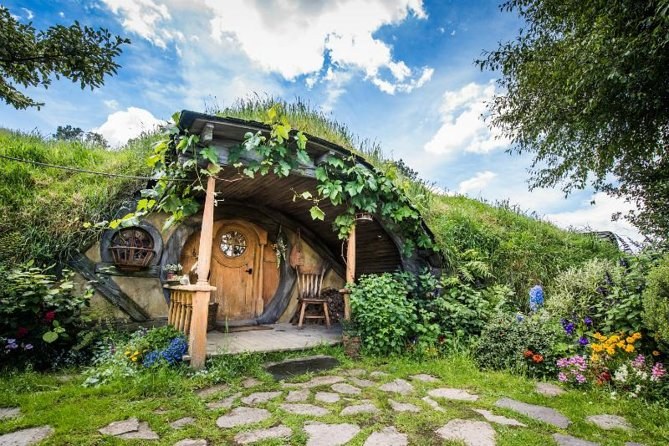
What you do Step inside the most beloved film set on earth — the Shire from The Lord of the Rings — then descend into the otherworldly Waitomo Caves, where thousands of glowworms illuminate an underground cathedral. A true once-in-a-lifetime New Zealand double-header.
What to expect A private vehicle collects you from the port and heads south through the lush Waikato countryside to the Alexander family farm. Your official Hobbiton guide leads you through all 44 Hobbit Holes, the Green Dragon Inn and the Party Tree, with an included ale or cider at the bar. After lunch, you continue to Waitomo where a guided boat glides silently beneath a galaxy of native glowworms (Arachnocampa luminosa). Your driver monitors the all-aboard time throughout, ensuring a relaxed and punctual return to Auckland.
Good to know Hobbiton sells out months ahead — book the official tour directly at hobbitontours.com immediately after confirming your cruise port day. Waitomo tickets at waitomo.com. Journey from Auckland is approx 2 hrs each way; this excursion requires a full port day (8–9 hrs ashore). Pre-book both attractions and arrange private transport as a package for seamless logistics.
book direct with Hobbiton Movie Set Tours (official) + Waitomo Glowworm Caves (official) → · the full guide →
What you do Leap from 192 metres above Auckland in a controlled base-jump style descent from the iconic Sky Tower — the tallest freestanding structure in the Southern Hemisphere — then ascend to the open-air observation deck for 360° panoramic views across the city, harbour and volcanic cones.
What to expect Arrive at the base of the 328-metre Sky Tower in the heart of the CBD and take the express lift to the jump platform. Fully trained AJ Hackett instructors brief you with calm precision before you step to the edge of Auckland's skyline. The 11-second freefall descent at 85 km/h is followed by a graceful slow-down — knees never buckle, heart never forgets. Afterwards, ride up to the open glass-floor observation deck for a celebratory drink and sweeping 80-km views across the Hauraki Gulf, Rangitoto Island and the city spread below.
Good to know Weight limit 35–150 kg; minimum age 10 years. Book the SkyJump directly at skyjump.co.nz — slots are timed and limited. The Sky Tower is a 10-minute walk from the cruise terminal at Princes Wharf. Allow 2–3 hours total; ideal as a morning excursion before exploring the waterfront. Closed in severe weather.
What you do Hike the perfectly symmetrical cone of Rangitoto — Auckland's youngest and most iconic volcano, rising straight from the Hauraki Gulf — with a private guide who brings the geology, Māori history and unique lava-field ecology to life. The 360° summit view is unforgettable.
What to expect Board the Fullers ferry from the downtown terminal for the scenic 25-minute crossing to Rangitoto Wharf. Your guide meets you on the island and leads you through ancient lava fields carpeted in the world's largest wild pohutukawa forest. The 2.5-hour return trail to the 259-metre summit is moderately challenging — lava rock underfoot, open skies above. At the top, a jaw-dropping panorama takes in Auckland's 53 volcanic cones, the Waitemata and Manukau harbours, and on clear days, the Coromandel Peninsula. Your guide shares the island's Māori significance and its 600-year geological story.
Good to know Wear sturdy walking shoes — lava rock is uneven. Bring sun protection and water; the island has no shops. Fullers ferries depart from the Ferry Building (5 min from cruise terminal); check the timetable at fullers.co.nz and match the return crossing to your all-aboard time. The hike takes approx 2.5–3 hrs return from the wharf.
What you do Step inside the world of the All Blacks — New Zealand's legendary national rugby team — at this world-class, technology-driven attraction in the heart of Auckland's Viaduct Harbour. Perform the haka, feel the weight of a black jersey, and understand why rugby is New Zealand's soul.
What to expect Your expert guide leads you through a series of cinematic, technology-rich galleries that trace the All Blacks' history from the 1905 'Originals' tour to World Cup glory. You stand in a full-scale replica changing room, listen to spine-tingling pre-match speeches, and attempt your own haka in the performance studio — a surprisingly moving and joyful experience. The final gallery, dedicated to Māori culture and its inseparability from the team's identity, provides genuine cultural depth. The attraction is just a 10-minute stroll from Princes Wharf.
Good to know Pre-book timed entry tickets at allblacksexperience.com to guarantee your slot — peak cruise season sells out. Allow 1.5–2 hours; perfectly paired with a waterfront lunch at the adjacent Viaduct Harbour before returning to the ship. Open daily; located at 102 Quay Street, a flat 10-min walk from the cruise terminal.
What you do Explore New Zealand's finest museum — a magnificent neoclassical landmark in the Auckland Domain — with a private expert guide who unlocks the world's greatest collection of Māori taonga (treasures) and Polynesian artefacts, plus the nation's most moving military memorial galleries.
What to expect Your private guide meets you at the grand portico of this 1929 heritage building, set above the Domain's sweeping parklands with views back to the harbour. The tour opens in the Māori Court, home to Te Ao Hou — a magnificent carved wharenui — and a 21-metre war canoe (waka taua), with your guide interpreting the carvings and oral histories that most visitors pass without understanding. The Pacific galleries, the largest such collection in the world, and the deeply affecting Hall of Memories war memorial follow. The experience is intimate, slow-paced and intellectually rich.
Good to know Request a private guided tour when booking at aucklandmuseum.com — or contact the museum directly by phone/email for bespoke arrangements. The museum is a 20-minute taxi or 30-minute walk from the cruise terminal, set in the Auckland Domain parklands. Allow 2–3 hours. A Māori cultural performance (additional cost) can be added. Open daily.
book direct with Auckland War Memorial Museum (official) → · the full guide →
After you step off · near Auckland
You end in a different port — stay on, and add what is within reach before you fly home.