Your cruise
Seven Seas Explorer · 11-night Australia & South Pacific cruise, Singapore to Hong Kong
Dec 11 – Dec 22 · 11 nights ·
Day 1–2 Singapore (board) · Day 3 Willis Island · Day 4 Kota Kinabalu · Day 5 Muara · Day 6 Willis Island · Day 7 Puerto Princesa · Day 8 Coron · Day 9 Boracay · Day 10 Manila · Day 11 Willis Island · Day 12 Hong Kong (step off)
What you do Board a rigid inflatable Zodiac for a close-up circumnavigation of one of the Coral Sea's most remote specks of land. Drift alongside vast nesting colonies of red-footed boobies, frigatebirds and brown noddies — a wildlife spectacle almost no traveller on earth ever witnesses.
What to expect Your Zodiac departs the ship's swim platform and skirts the island's entire coastline at water level, giving you eye-to-eye encounters with seabird colonies that number in the tens of thousands. The guide pauses the engine so you can hear the cacophony of calls and photograph birds in undisturbed flight. Shallow coral gardens glow electric beneath the hull as you round each headland. The round trip typically takes 90–120 minutes, leaving ample buffer before all-aboard.
Good to know Pre-book directly via email well in advance — this is a tender-only island and Zodiac capacity is strictly capped. Wear non-marking soles, bring a hat and reef-safe sunscreen. Confirm your ship's all-aboard time and allow 30 minutes' return buffer.
Versus the ship tour An intimate, expert-led small-group Zodiac — never more than 12 guests — means you can idle silently within metres of nesting birds and low reef outcrops that larger vessels simply cannot access, guided by a marine biologist who narrates every species in real time.
What you do Slip beneath the surface of some of the least-dived water on the planet — the Coral Sea surrounding Willis Island, hundreds of kilometres from the nearest coast. Visibility regularly exceeds 30 metres, revealing walls of hard coral, reef sharks, giant trevally and undisturbed sea-turtle feeding grounds.
What to expect Guests kit up in a purpose-equipped dive room and giant-stride into waters of extraordinary clarity. The reef structures here are pristine — no bleaching, no crowds — and the sheer biomass of pelagic life reflects the island's status as a protected marine reserve. Drift snorkelling across shallow coral plateaus, you are likely to encounter hawksbill turtles grazing, schools of chevron barracuda and the flash of a reef whaler in the blue. Safety divers and guides remain in the water throughout.
Good to know Swimming competency is required; full snorkel equipment is provided. Confirm landing and in-water permissions with the Australian Bureau of Meteorology station keeper in advance — access can be subject to weather and conservation protocols. Bring a rash vest for UV protection.
Versus the ship tour Mike Ball operates the definitive liveaboard expeditions to the Coral Sea's outer reefs, with certified dive guides who have logged thousands of hours specifically on these formations. Group size is tightly managed, and every dive brief is site-specific — the antithesis of a mass-market snorkel.
book direct with Mike Ball Dive Expeditions (Townsville/Cairns — Coral Sea specialists) → · the full guide →
What you do Step ashore — one of only a handful of visitors ever permitted — and receive a private briefing inside Australia's most remote operational weather station. The data collected here has guided cyclone warnings across Queensland for over a century; it is a living piece of scientific history.
What to expect After a short Zodiac transfer to the beach, you walk across the coral-rubble islet — the entire thing is barely 400 metres across — to the weatherboard station compound. The duty meteorologist explains the island's role in tracking Coral Sea cyclogenesis, shows you the instrument arrays and balloon launch facilities, and fields questions with refreshing candour. The sense of absolute remoteness — no roads, no shops, just science and sea — is profoundly affecting. Visits are brief (30–45 minutes) out of respect for operations.
Good to know Landing is at the discretion of BOM and sea conditions; it is never guaranteed. Wear closed shoes for the coral-rubble foreshore. Do not touch or enter any instrument enclosures. This is one of cruising's rarest privileges — treat it accordingly.
Versus the ship tour Landing on Willis Island is granted to very few vessels per year and always requires advance coordination with the BOM. The briefing is delivered by the station's resident meteorologist — one of Australia's most isolated postings — lending an authenticity and depth no third-party guide could replicate.
What you do Join a dedicated marine naturalist on a slow, deliberate circuit of Willis Island's offshore waters — prime habitat for dwarf minke whales, spinner dolphins, red-tailed tropicbirds and occasional whale sharks. This is expedition-grade wildlife observation in one of Earth's most intact marine environments.
What to expect The excursion runs in the calm conditions that typically prevail in the lee of the island, with the naturalist briefing the group on cetacean behaviour before departure. Spinner dolphins frequently bow-ride the vessel's wake, while tropicbirds trace lazy arcs overhead trailing their extraordinary white tail streamers. In season (June–September), dwarf minke whales approach curious vessels with remarkable boldness. The naturalist's running identification and ecological commentary transforms an already astonishing scene into a masterclass in Coral Sea ecology.
Good to know Bring image-stabilised binoculars if you own them — loaner binoculars are available but limited. A polarised lens filter dramatically improves underwater wildlife sighting from the deck. Morning cruises yield the best light and the calmest seas.
Versus the ship tour Coral Expeditions' marine naturalists carry years of Coral Sea field experience and use hydrophones and binoculars to locate and interpret marine megafauna well beyond what a casual deck scan achieves. Groups are capped at 20, ensuring every guest has unobstructed sightlines and personalised commentary.
book direct with Coral Expeditions (Australia's premium expedition cruise specialist) → · the full guide →
What you do Combine world-class snorkelling with a dedicated underwater photography tuition session led by a professional marine photographer. The pellucid, undisturbed waters around Willis Island provide a studio backdrop that professionals travel half a year to reach — and you are already here.
What to expect After a 20-minute on-deck briefing covering exposure, buoyancy control for photography and coral-safe positioning, the group enters the water with the lead photographer. Each participant is given real-time feedback via underwater slates and post-dive screen reviews. The reef here hosts nudibranchs, juvenile turtles and extraordinary soft-coral detail that rewards close, patient framing. By the final dive, guests leave with a curated set of images that would pass muster in any travel magazine.
Good to know Bring your own mirrorless or compact camera with an underwater housing if possible; hire housings are limited. Basic snorkel competency required. Maximum group size of 6 is strictly enforced — book your place the moment you board the ship.
Versus the ship tour A professional marine photographer leads groups of no more than six, providing personalised composition coaching in real time — in the water, beside you. The combination of tuition and a location almost nobody else will ever photograph makes every frame genuinely irreplaceable.
What you do Rise before the rest of the ship and join an ornithologist-guide for a dawn landing on Willis Island — arguably the most exclusive birdwatching address in the Southern Hemisphere. The island hosts one of Australia's largest documented seabird colonies, and first light is when it erupts into extraordinary life.
What to expect The Zodiac lands on the coral-rubble beach just as the sky softens to indigo. Within seconds, frigatebirds begin their courtship displays, inflating scarlet throat pouches while brown boobies jostle on nesting scrapes metres from your feet. The ornithologist narrates the scene with infectious expertise, calling species by name as they lift and wheel overhead in their thousands. The island's absolute silence — broken only by wind and wings — produces a meditative quality that experienced travellers consistently describe as one of cruising's most affecting moments.
Good to know Landing is subject to BOM approval and sea-state — pre-register your interest at the expedition desk on day one of the voyage. Wear dark, non-reflective clothing to avoid disturbing nesting birds. Carry a long lens (200mm+ equivalent) for perched-bird shots. Soft-soled shoes protect both the coral-rubble substrate and your footing.
Versus the ship tour A qualified ornithologist leads a structured census-style walk, naming every species, explaining colony dynamics and pointing out nesting behaviours that an untrained eye would miss entirely. The pre-sunrise timing means you experience the island in its rawest, most atmospheric state — long before the day-trippers (there are none) arrive.
book direct with Coral Expeditions (Australia's premium expedition cruise specialist) → · the full guide →
What you do Step into the surreal world of Gardens by the Bay — marvel at the towering Supertrees, walk the aerial OCBC Skyway, and lose yourself in the Cloud Forest's misty 35m indoor waterfall. As dusk falls, the Supertrees ignite in a breathtaking light-and-music spectacular.
What to expect Enter the Cloud Forest and be engulfed by a wall of tropical mist cascading down the world's tallest indoor waterfall. Wind your way up walkways draped in exotic orchids and carnivorous plants with jaw-dropping views of Marina Bay. As evening arrives, settle on the lawn below the 50-metre Supertrees and watch the grove erupt in choreographed colour and music. The juxtaposition of futuristic architecture and lush biodiversity is unlike anything else on earth.
Good to know Gardens by the Bay is a 10-min taxi from Marina Bay Cruise Centre (approx SGD 12–15). Pre-book timed-entry tickets online to avoid queues. Last Cloud Forest entry is 8 pm; Garden Rhapsody shows at 7:45 pm & 8:45 pm. Check ship's all-aboard time — most evening departures allow this comfortably.
Versus the ship tour Booking direct gives you the flexibility to time your Cloud Forest visit in the cool of morning and linger for the famous Garden Rhapsody light show at 7:45 pm — a magical payoff that pre-packaged tours routinely miss. The Supertree Observatory at sunset is a bucket-list moment in itself.
What you do Ascend to the iconic SkyPark atop Marina Bay Sands — 200 metres above the city — for the most photographed panorama in Asia. Hotel guests can take a dip in the infinity pool seemingly suspended over the skyline; non-guests access the observation deck for equally staggering views.
What to expect Ride the express lift to the 57th floor and step out onto the ship-shaped SkyPark. The city unfurls in every direction — the glittering bay, the green lung of Gardens by the Bay, the colonial CBD, and the Strait of Malacca beyond. Sunset here turns the skyline amber and gold. Hotel guests can slip into the infinity pool at the sky's edge and float above one of the world's great city panoramas. The attached bar serves Singapore Slings 200 metres in the air.
Good to know Observation deck is open daily 11 am–9 pm (last entry 8:30 pm). Marina Bay Sands is a 10-min taxi from Marina Bay Cruise Centre. Book observation deck tickets online at marinabaysands.com. If overnighting, book well in advance — rooms sell out fast on cruise-call dates.
Versus the ship tour There is no other vantage point in Singapore — or arguably Asia — quite like this. The 360-degree cantilevered deck stretches 340 metres across three towers, framing the entire Marina Bay skyline, Sentosa Island, and on a clear day, the Indonesian islands. For those who book a room, the world-famous infinity pool is simply one of travel's great bucket-list swims.
What you do Guided by a passionate local expert, eat your way through Singapore's legendary hawker culture — UNESCO-listed and utterly irreplaceable. Taste laksa, char kway teow, Hainanese chicken rice and chilli crab across Maxwell Food Centre and the lanes of Chinatown and Tanjong Pagar.
What to expect Begin at Maxwell Food Centre, one of Singapore's most storied hawker complexes, where Tian Tian Chicken Rice has a legendary queue. Your guide explains the fascinating immigrant heritage behind each dish — Hokkien, Teochew, Malay, Tamil. Wind through the shophouse lanes of Chinatown, stop for a traditional kopi (coffee) in a century-old kopitiam, and finish with Singapore's greatest controversy: which laksa is best. Every bite is backed by a story.
Good to know Tours depart from central Singapore and can be customised by Hello! Singapore Tours. Book directly via their website and mention your cruise all-aboard time so the guide tailors the pace. Most food tours run 3–4 hours. Maxwell Food Centre is a short taxi ride from Marina Bay Cruise Centre.
Versus the ship tour Hello! Singapore Tours is an award-winning, guide-led specialist — not a bus-tour operator. Your expert knows exactly which hawker stall has the 30-year-old wok hei technique and which kopitiam has been serving the same Hainanese breakfast since 1965. Group sizes are kept small so you eat like a local, not a tourist.
book direct with Hello! Singapore Tours → · the full guide →
What you do Plunge into the riot of marigolds, incense, and vibrant street art of Little India, then cross to the bougainvillea-draped lanes of Arab Street and Kampong Glam. A private local guide unlocks the spiritual, artistic, and culinary soul of Singapore's most colourful precincts.
What to expect Arrive in Little India and immediately sense the sensory shift — jasmine garlands, Tamil film music, and the copper glow of temple gopurams. Enter Sri Veeramakaliamman Temple, one of Singapore's holiest Hindu shrines, and hear its 19th-century founding story. Stroll the candy-coloured shophouses of Haji Lane, where indie boutiques and striking murals fill every wall. At the Sultan Mosque, your guide contextualises Singapore's extraordinary multicultural governance. A short detour to a family-run spice merchant completes the portrait.
Good to know Culture Curious tours are fully private and customisable — email directly to tailor the itinerary to your interests and ship schedule. Dress modestly for temple and mosque visits (covered shoulders and knees). Little India is 15–20 minutes by taxi from Marina Bay Cruise Centre.
Versus the ship tour Culture Curious specialises exclusively in private, expert-led cultural tours with deep knowledge of Singapore's ethnic enclaves, urban planning, and living heritage. You set the pace — linger at Sri Veeramakaliamman Temple, browse the perfumeries of Arab Street, or step inside the Sultan Mosque at the guide's invitation. This is not a highlight reel; it is genuine cultural access.
book direct with Culture Curious Singapore Tours → · the full guide →
What you do Wander 160 years of living botanical history at the Singapore Botanic Gardens — a UNESCO World Heritage Site — culminating in the National Orchid Garden, home to over 1,000 species including the rare black orchid and hybrid orchids named for visiting royalty.
What to expect Enter through the grand Tanglin Gate and immediately shed the city's pace. Heritage rain trees form a cathedral canopy over meandering paths through themed gardens — the Swan Lake, the Evolution Garden, the fragrant Ginger Garden. In the National Orchid Garden, colour saturates every sightline: cascading purple Dendrobiums, blazing orange Arantheras, and the pale, ethereal Vanda Miss Joaquim, Singapore's national flower. Benches, birdsong, and cool shade make this a rare moment of genuine tranquillity.
Good to know Gardens open daily 5 am–midnight (free); National Orchid Garden 8:30 am–7 pm (last entry 6 pm). Roughly 20 minutes by taxi from Marina Bay Cruise Centre (SGD 18–22). Pre-purchase Orchid Garden tickets at the gates or online via nparks.gov.sg. Allow 2–3 hours minimum.
Versus the ship tour The National Orchid Garden is the world's largest tropical orchid collection and one of the few places on earth where you can see VIP Orchids — rare hybrid blooms created to honour heads of state, from Queen Elizabeth II to Nelson Mandela. The heritage Ginger Garden and Swan Lake add layers of beauty found nowhere else. This is botanical luxury at its finest.
What you do Board a converted WWII-style DUKW amphibious craft for Singapore's only land-and-water city tour — rolling past the colonial CBD, Esplanade, and Marina Bay before dramatically splashing into the Singapore River for a unique skyline perspective from the water.
What to expect Your guide narrates Singapore's dramatic transformation from colonial trading port to futuristic metropolis as you roll past the Padang, St Andrew's Cathedral, and the glittering towers of Marina Bay. Then — with a roar and a splash — the DUCK powers into the Singapore River, and the skyline rearranges itself into a postcard. From the water you drift past the Merlion statue, under the Cavenagh Bridge, and along the rejuvenated banks of Boat Quay. The combination of history, humour, and spectacle makes this a genuinely joyful 60 minutes.
Good to know DUCKtours depart from Suntec City (central Singapore), approx 15-min taxi from Marina Bay Cruise Centre. Tours run daily; book direct at bigducktours.com to secure your preferred time slot. Duration approx 60 minutes. Ideal as a morning orientation before exploring on your own.
Versus the ship tour No other city tour in Singapore offers the double perspective of both street level and the waterway — in the same vehicle, with no transfers. The dramatic water entry beside Suntec City draws gasps every time, and the river approach to the Merlion and Esplanade Theatres (the 'Durians') is a genuinely unique photo angle. It's theatrical, expert-narrated, and accessible to all ages.
book direct with Singapore DUCKtours (official) → · the full guide →
What you do Board a rigid inflatable Zodiac for a close-up circumnavigation of one of the Coral Sea's most remote specks of land. Drift alongside vast nesting colonies of red-footed boobies, frigatebirds and brown noddies — a wildlife spectacle almost no traveller on earth ever witnesses.
What to expect Your Zodiac departs the ship's swim platform and skirts the island's entire coastline at water level, giving you eye-to-eye encounters with seabird colonies that number in the tens of thousands. The guide pauses the engine so you can hear the cacophony of calls and photograph birds in undisturbed flight. Shallow coral gardens glow electric beneath the hull as you round each headland. The round trip typically takes 90–120 minutes, leaving ample buffer before all-aboard.
Good to know Pre-book directly via email well in advance — this is a tender-only island and Zodiac capacity is strictly capped. Wear non-marking soles, bring a hat and reef-safe sunscreen. Confirm your ship's all-aboard time and allow 30 minutes' return buffer.
Versus the ship tour An intimate, expert-led small-group Zodiac — never more than 12 guests — means you can idle silently within metres of nesting birds and low reef outcrops that larger vessels simply cannot access, guided by a marine biologist who narrates every species in real time.
What you do Slip beneath the surface of some of the least-dived water on the planet — the Coral Sea surrounding Willis Island, hundreds of kilometres from the nearest coast. Visibility regularly exceeds 30 metres, revealing walls of hard coral, reef sharks, giant trevally and undisturbed sea-turtle feeding grounds.
What to expect Guests kit up in a purpose-equipped dive room and giant-stride into waters of extraordinary clarity. The reef structures here are pristine — no bleaching, no crowds — and the sheer biomass of pelagic life reflects the island's status as a protected marine reserve. Drift snorkelling across shallow coral plateaus, you are likely to encounter hawksbill turtles grazing, schools of chevron barracuda and the flash of a reef whaler in the blue. Safety divers and guides remain in the water throughout.
Good to know Swimming competency is required; full snorkel equipment is provided. Confirm landing and in-water permissions with the Australian Bureau of Meteorology station keeper in advance — access can be subject to weather and conservation protocols. Bring a rash vest for UV protection.
Versus the ship tour Mike Ball operates the definitive liveaboard expeditions to the Coral Sea's outer reefs, with certified dive guides who have logged thousands of hours specifically on these formations. Group size is tightly managed, and every dive brief is site-specific — the antithesis of a mass-market snorkel.
book direct with Mike Ball Dive Expeditions (Townsville/Cairns — Coral Sea specialists) → · the full guide →
What you do Step ashore — one of only a handful of visitors ever permitted — and receive a private briefing inside Australia's most remote operational weather station. The data collected here has guided cyclone warnings across Queensland for over a century; it is a living piece of scientific history.
What to expect After a short Zodiac transfer to the beach, you walk across the coral-rubble islet — the entire thing is barely 400 metres across — to the weatherboard station compound. The duty meteorologist explains the island's role in tracking Coral Sea cyclogenesis, shows you the instrument arrays and balloon launch facilities, and fields questions with refreshing candour. The sense of absolute remoteness — no roads, no shops, just science and sea — is profoundly affecting. Visits are brief (30–45 minutes) out of respect for operations.
Good to know Landing is at the discretion of BOM and sea conditions; it is never guaranteed. Wear closed shoes for the coral-rubble foreshore. Do not touch or enter any instrument enclosures. This is one of cruising's rarest privileges — treat it accordingly.
Versus the ship tour Landing on Willis Island is granted to very few vessels per year and always requires advance coordination with the BOM. The briefing is delivered by the station's resident meteorologist — one of Australia's most isolated postings — lending an authenticity and depth no third-party guide could replicate.
What you do Join a dedicated marine naturalist on a slow, deliberate circuit of Willis Island's offshore waters — prime habitat for dwarf minke whales, spinner dolphins, red-tailed tropicbirds and occasional whale sharks. This is expedition-grade wildlife observation in one of Earth's most intact marine environments.
What to expect The excursion runs in the calm conditions that typically prevail in the lee of the island, with the naturalist briefing the group on cetacean behaviour before departure. Spinner dolphins frequently bow-ride the vessel's wake, while tropicbirds trace lazy arcs overhead trailing their extraordinary white tail streamers. In season (June–September), dwarf minke whales approach curious vessels with remarkable boldness. The naturalist's running identification and ecological commentary transforms an already astonishing scene into a masterclass in Coral Sea ecology.
Good to know Bring image-stabilised binoculars if you own them — loaner binoculars are available but limited. A polarised lens filter dramatically improves underwater wildlife sighting from the deck. Morning cruises yield the best light and the calmest seas.
Versus the ship tour Coral Expeditions' marine naturalists carry years of Coral Sea field experience and use hydrophones and binoculars to locate and interpret marine megafauna well beyond what a casual deck scan achieves. Groups are capped at 20, ensuring every guest has unobstructed sightlines and personalised commentary.
book direct with Coral Expeditions (Australia's premium expedition cruise specialist) → · the full guide →
What you do Combine world-class snorkelling with a dedicated underwater photography tuition session led by a professional marine photographer. The pellucid, undisturbed waters around Willis Island provide a studio backdrop that professionals travel half a year to reach — and you are already here.
What to expect After a 20-minute on-deck briefing covering exposure, buoyancy control for photography and coral-safe positioning, the group enters the water with the lead photographer. Each participant is given real-time feedback via underwater slates and post-dive screen reviews. The reef here hosts nudibranchs, juvenile turtles and extraordinary soft-coral detail that rewards close, patient framing. By the final dive, guests leave with a curated set of images that would pass muster in any travel magazine.
Good to know Bring your own mirrorless or compact camera with an underwater housing if possible; hire housings are limited. Basic snorkel competency required. Maximum group size of 6 is strictly enforced — book your place the moment you board the ship.
Versus the ship tour A professional marine photographer leads groups of no more than six, providing personalised composition coaching in real time — in the water, beside you. The combination of tuition and a location almost nobody else will ever photograph makes every frame genuinely irreplaceable.
What you do Rise before the rest of the ship and join an ornithologist-guide for a dawn landing on Willis Island — arguably the most exclusive birdwatching address in the Southern Hemisphere. The island hosts one of Australia's largest documented seabird colonies, and first light is when it erupts into extraordinary life.
What to expect The Zodiac lands on the coral-rubble beach just as the sky softens to indigo. Within seconds, frigatebirds begin their courtship displays, inflating scarlet throat pouches while brown boobies jostle on nesting scrapes metres from your feet. The ornithologist narrates the scene with infectious expertise, calling species by name as they lift and wheel overhead in their thousands. The island's absolute silence — broken only by wind and wings — produces a meditative quality that experienced travellers consistently describe as one of cruising's most affecting moments.
Good to know Landing is subject to BOM approval and sea-state — pre-register your interest at the expedition desk on day one of the voyage. Wear dark, non-reflective clothing to avoid disturbing nesting birds. Carry a long lens (200mm+ equivalent) for perched-bird shots. Soft-soled shoes protect both the coral-rubble substrate and your footing.
Versus the ship tour A qualified ornithologist leads a structured census-style walk, naming every species, explaining colony dynamics and pointing out nesting behaviours that an untrained eye would miss entirely. The pre-sunrise timing means you experience the island in its rawest, most atmospheric state — long before the day-trippers (there are none) arrive.
book direct with Coral Expeditions (Australia's premium expedition cruise specialist) → · the full guide →
What you do Stand atop Low's Peak at 4,095 m — the highest point between the Himalayas and New Guinea. This UNESCO World Heritage ascent through cloud forest is the single greatest bucket-list achievement in all of Borneo.
What to expect The climb winds through five distinct vegetation zones — from lush montane forest to surreal granite moonscape near the summit. Sunrise from Low's Peak at 4,095 m, with cloud seas rolling below and Borneo stretching to the horizon, is one of the most transcendent sights on Earth. Guides are expert naturalists who reveal the park's astonishing biodiversity — over 600 orchid species and the world's largest rafflesia — along the way. Note: this is a 2D1N adventure requiring an overnight at Laban Rata; best suited to guests with a two-day port call or an overnight stay pre/post-cruise.
Good to know Book 6 months in advance — daily climber quotas sell out fast. Kinabalu Park is ~2 hours from Kota Kinabalu; private transfers recommended. All-aboard times must be confirmed with your cruise before booking. A fitness assessment is advised; the descent is harder than the ascent.
Versus the ship tour Officially regulated small groups, certified mountain guides, and the only legitimate gateway to Low's Peak — a once-in-a-lifetime ascent capped at strictly limited daily climber numbers to preserve the experience.
book direct with Sutera Sanctuary Lodges (official Mount Kinabalu climb operator) → · the full guide →
What you do Glide through the ink-black Klias wetlands as Borneo's endemic proboscis monkeys settle into the mangroves at dusk, then watch thousands of fireflies illuminate the riverbanks like living constellations — one of Southeast Asia's most magical wildlife spectacles.
What to expect The journey begins in late afternoon with a scenic 2-hour drive through palm plantations to the Klias River delta. At sunset, flat-bottomed boats slip silently into the mangrove labyrinth while guides spotlight proboscis monkeys, silver langurs, and monitor lizards roosting overhead. As darkness falls, entire trees pulse with synchronised fireflies in a display that defies description. A traditional dinner is served riverside before the return transfer. Back in Kota Kinabalu by approximately 10–11 pm.
Good to know All-aboard is typically late evening for KK port calls — confirm your ship's schedule. Private transfers from the cruise terminal included with reputable operators. Bring insect repellent and a light layer for the river breeze. Pre-booking is essential in peak season (Jul–Aug).
Versus the ship tour Small wooden river boats carry a handful of guests, ensuring intimate sightings of proboscis monkeys — found nowhere outside Borneo — and a front-row view of the firefly display without crowds or noise.
What you do Step inside the living longhouses of five indigenous Sabahan tribes — Kadazan-Dusun, Bajau, Murut, Lundayeh, and Rungus — for an immersive afternoon of fire-making, traditional tattooing, blowpipe demonstrations, and rice wine ceremonies.
What to expect A dedicated guide leads your group through five authentically reconstructed longhouses, each representing a distinct Sabahan ethnic tradition. Watch a warrior demonstrate the blowpipe with startling accuracy, observe the ancient art of fire-making by friction, and participate in a rice wine (tapai) ceremony. The experience culminates in a beautifully presented traditional Sabahan feast served inside the longhouse. The village sits in a lush jungle valley just 25 minutes from the cruise terminal.
Good to know Private afternoon sessions can be scheduled to align with your all-aboard time — confirm when booking. Comfortable walking shoes recommended as the village is set on uneven jungle terrain. Photography is warmly welcomed throughout. Book direct via the official website for priority private session slots.
Versus the ship tour Private bookings grant exclusive use of the village with a dedicated cultural host — no shared crowds — allowing genuine conversation with tribal custodians who are descendants of the communities they represent.
book direct with Mari Mari Cultural Village (official) → · the full guide →
What you do Charter a private catamaran to the five coral-fringed islands of Tunku Abdul Rahman Marine Park — just 15 minutes offshore — for world-class snorkelling over technicolour reefs, paddleboarding in gin-clear water, and a sundowner sail back to Jesselton Point.
What to expect Board your private catamaran at Jesselton Point Ferry Terminal, a 10-minute taxi from the cruise pier. The skipper navigates to the marine park's prime snorkel sites — where blacktip reef sharks, sea turtles, and parrotfish are routine sightings in 10–15 m visibility. Between dives, kayak the island's jungle fringe or paddleboard in the turquoise lagoon. A freshly prepared lunch of local seafood is served on deck. The return sail at golden hour, with Mount Kinabalu visible on the horizon, is a photographer's dream.
Good to know Departure from Jesselton Point Ferry Terminal — allow 15 minutes transit from the cruise terminal. Charter schedules can be tailored to your all-aboard time. Marine park entry fee (RM 15–RM 20 per person) is payable locally. Advance booking strongly advised; private charters fill quickly on port days.
Versus the ship tour A private charter means you dictate the islands, the pace, and the anchorage — lingering at the best reef on Manukan or the secret shallows of Sapi without a crowd, with a skipper and guide entirely at your service.
book direct with Kota Kinabalu Watersports (official local operator) → · the full guide →
What you do Soak in Japanese-style jungle hot springs deep inside a UNESCO World Heritage rainforest, then walk the 40-metre-high canopy walkway suspended between ancient dipterocarp trees — a sublime double act at the foot of Mount Kinabalu.
What to expect Poring sits at 550 m altitude within Kinabalu Park, a 90-minute private drive from the cruise terminal. On arrival, reserve a private outdoor hot-spring pavilion framed by jungle — the hot sulphurous water is a genuine restorative after a morning of exploration. The adjacent canopy walkway — suspended up to 40 m above the forest floor — offers eye-level encounters with hornbills, gibbons, and rare orchids. Naturalist-guided forest walks to the Kipungit waterfall round out the experience.
Good to know An early 07:00–08:00 departure from the cruise terminal allows a full morning and comfortable return by 14:00–15:00 for most all-aboard times. Arrange a private driver/guide through your hotel or a reputable local operator. Pavilion bookings can be made on arrival; weekends are busier. Light, moisture-wicking clothing and trail shoes recommended.
Versus the ship tour With a private vehicle and early departure, you arrive before the day-trippers and have the steaming outdoor tubs and the canopy walkway virtually to yourself — an otherworldly morning in one of the world's great rainforests.
book direct with Sabah Parks – Poring Hot Springs (official) → · the full guide →
What you do Explore the colonial waterfront, Atkinson Clock Tower, and vibrant Filipino Market with a private local expert, then sit down to a curated tasting journey through Sabahan cuisine — where Malay, Chinese, Kadazan, and Bajau Sea Gypsy flavours collide.
What to expect Your guide meets you at the cruise terminal and leads a leisurely walk through KK's layered heritage — the colonial-era Atkinson Clock Tower (Sabah's oldest surviving structure), the neon-lit Filipino Market on the waterfront, and the city's Chinese shophouse quarter. Tastings are woven throughout: fresh sashimi-grade fish at the market, beef rendang from a Kadazan hawker stall, and the legendary 'kopi susu' at a 1950s coffeehouse. The tour concludes at Signal Hill Tower, where the entire Tunku Abdul Rahman archipelago stretches before you.
Good to know The entire tour operates within 10–15 minutes of the cruise terminal — no long transfers required, making this ideal if your all-aboard time is early. Guides are vetted locals with deep knowledge of Sabahan history and food culture. Confirm your exact all-aboard time at booking so the guide can tailor the pace accordingly.
Versus the ship tour A single, dedicated private guide means the itinerary bends entirely to your curiosity — lingering at a century-old coffee shop, negotiating the Filipino Market for pearls and dried seafood, or detour to Signal Hill Observatory for the city panorama, all at your pace.
book direct with ToursbyLocals – Kota Kinabalu Private Guides → · the full guide →
What you do Step inside one of Southeast Asia's most breathtaking mosques — a gold-domed masterpiece rising from a lagoon in Bandar Seri Begawan. A private expert guide unlocks the spiritual and architectural story of this iconic landmark.
What to expect Arrive to the gilded spectacle of pure gold domes reflected in the artificial lagoon surrounding the mosque. Your private guide explains the architectural fusion of Mughal, Italian, and Malay styles as you explore the ornate interior, the 44-metre minaret, and the famous stone boat replica. Dress modestly (robes are provided at the entrance). Visit in the soft morning or late-afternoon light for extraordinary photography.
Good to know Muara Port to Bandar Seri Begawan city centre is approximately 25–30 minutes by private car or taxi. The mosque is open to non-Muslim visitors outside prayer times; close Friday midday. Pre-book your guide in advance via Showaround. Allow 2–3 hours including transport.
Versus the ship tour A private local guide grants unhurried, personalised access and insider context — no crowds, no rushed commentary, and full flexibility to linger at the marble courtyards and shimmering lagoon at your own pace.
book direct with Showaround Muara Private Guides → · the full guide →
What you do Glide by private boat through Kampong Ayer — the world's largest water village — where 30,000 people live across 42 stilted communities on the Brunei River. An intimate, living portrait of a civilisation unchanged for centuries.
What to expect Board your private traditional boat at the Bandar Seri Begawan waterfront and weave through the labyrinthine canals of wooden houses, mosques, schools, and clinics all perched on stilts. Your guide narrates 1,300 years of history as you pass colourfully painted homes and bustling waterway traffic. Disembark to walk the boardwalks and visit the Kampong Ayer Cultural & Tourism Gallery. End with a riverside view at golden hour.
Good to know Port to Bandar Seri Begawan waterfront is ~25–30 minutes by car. Morning departures beat the midday heat. Pre-book your guide and confirm boat inclusion via Showaround. Allow 3–4 hours including transit. Wear light, breathable clothing and sun protection.
Versus the ship tour A private local host arranges a traditional wooden boat with a knowledgeable guide who can navigate the inner waterways, introduce you to residents, and take you inside community mosques and homes — an intimacy that group tours cannot replicate.
book direct with Showaround Muara Private Guides → · the full guide →
What you do Venture deep into one of Borneo's last pristine rainforests — accessible only by longboat — and ascend a soaring aluminium canopy walkway 50 metres above the jungle floor for views that define bucket-list. Brunei's crown jewel of conservation.
What to expect The adventure begins with a thrilling 45-minute longboat ride up the Temburong River to the park entrance. Guided trails through primary dipterocarp rainforest lead you past rope bridges and cascading streams before you ascend the iconic canopy walkway. At the summit, you're level with the treetops — gibbons call, hornbills glide, and the unbroken emerald canopy stretches to the horizon. Swim in crystal-clear river pools on the way back.
Good to know Full-day excursion; depart port by 8:00 AM and return by 4:30–5:00 PM — confirm all-aboard time carefully. The journey requires a water taxi from Bandar Seri Begawan to Bangar, then longboats. Pre-booking with Freme Travel is essential; park entry permits are limited. Moderate fitness required for trail sections.
Versus the ship tour Freme Travel is Brunei's foremost inbound specialist, running small private groups with certified naturalist guides who are deeply versed in Borneo's extraordinary biodiversity — delivering an experience far beyond the ordinary jungle tour.
book direct with Freme Travel Services (official Brunei inbound operator) → · the full guide →
What you do Explore the spectacular Royal Regalia Museum, home to the Sultan of Brunei's coronation chariot, ceremonial armour, and priceless crown jewels — a dazzling, unique window into one of the world's wealthiest monarchies. Guided privately for full depth.
What to expect The museum's centrepiece is the gilded royal chariot used in the Sultan's 1992 Silver Jubilee — surrounded by bejewelled regalia, ceremonial weapons, and gifts from world leaders. Your guide weaves the story of Brunei's 600-year-old sultanate, its Islamic traditions, and its remarkable transformation into one of the world's wealthiest nations per capita. Photography is restricted inside, keeping the experience contemplative and absorbing. Pair with a visit to the adjacent Lapau (Royal Ceremonial Hall) for the full regal picture.
Good to know Located in central Bandar Seri Begawan, ~25–30 minutes from the port. Museum is closed on Fridays and public holidays — verify dates before sailing. Dress modestly: covered shoulders and knees required. Allow 2–3 hours with guide. Combine with the mosque or Kampong Ayer for a full-day Bandar cultural circuit.
Versus the ship tour A private local guide contextualises the astonishing display of royal wealth and Brunei's political history with nuance and personal anecdote — transforming what might seem like a museum visit into a compelling story of power, faith, and oil-fuelled modernity.
book direct with Showaround Muara Private Guides → · the full guide →
What you do Unwind on Muara Beach — just 10 minutes from the cruise pier — where soft white sand and clear turquoise water offer a serene, crowd-free retreat. A rare luxury: a beautiful, safe beach within minutes of the ship.
What to expect A short, scenic drive from the pier delivers you to the well-maintained shores of Muara Beach, framed by casuarina trees and lapped by calm, clear South China Sea waters. The beach is clean, safe, and rarely crowded — ideal for swimming, strolling, and simply absorbing the tranquillity of Brunei's coast. Your private guide can arrange chilled drinks and local snacks. The relaxed Brunei atmosphere makes this a wonderfully unhurried counterpoint to a packed city itinerary.
Good to know Only ~10 minutes from the cruise terminal by car — the closest and easiest excursion of the day. Best visited in the morning before heat peaks. Combine with a quick stop at the Muara War Memorial nearby. Bring your own sun lounger/mat as facilities are basic — part of the charm. Return on your own schedule, leaving maximum buffer before all-aboard.
Versus the ship tour With a private driver and guide at your disposal, you travel on your own schedule, can request a curated local picnic spread, and have someone on hand to explore the beach's quieter stretches — a personal beach day rather than a group transfer.
book direct with Showaround Muara Private Guides → · the full guide →
What you do Cruise the mangrove-fringed Brunei River at dusk on a private wildlife boat, spotting the endemic proboscis monkey — one of Borneo's most extraordinary and endangered primates — as they gather in the treetops before nightfall. Utterly unforgettable.
What to expect As the sun dips toward the mangroves, your private river boat slips silently through channels alive with kingfishers, silver-leaf monkeys, and water monitors. The star of the show arrives at dusk: troops of proboscis monkeys — the world's largest arboreal primates, found only in Borneo — descend to riverside trees to sleep. Your naturalist guide narrates their remarkable biology and conservation story. The river glows amber and crimson as you toast the spectacle with a chilled local drink on the water.
Good to know Afternoon departure (around 4:00–4:30 PM) is ideal for the best wildlife activity and light. Confirm all-aboard time carefully — this is a late-afternoon excursion. Approximately 30–40 minutes from the port to the river embarkation point. Pre-book with Freme Travel to secure a private boat. Bring insect repellent and a light jacket for the return in the evening breeze.
Versus the ship tour Freme's expert naturalist guides know exactly where and when the proboscis monkeys congregate — maximising sightings. The private boat means you set the pace, linger at the best viewpoints, and enjoy a curated sundowner as the jungle turns gold.
book direct with Freme Travel Services (official Brunei inbound operator) → · the full guide →
What you do Glide by kayak into one of the world's longest navigable underground rivers — a UNESCO World Heritage Site and New7Wonders of Nature. Cathedral-scale caverns dripping with stalactites, bats swirling overhead, and near-silence make this utterly otherworldly.
What to expect A 90-minute van transfer through lush Palawan jungle brings you to Sabang Wharf, where a private pump boat whisks you to the park entrance. Helmeted and life-vested, you board a paddle kayak and drift into the darkness as your licensed guide illuminates towering limestone formations with a torch. The river stretches 8.2 km underground; the navigable tourist section takes roughly 45 minutes and passes the breathtaking Cathedral and Italian's Room chambers. A buffet lunch at Sabang Wharf is included before the scenic return.
Good to know Permits sell out — book at least 2–3 weeks ahead. The park is ~2 hours from Puerto Princesa port; plan for a full day (8 AM–5 PM) to be comfortable before all-aboard. Wear clothes you don't mind getting splashed. Bring insect repellent for the Sabang beachfront.
Versus the ship tour A fully private boat to Sabang means no group queues at the cave entry — your guide paces the kayak journey entirely around you, lingering in the cathedral chambers and narrating the formations with expert depth.
What you do Escape to the shimmering coral gardens of Honda Bay on a fully chartered private pump boat, stopping at postcard-perfect Cowrie Island and shallow Starfish Island. Crystal-clear water, live coral snorkeling, and powdery white sand — this is quintessential Palawan luxury.
What to expect Honda Bay is a 20-minute drive from the cruise pier, making it one of the most time-efficient island experiences in Palawan. Your private pump boat departs Santa Lourdes Wharf and island-hops across jewel-colored shallows. Cowrie Island offers a pristine beach with swaying palms and a floating cottage for relaxing between snorkel sessions. Starfish Island lives up to its name — wade through ankle-deep water to find enormous starfish resting on the seabed. Equipment, environmental fees, and a light lunch are included.
Good to know Honda Bay is only 30–40 minutes from port — ideal if your ship has a shorter call. Bring reef-safe sunscreen and water shoes; the coral is very close to the surface. Book direct to secure the private vessel and not share with other groups.
Versus the ship tour A chartered private boat means you set the pace — linger at the reef that captivates you, skip the crowds at busier islands, and choose your own snorkel spots with a guide who knows exactly where the sea turtles feed.
What you do Climb through the eerie limestone passages of Ugong Rock, then launch off a 420-metre zipline above an untouched rainforest canopy. This rare combo of cave adventure and aerial thrill is run entirely by the indigenous Tagbanua community — raw, authentic, and unforgettable.
What to expect Located in Barangay Salvacion, roughly 45 minutes from the city centre, Ugong Rock rises dramatically from the jungle floor. Your Tagbanua guide leads you through a series of tight, lamp-lit chambers — squeezing, climbing, and marvelling at glittering formations — before you emerge blinking into sunlight at the summit. The reward is a 420-metre dual zipline that sends you soaring above the forest canopy with a jungle-framed horizon stretching to the bay. The whole experience takes 2–3 hours and is exhilarating without being extreme.
Good to know Wear sturdy closed-toe shoes and clothes that can get dirty. Combine with the Underground River on the same day if your ship has a late all-aboard — Ugong Rock is on the Sabang road. Not suitable for those with severe claustrophobia.
Versus the ship tour This is community-owned and operated by the indigenous Tagbanua people — your fee goes directly to conservation and local livelihoods. No other operator offers this exact combination of living limestone cave and rainforest zipline with such authentic cultural context.
book direct with Ugong Rock Adventures (Tagbanua Community Enterprise) → · the full guide →
What you do Drift silently down a Palawan mangrove river as thousands of synchronised fireflies transform the trees into living constellations. This once-in-a-lifetime twilight spectacle is one of Southeast Asia's greatest natural light shows.
What to expect After a traditional Filipino dinner at a riverside pavilion, you board a narrow wooden bangka boat as dusk deepens over the mangroves. The forest falls quiet, then the trees begin to pulse — first one, then hundreds, then thousands of Pteroptyx fireflies flashing in perfect synchrony. Your guide cuts the engine and lets you drift in near-silence, the only light a green-gold shimmer reflected on the water. The return journey along the illuminated riverbank feels like floating through a dream. Total experience: approximately 3–4 hours.
Good to know Tours depart at approximately 6 PM — ideal for ships with a late afternoon or evening all-aboard. Bring mosquito repellent. This tour runs year-round but is most vivid during the dry season (November–May). Book at least a week in advance as group sizes are capped for environmental reasons.
Versus the ship tour A small, silent boat on the Iwahig or Santa Lourdes river puts you inside the firefly display, not watching from a distance. Expert naturalist guides explain the bioluminescent behaviour and help you spot river wildlife — this is genuine eco-luxury.
book direct with Corazon Travel and Tours → · the full guide →
What you do Go behind the scenes at the Philippines' premier crocodile rescue facility, home to the legendary 6-metre saltwater crocodile Lolong's legacy and over 900 endemic Palawan species. A private naturalist guide unlocks access far beyond the standard visitor experience.
What to expect The Palawan Wildlife Rescue and Conservation Center sits just minutes from the city centre, making it perfect for a morning excursion. Your private guide narrates the remarkable conservation history as you walk through enclosures housing Philippine crocodiles, Palawan bearcat, sea turtles, and exotic birds — many rescued from illegal wildlife trade. The highlight is the breeding lagoon, where massive saltwater crocodiles glide under the boardwalk beneath your feet. A visit to the on-site butterfly garden and medicinal plant nursery rounds out a surprisingly rich two-hour experience.
Good to know Located only 15 minutes from the cruise pier — excellent as a standalone morning visit or combined with the Honda Bay island hop. The centre opens at 8 AM. Photography is encouraged. Wear light, breathable clothing as the outdoor enclosures have little shade.
Versus the ship tour A private expert guide transforms this from a zoo visit into a conservation masterclass — you'll learn the rescue stories behind individual crocodiles, handle endemic Palawan species under supervision, and understand why this centre is critical to saving the world's most endangered reptile.
book direct with Corazon Travel and Tours → · the full guide →
What you do Discover the soul of Palawan's capital through its Spanish-era cathedral, living heritage markets, panoramic Mitra's Ranch viewpoint, and a private tasting of Palawan's freshest seafood. A bespoke half-day that reveals the city's beauty far beyond the port gates.
What to expect Your air-conditioned private vehicle and knowledgeable local guide collect you at the pier and begin at the Immaculate Conception Cathedral, whose Spanish colonial facade frames the city's history perfectly. The Palawan Public Market overflows with dried mango, cashews, and the freshest tuna sashimi you'll find anywhere in the Philippines. Mitra's Ranch, a working farm-turned-viewpoint on the city outskirts, rewards with sweeping 360° vistas over Honda Bay and the Sulu Sea. The tour closes with a private lunch at a top local restaurant featuring fresh Palawan seafood. Total: approximately 4–5 hours.
Good to know This tour is entirely close to the port — all stops are within 30 minutes of the pier, making it the safest choice for ships with an early all-aboard. Ideal as a complement to an early-morning wildlife visit. Confirm private vehicle (not shared) when booking for the full luxury experience.
Versus the ship tour A private vehicle and local expert guide means you set every stop's length — spending longer at Mitra's Ranch for the sweeping bay panorama, diving deeper into the heritage market for hand-picked Palawan specialities, and avoiding every tourist-bus bottleneck.
book direct with Corazon Travel and Tours → · the full guide →
What you do Coron's crown jewels — crystalline Kayangan Lake, the mysterious thermocline of Barracuda Lake, and the emerald Twin Lagoon — explored at your own pace on a private chartered bangka. This is the definitive Coron day, done in luxury.
What to expect Board your dedicated traditional bangka at Coron town pier, draped in shade cloth and equipped with snorkel gear. Glide to Kayangan Lake — UNESCO-recognised as one of Asia's cleanest — and swim beneath towering karst cliffs. Slip through the mangrove channel into Twin Lagoon, where warm and cool water layers create an almost supernatural glow. Finish with a stop at Barracuda Lake, whose eerie thermocline shifts the water from warm to cold in a single kick.
Good to know Pre-book the private charter directly to lock your date; environmental fees (approx. PHP 200–400 per person) are collected at each site and paid on arrival. Depart by 07:00 to beat crowds at Kayangan; all-aboard is typically 17:00–18:00, giving ample buffer.
Versus the ship tour A fully private bangka with your own crew means you arrive at Kayangan Lake before the midday crowds, linger as long as you wish at Twin Lagoon's luminous teal waters, and have a freshly prepared lunch served on deck — an unhurried pace impossible on a large group joiner tour.
book direct with Calamian Islands Travel and Tours (coron-travel.com) → · the full guide →
What you do Coron Bay holds one of the world's great wreck-diving graveyards — a fleet of Japanese supply ships sunk in a single 1944 US airstrike. Descend on the massive Okikawa Maru tanker and the hauntingly intact Skeleton Wreck with an expert local dive guide.
What to expect Kit up at the Coron Divers base, then motor across the glassy bay to your first wreck. The Okikawa Maru lies at 10–28 m, her vast hull blanketed in vibrant soft corals and patrolled by batfish and barracuda. The Skeleton Wreck (Kogyo Maru) rewards with intact engines and dramatic swim-throughs. Your guide narrates the 1944 raid history both above and below water. Surface intervals are taken on deck with cold towels and local fruit.
Good to know Minimum Open Water certification required; Advanced OW recommended for deeper sections. Book at least 48 hours ahead as guides fill quickly. Full-day 2-tank dives depart 07:30 and return by 13:00, well within any all-aboard window.
Versus the ship tour A small-group dive (max 4–6 divers per guide) with a PADI-certified Coron specialist who knows every porthole, coral-encrusted gun turret, and resident lionfish on these wrecks — providing expert historical context and underwater photography guidance at each site.
What you do On a remote island north of Coron, giraffes, zebras, and Calamian deer roam freely alongside endemic Philippine wildlife — a surreal safari experience transplanted from Africa to tropical karst. Calauit Game Preserve is one of Southeast Asia's most extraordinary wildlife encounters.
What to expect Depart Coron town by motorised bangka for the 1.5-hour crossing to Calauit Island, watching flying fish leap alongside the bow. Inside the 3,700-hectare reserve, a jeepney takes you through open savannah where Rothschild's giraffes and Burchell's zebras graze beside Calamian deer and bearcats. Guides share the remarkable story of how Ferdinand Marcos relocated these animals from Africa in the 1970s. The return journey crosses open sea with dramatic views of the Calamian archipelago.
Good to know This is a full-day excursion (approx. 8–9 hours); confirm your ship's all-aboard time before booking — most Coron port calls are long enough. Bring sun protection; the open jeepney offers limited shade. Calauit is best visited on a private charter to control timing.
Versus the ship tour A private or small-group charter to Calauit means unhurried time with the giraffes — feeding them by hand from the open jeepney — without the rushed schedule of a large group. Expert local naturalist guides explain the island's fascinating conservation history.
book direct with Calamian Islands Travel and Tours (coron-travel.com) → · the full guide →
What you do Paddle a sea kayak through Coron Island's hidden tidal lagoons as the limestone karsts glow amber and rose in the dying light. This intimate evening experience reveals a side of Coron that almost no visitor sees.
What to expect Launch your stable sit-on-top sea kayak from a quiet beach on Coron Island's sheltered western shore. Your guide leads you through narrow rock channels where bats begin their evening flight above and phosphorescent plankton shimmer below. Paddle into a hidden lagoon framed by 200-metre limestone cliffs glowing deep orange in the sunset. Drift in silence, listening to nesting birds before paddling back under a sky full of stars. Cold towels and local refreshments await on the support boat.
Good to know No kayaking experience necessary; guides are experienced with first-timers. Departs approximately 3.5 hours before sunset — confirm exact time with operator based on season. Lightweight dry bags provided for cameras and valuables.
Versus the ship tour A maximum of 6 paddlers with a knowledgeable local guide, launching after the day-tour crowds have gone, giving you the secret lagoons and cathedral-like rock channels entirely to yourselves in the golden hour.
book direct with Calamian Islands Travel and Tours (coron-travel.com) → · the full guide →
What you do Malcapuya Island is routinely cited as one of the Philippines' most beautiful beaches — powdery white sand, transparent turquoise shallows, and almost no development. A private day charter delivers you there before any other boats arrive.
What to expect The one-hour bangka crossing from Coron town is itself spectacular, threading past uninhabited limestone islands and over reefs visible in 20 metres of gin-clear water. Malcapuya greets you with a crescent of flour-white sand that squeaks underfoot. Snorkel the fringing reef alive with clownfish and parrotfish, then retreat to the shade of coconut palms with a chilled drink. A crew-prepared lunch of grilled fresh catch, rice, and tropical fruit is served on your private boat as gentle waves lap the hull.
Good to know Malcapuya is about 1 hour from Coron — factor in travel time when planning around your all-aboard. The beach has minimal facilities; the private charter provides everything you need. Combine with a stop at Bulog Dos sandbar on the return for an aerial-worthy photograph.
Versus the ship tour Exclusively private charter means you have your own crew, your own stretch of beach, and a freshly prepared floating seafood lunch — arriving before the midday rush to claim the island virtually to yourself.
book direct with Calamian Islands Travel and Tours (coron-travel.com) → · the full guide →
What you do One of only two saltwater hot springs in the world, Maquinit is fed by volcanic rock and fringed by mangroves — a deeply restorative soak just 7 km from the pier. At dusk, fireflies emerge and the karst ridgeline silhouettes against an indigo sky.
What to expect The main pool sits at a consistent 39°C (102°F), naturally heated by volcanic activity deep beneath Coron Island — warm enough to ease every muscle after a day of island-hopping. Elevated timber decks overlook the mangrove forest; a cooler freshwater pool provides relief between hot soaks. The salt content gives the water a silky, skin-softening quality distinct from any freshwater onsen. After dark, the mangroves light up with bioluminescent fireflies in a genuinely magical display.
Good to know Only 7 km from the cruise pier — a 15-minute tricycle ride. Best visited from 16:00 onwards when day crowds thin. Bring a change of clothes and a small towel; lockers and basic changing facilities are on-site. This pairs perfectly as a late-afternoon wind-down after an earlier island excursion.
Versus the ship tour Arriving by private tricycle in the late afternoon means you soak in near-solitude as the day-trippers leave — the springs at their most atmospheric, with mangrove fireflies blinking on as the temperature drops and steam rises from the 39°C pools.
book direct with Maquinit Hot Springs (official site) → · the full guide →
What you do Venture beyond the famous strip to secret coves, local fishing villages, and a lavish Filipino feast on the sand. This intimate, expert-led half-day is the most authentic Boracay experience available — and utterly bucket-list.
What to expect Your local guide leads you by outrigger banca boat to secluded coves inaccessible by road, where fishermen still dry their nets at dawn. A traditional Filipino spread — kinilaw, grilled seafood, sinangag — is laid out on a private stretch of sand. The afternoon weaves in heritage stops: ancestral homes, a visit to a local weaver, and the stories behind Boracay before the tourists arrived. Groups are kept deliberately intimate so you feel like a privileged guest, not a sightseer.
Good to know Half-day format fits comfortably within a typical all-aboard window. Book directly via Shore Excursions Asia and confirm your all-aboard time so the guide tailors the return. Wear reef-safe sunscreen and bring a light sarong for cultural stops.
Versus the ship tour A rare small-group format guided by a local cultural expert who reveals hidden beaches, heritage fishing communities, and traditional cooking — places that mass tourism never reaches. The feast is prepared fresh on-site, not at a resort buffet.
book direct with Shore Excursions Asia (Boracay specialists) → · the full guide →
What you do A fully private outrigger boat, your own crew, and a curated route through Boracay's finest snorkel reefs and deserted beaches — with a freshly prepared lunch served on board. The definitive Boracay sea day, entirely on your terms.
What to expect Step aboard a gleaming traditional banca and set off across the brilliant turquoise waters of the Sibuyan Sea. Your first stop is a vibrant coral garden where the snorkelling rivals anything in the Visayas — hawksbill turtles are a regular sighting. The captain then anchors at a sandbar that appears only at low tide, where you wade in knee-deep warm water with the island all to yourselves. A freshly grilled seafood lunch — lapu-lapu, prawns, mango salad — is served on deck with cold drinks before a leisurely return.
Good to know Departs from Boat Station 1 or 2 on White Beach; arrange exact pick-up point when booking. A 4–5 hour tour fits most all-aboard schedules — confirm yours at booking. Request dietary preferences (vegetarian, shellfish-free) in advance.
Versus the ship tour The entire vessel is yours — no strangers, no fixed itinerary, no rush. Your captain adjusts stops in real time based on conditions and your wishes, including off-map reefs that larger boats can't reach. Lunch is cooked fresh on the boat using market-bought seafood.
book direct with Shore Excursions Asia (Boracay specialists) → · the full guide →
What you do Glide across Boracay's famed sunset waters aboard a hand-crafted paraw — the iconic double-outrigger sailboat of the Visayas. Watching the sky ignite over White Beach from the water is one of the Philippines' most sublime travel moments.
What to expect The paraw's hand-sewn sail catches the afternoon breeze as you push off from White Beach into open water. Within minutes the shore recedes and you're surrounded by nothing but sea and sky — Mount Luho rising in silhouette behind you. As the sun dips, the sky cycles through peach, amber, and deep crimson, perfectly reflected in the flat-calm water. Your helmsman shares stories of the paraw's centuries-old seafaring heritage while you sip chilled coconut water and watch the lights of White Beach flicker on.
Good to know Sails depart roughly 90 minutes before sunset — check the exact time at booking as it shifts seasonally. A private paraw (4 pax max) is strongly recommended for the full luxury experience. Transfers from the port to White Beach take 15–20 minutes by tricycle.
Versus the ship tour A private paraw means just your group, a skilled local helmsman, and total silence save for the wind in the sail. You set your own pace, choose your position on the hull, and toast the sunset without a crowd. This is the living seafaring tradition of the Visayan people — not a tourist gimmick.
book direct with My Boracay Guide (official activity hub) → · the full guide →
What you do Soar above Boracay's iconic white crescent, jade-green shallows, and surrounding island chain in a private helicopter — the single most dramatic perspective the island offers and a memory that lasts a lifetime.
What to expect You're met at the helipad by your pilot for a thorough safety briefing before lifting off over the rooftops of D'Mall and climbing above the palm canopy. The classic flight path sweeps north along White Beach, banking over Diniwid and Balinghai before arcing east to reveal the wild, reef-fringed Bulabog Beach. The pilot can circle above Crocodile Island for a dramatic reef flyover before returning. Flights run 8–15 minutes depending on the package — short enough to feel exhilarating, long enough to fill your camera roll completely.
Good to know Helipad is located on the island — ground transfer from the port (~20 min) should be factored in. Book well in advance as slots fill quickly, especially in peak season (Nov–May). Weight limits apply; confirm at booking. Mornings offer the calmest conditions and best light.
Versus the ship tour An aerial vantage point that reveals what no boat or beach ever can: the full arc of White Beach, the secret coves of the island's eastern coast, and the emerald geometry of the reef below — all in one sweeping, private panorama.
book direct with My Boracay Guide (official activity hub) → · the full guide →
What you do Paddle a fully transparent kayak directly over Boracay's pristine coral gardens — every stroke reveals the reef life beneath you in vivid, living colour. A uniquely intimate, non-motorised way to experience the island's extraordinary marine world.
What to expect Your guide leads you from a quiet beach launch point to a series of shallow reef patches where the water is gin-clear and the coral cover is exceptional. Peering through the hull, you'll spot parrotfish grazing, sea stars resting on sand between coral heads, and the occasional sea turtle drifting below. The pace is entirely yours — glide, pause, photograph, repeat. Sessions are kept to very small groups to protect the reef and preserve the serenity of the experience.
Good to know Best timed for mid-morning when light penetrates the water most dramatically. Reef-safe sunscreen is mandatory — standard sunscreen damages the coral and will not be permitted. Guides provide reef identification cards. Allow 1.5–2 hours including briefing and return paddle.
Versus the ship tour The crystal hull removes every barrier between you and the reef — no snorkel, no dive gear, no crowds. This silent, self-paced experience lets you linger above a coral bommie or a school of reef fish for as long as you like, on your own schedule, with zero noise pollution.
book direct with My Boracay Guide (official activity hub) → · the full guide →
What you do Leap from dramatic sea cliffs into crystal-blue water, then snorkel the wild reefs of Boracay's less-visited eastern coast — all in a fully private experience with a dedicated safety guide. Thrilling, beautiful, and completely unforgettable.
What to expect A private banca takes you around the island's rugged limestone coastline to a series of cliff platforms ranging from 3 to 8 metres — your guide assesses conditions and recommends the right height for each guest. The leap into the impossibly clear water below is pure, primal joy. Afterwards, you drop anchor at a remote reef wall where nudibranch, lionfish, and giant clams share the coral with darting anthias. Your guide provides full snorkel equipment and narrates the marine life throughout. A cooler of cold water and local snacks is on board for the return journey.
Good to know Not suitable for guests with heart conditions, recent surgery, or limited mobility — confirm fitness at booking. Life vests and safety lines are always on board. This excursion runs on Boracay's eastern (Bulabog) side where conditions are calmer in the afternoon. Allow 3–4 hours total.
Versus the ship tour The private format means your certified safety guide sets the pace entirely around you — coaching first-timers gently or showing seasoned jumpers the highest ledges. The snorkel sites visited are off the standard tourist circuit, with dramatically richer reef life and no day-tripper crowds.
book direct with Shore Excursions Asia (Boracay specialists) → · the full guide →
What you do Glide through Asia's best-preserved colonial walled city on a bamboo bicycle, weaving past 16th-century ramparts, cobblestone lanes, and the haunting Fort Santiago dungeon where national hero José Rizal awaited execution.
What to expect Your bamboo bicycle — handcrafted by Manila artisans — carries you along the 4.5 km perimeter walls of Intramuros, past Baluarte de San Diego and through the grand gates of Fort Santiago. Inside the fort, you walk the very corridors where Rizal was imprisoned, then stand in the garden where his footprints are cast in brass marking his final walk to execution. The tour concludes at San Agustín Church, a UNESCO World Heritage Site and the oldest stone church in the Philippines, where the baroque interior glows in the afternoon light.
Good to know Tours run in the morning (8 am) and early afternoon (1 pm); allow 2.5–3 hours total. Intramuros is 10–15 minutes by taxi or ride-share from the Manila cruise terminal. Pre-book directly via the Bambike website to secure a private slot. All-aboard times at Manila port are typically 5–6 pm, so a morning tour is ideal.
Versus the ship tour Bambike's expert heritage guides weave living Filipino history into every pedal stroke — small groups only, at a pace that lets you duck into hidden courtyards, hear Rizal's last poems read aloud at Fort Santiago, and photograph the stone gates without a crowd.
book direct with Carlos Celdran's Intramuros Walking Tours / Bambike Ecotours → · the full guide →
What you do Binondo has fed Manila since 1594 — this expert-led food walk through the world's oldest Chinatown is a sensory pilgrimage of siopao, tikoy, fresh lumpia, and century-old dim sum parlours that no restaurant reservation can replicate.
What to expect The walk begins at the Binondo Church, one of the oldest in the world, before threading into the labyrinthine lanes where every doorway reveals a culinary secret. You'll taste fresh hand-rolled pork asado siopao still warm from the steamer, slurp wonton noodle soup at a 90-year-old eatery, nibble on sesame-studded tikoy, and sample calamansi juice pressed to order. Ivan's storytelling connects each dish to waves of Chinese migration, the Spanish colonial era, and Manila's modern identity — a living history you eat your way through.
Good to know Tours start at 9 am and last approximately 3 hours. Binondo is a 10-minute taxi ride from the cruise terminal. Private bookings are strongly recommended — contact Old Manila Walks directly via the website. Come hungry and wear comfortable walking shoes; streets can be uneven.
Versus the ship tour Ivan Man Dy — the Philippines' most celebrated food-culture guide and a Chinatown native — leads this in intimate groups, opening doors to family-run stalls and heritage shophouses that have traded for generations, sharing stories of the Sino-Filipino identity you simply won't find on a bus tour.
book direct with Ivan Man Dy / Old Manila Walks → · the full guide →
What you do Corregidor — the 'Rock' that guarded Manila Bay — is among the Pacific War's most hallowed battlegrounds. Traverse its haunting gun batteries, the legendary Malinta Tunnel, and the Pacific War Memorial on a guided day voyage that reads like living history.
What to expect The Sun Cruises catamaran departs CCP Complex (a 15-minute ride from the cruise port) and crosses Manila Bay in about 1.5 hours, with sweeping views of the bay at dawn. On the island, an open-air tram ferries you past the bombed-out Mile-Long Barracks, the Spanish Lighthouse, and the Pacific War Memorial, where the eternal flame burns for Filipino and American soldiers. Inside Malinta Tunnel, a dramatic sound-and-light show recreates General MacArthur's final hours before his famous escape. The return sail offers sundowners with the Manila skyline silhouetted against the bay.
Good to know Ferries depart at 7:30 am from CCP Complex; the full-day tour returns by approximately 4–4:30 pm, comfortably before typical all-aboard times. Book ferry tickets directly on the Corregidor Philippines website well in advance — weekend departures sell out. Wear sun protection and comfortable shoes; the island terrain is uneven.
Versus the ship tour Access to Corregidor is exclusively by the official ferry — meaning your entire day unfolds on this storied island with expert WWII historian-guides, the eerie silence of mile-long Malinta Tunnel, and panoramic Manila Bay views that bookend one of the most moving days possible at sea.
book direct with Sun Cruises / Corregidor Island (Official Ferry & Tour Operator) → · the full guide →
What you do Step inside the Philippines' only UNESCO World Heritage baroque church — San Agustín — then cross the cobblestones to Casa Manila, a jaw-dropping recreation of a 19th-century ilustrado mansion, on a private expert-led tour of Manila's golden colonial age.
What to expect Your private guide meets you at the Intramuros gates and leads you first into San Agustín Church, whose interior is a masterclass in baroque excess: trompe-l'œil ceilings, 17th-century frescoes, and the tombs of Spanish conquistadors. The adjacent Augustinian Museum holds one of the finest collections of religious art and vestments in Southeast Asia. Crossing the plaza, Casa Manila's three floors of antique Filipino furniture, Chinese porcelain, and capiz-shell windows transport you into the world of Manila's 19th-century elite — the very ilustrados who inspired the Philippine Revolution.
Good to know Tours can be customised for a half-day (3–4 hours) or combined with a Binondo food walk for a full-day experience. Both sites are within Intramuros — 10–15 minutes by taxi from the pier. Book via the Don't Skip Manila website; private slots fill quickly on port days. San Agustín Church may be closed for Mass from 8–9 am.
Versus the ship tour Don't Skip Manila's specialists are passionate local historians who illuminate the layers of Spanish, American, and Filipino identity embedded in every gilded altarpiece and capiz-shell window — providing an intimate, unhurried experience in spaces that reward slow looking.
book direct with Don't Skip Manila Tours → · the full guide →
What you do The Philippines' national shrine and its world-class museum complex sit side by side along Manila Bay — a profound pairing of outdoor monument and extraordinary collection that frames the entire Filipino story in a single luminous morning.
What to expect Begin at Rizal Park, where the monument to Dr. José Rizal — the polymath martyr whose writings ignited Philippine independence — commands the grand Luneta esplanade. Stroll the landscaped grounds past the relief maps of the archipelago and the serene Japanese garden before crossing to the National Museum complex. Inside the Fine Arts building, the rotunda soars above you as you approach Luna's 4.22 × 7.675-metre 'Spoliarium', a canvas of such scale and emotion it stops visitors in their tracks. The Natural History Museum's Tree of Life atrium — a sculptural centrepiece rising five floors — is an architectural wonder in its own right.
Good to know Both sites are easily walkable from each other and 10–15 minutes by taxi from the pier. Arrive at opening (10 am) for the coolest temperatures and fewest visitors. Engage a private licensed guide through Don't Skip Manila or ToursbyLocals for context that transforms the visit. Allow 3–4 hours for both sites comfortably.
Versus the ship tour The National Museum of Fine Arts occupies the former Congress building — a neoclassical palace — and houses Juan Luna's monumental 'Spoliarium', one of Southeast Asia's greatest paintings. Paired with Rizal Park's monument, Japanese garden, and bayside promenade, this is Manila at its most majestic and most moving.
book direct with National Museum of the Philippines (Official) → · the full guide →
What you do Shoot the legendary Pagsanjan Gorge rapids by dugout canoe — bankero paddlers steering you through 14 thundering cascades to the foot of a 91-metre waterfall — a raw, cinematic adventure filmed in 'Apocalypse Now' and utterly unlike anything else in the region.
What to expect Your private vehicle departs Manila early morning, arriving at Pagsanjan (Laguna province) by 9–9:30 am when the gorge light is magical. Two barefoot bankero (boatmen) — masters of the rapids, whose families have paddled this gorge for generations — power your narrow dugout upstream through swirling green water, ducking under rock overhangs and riding white-water chutes. At the base of Pagsanjan Falls, a bamboo raft is lashed together on the spot; your bankero guide you through the mist and spray to stand directly beneath the 91-metre cascade. The downstream return is an exhilarating half-hour ride as the rapids work in your favour.
Good to know Allow a full day: depart by 6:30–7 am from Manila to return comfortably by 4–4:30 pm. The boating portion takes 2–3 hours round-trip on the river. Book a private round-trip transfer in advance (ToursbyLocals or a Manila-based private driver) and pre-register at the official tourism office upon arrival. Wear clothes you don't mind getting wet; waterproof bags for cameras are essential. Not suitable on days of heavy rain/flooding.
Versus the ship tour This is the Philippines' most legendary waterfall journey — 2.5 hours from Manila, through a gorge of cathedral-tall volcanic rock walls draped in ferns. Two expert bankero paddlers propel your dugout through the rapids; at the falls, a bamboo raft takes you beneath the curtain of water itself for a drenching, exhilarating finale.
book direct with Pagsanjan Falls Tourism Office (Official Boating Concession) → · the full guide →
What you do Ride the legendary Peak Tram to Hong Kong's most iconic viewpoint and stand on Sky Terrace 428 as the city's skyline ignites at dusk — a panorama that defines the word 'bucket-list.'
What to expect The 125-year-old funicular climbs at a thrilling 27-degree angle through the Mid-Levels jungle before delivering you to Sky Terrace 428 — the highest viewing platform on the Peak at 428 metres. Victoria Harbour stretches below you in every direction, skyscrapers glinting gold and then neon. Linger for the full colour change from sunset to city-glow before descending to Central for dinner. The Peak Tower complex also houses upscale dining for a post-view sundowner.
Good to know Trams run daily 07:00–23:00; the last return tram is 23:30. Book online in advance to skip the physical ticket queue — walk-up waits can exceed 45 min at peak times. Central Star Ferry pier is a 10-min taxi from the Ocean Terminal (Harbour City), giving you maximum time ashore. Factor ~3 hours return.
Versus the ship tour Booking the priority online ticket lets you bypass queues and time your ascent for the golden hour, so you're on the terrace the moment the harbour lights flicker on — an unhurried, magazine-cover moment impossible on a group coach.
book direct with The Peak Tram (Hong Kong & Shanghai Hotels, official) → · the full guide →
What you do Board a traditional Chinese junk decked in teak and lanterns for a private sunset-to-nightfall voyage across Victoria Harbour, watching the world's largest permanent light show paint 44 skyscrapers in laser and neon.
What to expect Step aboard one of Aqua Luna's iconic red-sailed wooden junks at Tsim Sha Tsui for a private voyage timed to the 20-minute Symphony of Lights show (nightly 20:00). The crew serves Champagne and canapés as the Kowloon and Hong Kong Island skylines synchronise in coloured lights and lasers to a soundtrack. After the show, your junk glides close to the Star Ferry crossing for a final iconic photo. The harbour breeze and zero light pollution at water level make the spectacle vastly more immersive than any shoreside vantage.
Good to know Charter departs from Central Pier 9 or Tsim Sha Tsui Pier; confirm your pickup point at booking. All-aboard times at Hong Kong cruise terminals vary — Symphony of Lights starts at 20:00 sharp, so confirm your ship's overnight schedule before booking an evening charter. Minimum 2 hrs ashore after 19:30 recommended.
Versus the ship tour A private charter means your own deck, your own timeline, and Champagne chilling on the bow — no sharing with 200 strangers. Aqua Luna's scarlet-sailed junks are themselves a living piece of Hong Kong heritage.
What you do Journey to Lantau Island by ferry or cable car, climb 268 steps to the world's largest outdoor seated bronze Buddha, then glide through Tai O — Hong Kong's last stilt-house fishing village — on a sampan boat.
What to expect The Ngong Ping 360 gondola soars above emerald ridges before depositing you at the monastery village. At 34 metres, Tian Tan Buddha commands the hilltop with quiet authority — your guide shares the Buddhist symbolism while the incense smoke curls below. The drive to Tai O feels like stepping back a century: weathered stilts over tidal channels, dried seafood hung like garlands, and pink dolphins sometimes spotted on the sampan. A private seafood lunch in the village rounds out an extraordinary day.
Good to know Lantau is ~45 min by ferry from Central Pier 6 or via MTR to Tung Chung for the cable car. Book the Ngong Ping 360 cable car separately in advance at np360.com.hk (HKD 235 standard return adult). The full circuit takes 7–8 hours; confirm all-aboard time before booking. Closed-toe shoes recommended for the 268 Buddha steps.
Versus the ship tour A private English-speaking guide calibrates every stop to your pace — meditating at Po Lin Monastery without a crowd, tasting fresh shrimp paste at a family stall in Tai O, and riding the cable car with panoramic pods rather than rushing to catch a coach.
book direct with Hello! Hong Kong Private Tours (official) → · the full guide →
What you do Let a private expert guide lead you through Kowloon's layered soul — incense-wreathed Wong Tai Sin Temple, the Jade Market, and hidden dai pai dong alleyways for a chef-curated dim sum and roast goose tasting.
What to expect Begin at the ornate Wong Tai Sin Temple, where fortune-tellers have practised their craft for generations and the air is thick with incense sticks. Wind through the Jade Market's covered stalls where connoisseurs tap rings to test quality. Descend into a Sham Shui Po wet market for a sensory awakening of live seafood and exotic spices. The tour climaxes at a neighbourhood roast-goose specialist and a century-old yum cha teahouse where bamboo steamers arrive in towers — dishes chosen by your guide for genuine authenticity.
Good to know Tsim Sha Tsui (Kowloon) is a 5-min walk or free shuttle from Ocean Terminal — ideal for half-day forays. The tour operates rain or shine; bring a compact umbrella. Confirm dietary restrictions in advance. A half-day tour (4 hrs) leaves ample time for independent exploration of Harbour City or a Star Ferry crossing before all-aboard.
Versus the ship tour Stephen's tours are famously intimate — never more than a private group — and he customises the route around your interests, unlocking local history and flavours that a bus simply cannot access. His decades of local knowledge turn a street corner into a story.
book direct with Hong Kong With Stephen Private Tours (official) → · the full guide →
What you do Cross Victoria Harbour on the legendary Star Ferry, then walk the layered colonial heart of Central — the Court of Final Appeal, Pottinger Street, and Man Mo Temple — guided by a private expert historian.
What to expect The Star Ferry crossing itself is a rite of passage — the 7-minute ride with the skyline bearing down is one of travel's great theatrical moments. On Hong Kong Island, your guide leads you through the granite neo-classical buildings of Central, up the steep stone steps of Pottinger Street to Sheung Wan, and into the incense-blackened interior of Man Mo Temple (1847), one of Hong Kong's oldest. Stories of British governors, Chinese merchant dynasties, and wartime resistance unfold at every corner. The walk ends with a glass of chilled Champagne at a rooftop bar overlooking the harbour.
Good to know Star Ferry departs from Tsim Sha Tsui Pier every 6–10 minutes (HKD 3.40 lower deck — collector's experience). The heritage walk covers ~4 km on gentle gradients with rest stops. Allow 4–5 hours total. Wear comfortable walking shoes. This tour can pair beautifully with a Victoria Peak visit in the same day if you have an overnight call.
Versus the ship tour A private historian-guide unlocks layers invisible to the casual visitor — the bullet holes still visible from WWII, the opium merchants who built Man Mo Temple, the neo-classical facades hiding 21st-century courts. The pace is entirely yours.
book direct with Hello! Hong Kong Private Tours (official) → · the full guide →
What you do Glide across two iconic routes on an open-top double-decker — past the neon-lit temples of Wan Chai, the waterfront of Kowloon, and up through Victoria Peak Road — with hop-on, hop-off freedom and a live commentary.
What to expect The red double-deckers cover both Hong Kong Island and Kowloon on colour-coded routes, with 24 stops including the Star Ferry, Man Mo Temple, the Peak, and the Temple Street Night Market. Live English commentary brings context to every neighbourhood. The optional harbour junk cruise can be added for a water-level contrast. The night route (departs ~18:00) transforms the city into a neon dreamscape viewed from above — one of the most photogenic ways to experience Hong Kong after dark.
Good to know Tickets bought online (bigbustours.com) save ~15% vs. at the kiosk. The nearest stop to the Ocean Terminal cruise port is Tsim Sha Tsui (Star Ferry), a 5-min walk. Day tours start ~09:00; night tours ~18:00. A 1-day pass covers both; ideal if your ship has an evening departure. Download the Big Bus app for live bus tracking and stop audio guides.
Versus the ship tour Big Bus is the city's premium hop-on hop-off operator with air-conditioned lower decks and open-top upper decks — choose your pace and linger at any stop. The night route is the showpiece: neon-drenched streets seen from an open roof are pure cinematic Hong Kong.
book direct with Big Bus Tours Hong Kong (official) → · the full guide →
Before you sail · near Singapore
Fly in at least a day early — every seasoned cruiser does, so a delay never costs you the ship. This is what is worth that day within reach of the port.
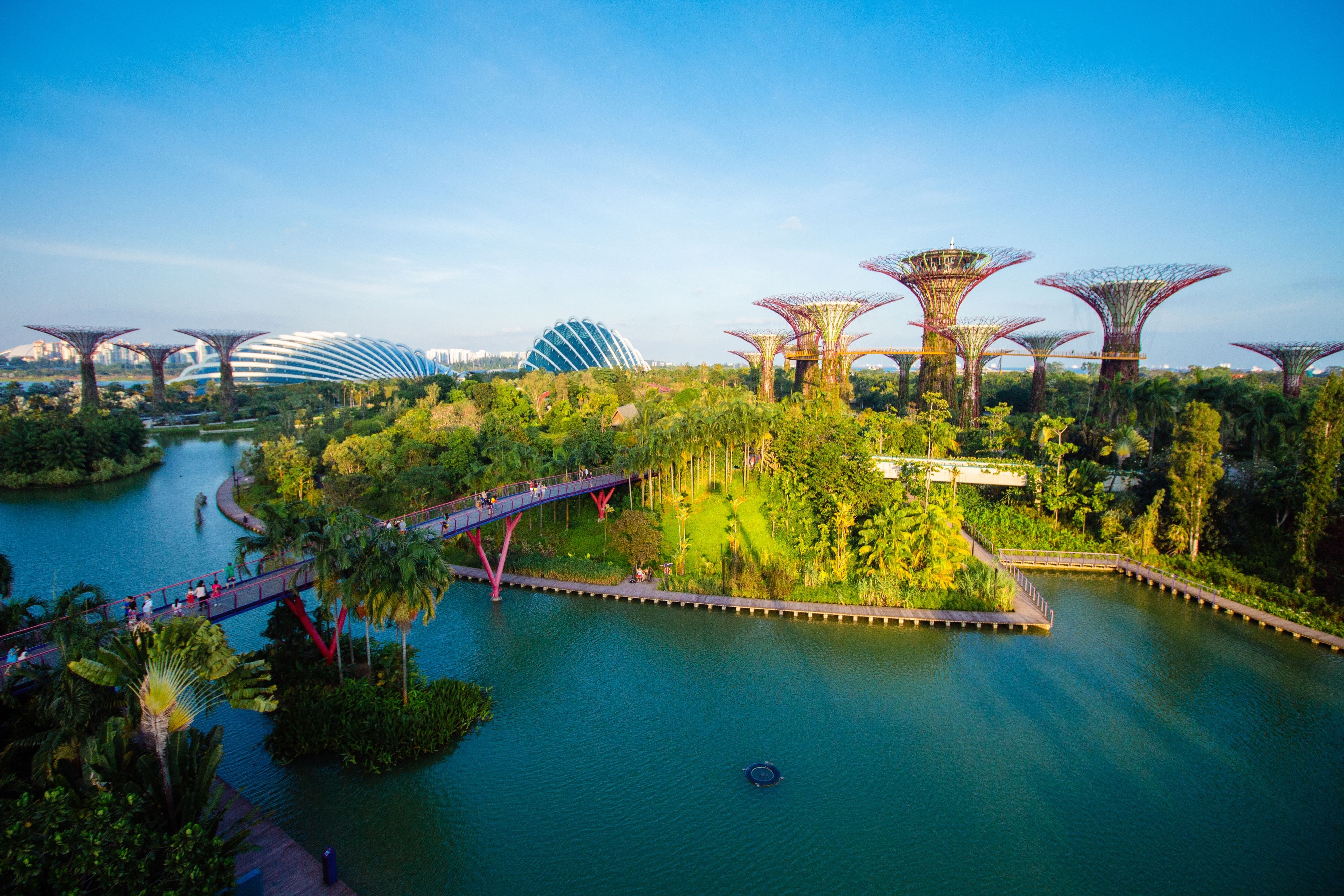
After you step off · near Hong Kong
You end in a different port — stay on, and add what is within reach before you fly home.