Your cruise
Silver Wind · 21-night Antarctica cruise, Puerto Williams to Buenos Aires
Mar 9 – Mar 30 · 21 nights ·
Day 1 Puerto Williams (board) · Day 2–3 Drake Passage · Day 4 Antarctic Peninsula · Day 5 Antarctic Peninsula · Day 6 Antarctic Peninsula · Day 7–8 at sea · Day 9 South Georgia · Day 10 South Georgia · Day 11 South Georgia · Day 12–13 at sea · Day 14 Port Stanley · Day 15 Saunders Island · Day 15 West Point · Day 16–17 at sea · Day 18 Puerto Madryn · Day 19–20 at sea · Day 21 Buenos Aires · Day 22 Buenos Aires (step off)
What you do Hike into the world's southernmost trekking circuit with a Yaghan-country guide — jagged peaks, wind-carved lenga forest, and a silence found almost nowhere else.
What to expect You start at dawn from the trailhead above town, climbing through native lenga forest into open alpine terrain with views over the Beagle Channel and toward Cape Horn. Your guide reads the notoriously fast-changing weather and adjusts the route in real time. Expect scree, wind, and total isolation — this is genuine backcountry, not a groomed path. You return by late afternoon having stood somewhere very few travelers ever reach.
Good to know Full day, 7-9 hours; requires solid fitness and layered wind/waterproof clothing. Book at least a few days ahead so the guide can plan around weather. Confirm return timing against your ship's all-aboard with real margin — this is not a trip to cut close.
Versus the ship tour Small-group or fully private, paced to your fitness, led by a guide who has summited the full 5-day circuit dozens of times and knows exactly which day-hike window gives the best light on the peaks.
What you do A small anthropological museum devoted to the Yaghan people, the world's southernmost indigenous culture — the single best hour for understanding what this place actually is.
What to expect Photographs, bark canoes, harpoons, and ceremonial objects trace the Yaghan from pre-contact life through the near-erasure that followed European arrival. Wall text is candid about that history rather than sanitized. The museum is small enough to take slowly — 45 minutes to an hour is plenty, and it rewards quiet attention over a rushed pass-through.
Good to know Located a short walk from the pier in town center; open weekday mornings and afternoons, hours can shift seasonally so confirm before you go. Pair it with a walk through the town itself — it's a five-minute stroll to see the actual settlement, not a manufactured attraction.
Versus the ship tour No crowds, no script — just you, the exhibits, and often a curator or Yaghan descendant willing to talk if you ask. This is the human context that makes everything else you see in Puerto Williams make sense.
book direct with Museo Antropológico Martín Gusinde → · the full guide →
What you do A private boat out into the Beagle Channel to sea lion colonies and seabird rookeries, at the unhurried pace only a small private craft allows.
What to expect You leave from the small craft harbor and cross toward Lobos Island, where South American sea lions haul out in loud, chaotic colonies along the rocks. Cormorants, skuas, and steamer ducks work the shoreline at Pájaros Island nearby. The channel itself, framed by the Dientes peaks, is as much the show as the wildlife. Expect cold spray and a guide who knows the animals' patterns well enough to time the approach.
Good to know Runs 2.5-3 hours; dress for open water and wind even on a calm day. Best booked directly a few days ahead since boat capacity is small. Time your return with real buffer before reboarding.
Versus the ship tour A private or near-private zodiac rather than a packed excursion boat means your skipper can idle beside a colony as long as the light and animals cooperate, and swing past channel scenery en route.
What you do A half-day trek to a hanging glacier and its iceberg-flecked lake, close enough to town for a half-day but wild enough to feel like Patagonia's edge.
What to expect The route climbs steadily through beech forest and open peat bog before reaching the lake, where small icebergs calved from Vinciguerra drift in blue-green water. The glacier itself sits above, streaked and crevassed against the ridgeline. It's a genuine trek — muddy, occasionally steep — but shorter and more accessible than the full Dientes circuit.
Good to know About 4-5 hours round trip; waterproof boots matter far more than technical gear here. Confirm pickup timing from the pier area directly with the operator, and build in a margin for the return before all-aboard.
Versus the ship tour Small-group, expert-led trek with a guide who explains the glacier's retreat and the peat-bog ecosystem underfoot, rather than a quick photo-stop drive-by.
What you do A private 4x4 run along the island's last stretch of road, tracing the Beagle Channel to the literal end of civilization on Isla Navarino.
What to expect The gravel road hugs the Beagle Channel coastline west of town, with Argentina's Ushuaia visible across the water and the Darwin Range beyond. You pass small Yaghan and Chilean settlements before reaching Puerto Navarino, a handful of buildings marking the end of the road system on the island. Condors and caracaras are common along the route, and your guide narrates the region's remote settlement history.
Good to know Roughly 3-4 hours round trip on unpaved road; a private vehicle is the only sensible way to do this given how few people are ever out here. Book ahead since vehicles and guides are limited on the island.
Versus the ship tour Private vehicle and guide means you stop wherever the channel views or a condor sighting demands, rather than following a fixed group itinerary.
What you do A steep, short climb straight above town to a viewpoint over the Beagle Channel, Ushuaia, and the Dientes peaks — best done early before the wind picks up.
What to expect The trail climbs hard through lenga forest for about an hour, gaining real elevation fast, before opening onto a wind-scoured ridge marking the start of the Dientes circuit. From the top, the entire Beagle Channel spreads out with Ushuaia visible across the water and the jagged Dientes ridge behind you. It's steep enough to feel earned but short enough to fit before a mid-morning excursion or lunch.
Good to know About 2-3 hours round trip; trailhead is a short taxi ride from the pier. Go as early as your ship's schedule allows — the wind here is a genuine factor by midday, not a minor annoyance.
Versus the ship tour A private early-morning start with a local guide gets you the summit in calm light, before the afternoon wind that regularly hits 40+ knots makes the ridge unpleasant.
What you do Glide in silence through the Lemaire Channel — Antarctica's most dramatic waterway — flanked by 900-metre cliffs and jewel-blue icebergs. A private Zodiac puts you inches from the ice, at your own pace, with a dedicated polar guide.
What to expect Your dedicated Zodiac departs before the larger groups, giving you first light on the channel's glassy surface. The guide narrates the geology of the towering Booth Island cliffs and identifies wildlife — Weddell seals, crabeater seals, humpback whales — in real time. You may cut your engine entirely and simply listen to the crack and groan of ancient glacial ice. The scale of the icebergs, some the size of apartment blocks, is genuinely awe-inspiring at water level.
Good to know Book the private Zodiac upgrade directly with Quark at the pre-expedition briefing or in advance via your expedition coordinator. Weather windows in the Lemaire are narrow — activity typically runs 06:00–10:00 before afternoon winds pick up. All-aboard times are set per itinerary; your guide tracks timing. Drysuits or expedition outerwear are provided.
Versus the ship tour A private Zodiac — just your group and one expert naturalist guide — means you can linger beside a grounded iceberg cathedral, drift silently past dozing leopard seals, and turn back only when you're ready. Unscripted, unhurried, and impossible to replicate from a ship's deck.
book direct with Quark Expeditions (direct add-on activity) → · the full guide →
What you do Spend a night sleeping on the Antarctic continent itself — bivouacking on the snow with nothing between you and the polar sky. It is the rawest, most intimate encounter with the seventh continent possible.
What to expect After a late Zodiac transfer ashore, your expedition team selects a sheltered snow basin away from wildlife colonies. You dig your own sleeping hollow, receive a full polar bivouac kit, and settle in as the sun dips to the horizon in a blaze of gold and rose (it never fully sets in austral summer). The silence is total. Dawn brings a private sunrise over the ice sheet and a warm breakfast back aboard. Most guests describe it as a life-defining night.
Good to know Spaces are strictly limited — typically 12–18 guests per night. Pre-book this add-on before departure as it sells out months in advance. Temperatures can reach -10°C or below; full cold-weather layering is essential and a kit list is provided. Not suitable for guests with severe mobility limitations. Confirm your booking directly with Aurora Expeditions at time of expedition reservation.
Versus the ship tour Fewer than a few dozen people on Earth sleep on the Antarctic ice on any given night. This is a true bivouac — no tents, just a bivvy bag on the snow — curated by expert polar guides who brief you on safety, glaciology, and the extraordinary soundscape of a continent after dark.
book direct with Aurora Expeditions (direct camping add-on) → · the full guide →
What you do Paddle a sea kayak through Paradise Bay — widely regarded as Antarctica's most beautiful anchorage — threading between turquoise icebergs and beneath calving glacier faces in complete silence. A bucket-list experience that fewer than 1% of Antarctica visitors attempt.
What to expect Small groups of 8–12 paddlers depart with two certified kayak guides who deliver a full safety and paddle briefing beforehand. You navigate slowly through bergy bits and brash ice, guided toward the best positions to watch glacier calving events and spot Gentoo penguins porpoising around your hull. The cold air and crystalline water make colours almost unreal — cobalt blues, mint greens, and pure white. Sessions last approximately 2–3 hours.
Good to know Pre-registration for the kayaking programme is required before embarkation — it cannot be added last-minute. Prior kayaking experience is recommended but not mandatory; guides adapt to skill level. Full drysuits, paddle jackets, gloves, and flotation devices are provided. Weather and ice conditions may occasionally require schedule changes — your guide will advise. Minimum age typically 16.
Versus the ship tour Seated at water level in a stable sea kayak, you experience the scale of Antarctic ice in a way no Zodiac can replicate — the silence is profound, the proximity to bergs is extraordinary, and the physical act of paddling gives you an embodied connection to this wilderness that is rare and deeply moving.
book direct with Oceanwide Expeditions (direct kayaking programme) → · the full guide →
What you do Hike to a clifftop ridge above Orne Harbour for a breathtaking overhead view of a vast chinstrap and Gentoo penguin rookery — one of the most dramatic wildlife spectacles on the planet. You are surrounded, on all sides, by thousands of penguins.
What to expect After a Zodiac landing on the shingle beach, a naturalist guide leads a 30–45 minute hike up a snow slope to the ridgeline. The effort is moderate and utterly worth it. At the top, chinstrap penguins nest within arm's reach of the path (IAATO rules require a 5-metre respectful distance, but penguins are famously indifferent to it). The noise, the smell, the sheer theatre of penguin life — courtship displays, chick feeding, the endless highway of birds tobogganing on their bellies — is overwhelming in the best possible way.
Good to know This landing is weather and ice dependent. Wear waterproof, ankle-supporting boots — the slope can be icy. Trekking poles are recommended and available from the ship's gear store. IAATO biosecurity protocols require boot washing before and after each landing; allow 10 minutes at the gangway. All-aboard times are strictly observed; your guide will give clear time checks throughout.
Versus the ship tour The ridge hike is physically rewarding and the payoff is staggering: a 360-degree panorama of the Peninsula's mountains, the Gerlache Strait, and an enormous penguin colony spilling across the cliffs below you. Expert ornithologist guides provide real-time natural-history commentary that transforms wildlife watching into genuine understanding.
book direct with Hurtigruten Expeditions (direct shore landing) → · the full guide →
What you do Step ashore at Port Lockroy — a perfectly preserved British wartime base from 1944, now a living museum and the world's most southerly working post office. Send a postcard stamped from Antarctica and walk through 80 years of polar history.
What to expect A Zodiac delivers you to the wooden jetty of Goudier Island, where you are met by UKAHT staff who share the remarkable story of Operation Tabarin, Britain's wartime Antarctic mission. The base interior — preserved as it was in the 1950s — includes the original radio room, kitchen, and sleeping quarters. Outside, Gentoo penguins nest undisturbed between the guy-ropes and equipment. The post office queue is part of the ritual: your postcards, hand-stamped with the Port Lockroy postmark, will arrive home weeks later — a perfect memento of an unrepeatable journey.
Good to know Landings are strictly managed by UKAHT to protect the colony; visitor numbers at any one time are capped. Your expedition ship will coordinate a timed landing slot. Cash (GBP or USD) or card payments are accepted in the shop. Post your cards on-site — they are collected by the next supply vessel. Port Lockroy operates only during the austral summer (November–March).
Versus the ship tour Port Lockroy is one of only a handful of staffed heritage sites in Antarctica, manned by a rotating team of four UKAHT staff each austral summer. Its authenticity — original 1940s radio equipment, bunk beds, tinned rations — is extraordinary. The Gentoo penguin colony nesting literally inside the compound fence adds a surreal, joyful dimension found nowhere else on Earth.
book direct with UK Antarctic Heritage Trust (Port Lockroy official operator) → · the full guide →
What you do Plunge into the near-freezing waters of the Southern Ocean and earn your place in the legendary Polar Plunge Club — one of Antarctica's most exhilarating rites of passage. Shared with a handful of fellow adventurers, it is an elemental, unforgettable minute.
What to expect Dressed in nothing but a swimsuit (and bravado), you step off the Zodiac platform and drop into water that hovers between -1°C and +2°C. The cold is instant, total, and magnificent. Safety lines and guides are in the water alongside you; the entire dip lasts 30–60 seconds. Warm towels, hot drinks, and the roar of your fellow travellers greet you back aboard. A personalised Polar Plunge certificate is presented at the evening recap. The adrenaline lasts for hours; the story, for life.
Good to know Participation is entirely voluntary and a doctor's sign-off is recommended for guests with cardiovascular conditions. The plunge is typically scheduled mid-expedition when the ship is anchored in a sheltered bay. Warm layers and a dry change of clothes should be ready immediately post-dip. Antarctica21 fly-cruise departures operate from Punta Arenas, Chile, reducing total travel time significantly — ideal for time-conscious luxury travellers.
Versus the ship tour Antarctica21's fly-cruise format means you skip the Drake Passage entirely and maximise your peninsula time — the polar plunge takes place from a Zodiac platform or ice floe in a protected bay, supervised by expedition doctors and safety-certified guides, making it as safe as it is spectacular.
book direct with Antarctica21 (direct expedition activity) → · the full guide →
What you do Ride deep into the Falklands' wild coastline in a private 4×4 to reach Bertha's Beach — a pristine arc of white sand hosting the Falklands' most accessible, photogenic Gentoo penguin colony. A bucket-list wildlife encounter at the end of the world.
What to expect Your guide collects you at the port in a dedicated 4×4 and navigates a mix of tarmac and rugged off-road tracks to reach Bertha's Beach, named for a historic shipwreck visible at low tide. On the wide, wind-sculpted strand you'll walk among hundreds of Gentoo penguins — curious, fearless, and utterly unhurried. Your guide provides naturalist commentary on behaviour, breeding cycles, and Falklands ecology. Snacks and water are included; the return journey follows the scenic coastline back to Stanley in time for all-aboard.
Good to know Pre-book directly before your ship arrives — private slots sell out fast on busy port days. Allow 4–5 hours. Wear waterproof layers and sturdy footwear; the beach can be boggy. Snack and water provided; port pick-up and drop-off included.
Versus the ship tour Fully private 4×4 vehicle with a professional English-speaking local guide means you set the pace — linger with the penguins as long as you wish, with no coach group crowding the beach around you.
book direct with Top Private Tours Falklands (Local Expert) → · the full guide →
What you do Walk a legendary minefield-turned-wildlife-sanctuary to encounter Magellanic penguins burrowing in the dunes at Gypsy Cove, then continue to Yorke Bay's bone-white beach for close-up encounters with Gentoo colonies — two species, one extraordinary morning.
What to expect You depart Stanley in a private van and reach Gypsy Cove within minutes — a sheltered bay where Magellanic penguins nest in grass-covered burrows just metres from the path, indifferent to onlookers. Your guide explains how the surrounding beach, still off-limits due to Argentine mines from 1982, has accidentally become a perfect wildlife sanctuary. The convoy then rolls on to Yorke Bay for Gentoos on a spectacular white-sand beach, with the chance to spot upland geese, steamer ducks, and black-crowned night herons en route. The return offers panoramic views across Stanley Harbour and the rusting hulks of historic sailing ships.
Good to know Book well ahead via Tripadvisor message or email — Lucky Private Tour operates in small groups only and fills quickly on ship-call days. Tours typically run 3–4 hours. Minefield perimeter fencing is clearly marked and safe; stay on designated paths. Dress in windproof layers.
Versus the ship tour Small private group with Glenn and team — veteran local guides who share intimate knowledge of Falklands wildlife, history, and landscape, moving at your pace rather than a timed group itinerary.
book direct with Lucky Private Tour Falklands → · the full guide →
What you do Journey across the dramatic moorland battlefields of Goose Green, Mount Longdon, and Tumbledown with a specialist local guide whose family lived through the 1982 conflict — a deeply moving, once-in-a-lifetime immersion into modern military history.
What to expect Leaving Stanley by 4×4, you cross rolling Camp landscape to Goose Green and Darwin, site of the first major land battle of the war. Your guide shares first-hand community accounts of the Argentine occupation and the British Task Force's advance, standing on the very ridgelines where paratroopers fought. Memorial crosses, rusting materiel, and Argentine cemeteries provide sombre, powerful context. You return via the outskirts of Stanley to view the Liberation Monument and 1982 Mine Clearance memorial before arriving back at the pier. A full-day commitment, but the most historically resonant experience in the South Atlantic.
Good to know Full-day tours (7–8 hours) require an early departure — confirm all-aboard time with your ship and communicate it to your operator. Some tracks are rough; 4×4 essential. Book via the official Falkland Islands Tourism operator directory at falklandislands.com well in advance.
Versus the ship tour Access to Darwin and Goose Green — well beyond Stanley town — is only possible by private vehicle. A guide with personal and family ties to the conflict brings history alive in a way no standard group tour can replicate.
book direct with Falkland Islands Tour Guides (Official Local Operators) → · the full guide →
What you do Explore the remarkably intact Victorian capital of the Falklands on foot with a local historian — a colourful mile of painted iron-clad houses, the world's most southerly Anglican cathedral, and the iconic rusting iron sailing ships rotting majestically in the harbour.
What to expect Beginning at the historic Government Pier, your guide leads you along Ross Road — the heart of Stanley — past colourful corrugated-iron homes and the landmark Whalebone Arch (formed from two blue whale jawbones). You step inside Christ Church Cathedral, the world's southernmost Anglican cathedral, before reaching the museum where Falklands War artefacts and natural history exhibits provide rich context. The walk ends at the harbour's edge where the iron hulks of 19th-century sailing ships — including SS Great Britain's sister vessels — list in the shallows, slowly becoming part of the landscape. Allow time for Stanley's independent boutiques and a warming cup of tea.
Good to know Walking tours typically run 2–3 hours and operate in nearly all weather — dress in windproof, waterproof layers regardless of forecasts. The route is mostly flat and paved. Book via falklandislands.com's local operator directory before your port call.
Versus the ship tour An intimate, on-foot exploration led by a local resident who can unlock the stories behind every facade — the whaling era, the wool trade, and the quiet daily life of one of the world's most remote communities.
book direct with Falkland Islands Tour Guides (Official Local Operators) → · the full guide →
What you do Fly by light aircraft to Sea Lion Island — the Falklands' premier wildlife destination — to witness Southern elephant seals, sea lions, five penguin species, and nesting black-browed albatross on a single pristine island. The ultimate Falklands wildlife day.
What to expect A short transfer takes you to Stanley Airport where you board a FIGAS Islander aircraft for the flight south over tussac grass islands and sapphire channels. Landing on the grass airstrip, a lodge guide meets you for a full circuit of the island — elephant seals hauled out by the hundred on kelp-strewn beaches, Rockhopper, Magellanic, Gentoo, King, and Macaroni penguins within walking distance of each other, and black-browed albatross gliding on permanent six-foot wingspans overhead. Lunch at the Sea Lion Island Lodge is included. The return flight completes an utterly extraordinary day at the southern edge of the world.
Good to know This excursion requires early coordination with FIGAS (falklandislands.com) and Sea Lion Island Lodge well before your cruise departs — flight seats are very limited. Weather can delay small aircraft; confirm all-aboard time with your ship and allow a generous buffer. Not suitable for guests with severe mobility limitations.
Versus the ship tour Sea Lion Island is unreachable overland — the 20-minute flight in a small Islander aircraft is itself a bucket-list experience, offering aerial views of the archipelago. Visitor numbers are strictly limited, ensuring utterly crowd-free encounters with mega-fauna.
book direct with FIGAS – Falkland Islands Government Air Service → · the full guide →
What you do Drive to the wind-scoured eastern tip of East Falkland to stand at Cape Pembroke Lighthouse — the most easterly point of the Falklands, with the Atlantic stretching unbroken to South Georgia — and explore dramatic coastal scenery teeming with birds and marine wildlife.
What to expect Your private van departs Stanley and rolls east along a mix of sealed and gravel tracks through open moorland carpeted in white grass and cushion plant. Arriving at Cape Pembroke, the 1855 lighthouse stands sentinel above dramatic quartzite ridges tumbling into a cold, green sea. Your guide explains the lighthouse's role in guiding vessels around the treacherous eastern approaches to Stanley, and the extraordinary ornithology of the headland — giant petrels, rock shags, and Falkland thrushes are common sightings. On clear days, views extend south along the coastline past Yorke Bay to distant hills still marked on maps by the names of 1982 battles. A shorter half-day option that pairs beautifully with an afternoon in Stanley town.
Good to know A 2–3 hour half-day excursion — ideal as a morning or afternoon addition alongside a Stanley town walk. Tracks to the lighthouse can be muddy; wear waterproof footwear. Wind at the cape is often fierce — bring a windproof jacket regardless of sunshine in the harbour. Book via Lucky Private Tour on Tripadvisor.
Versus the ship tour The drive out to Cape Pembroke is through open Camp — the vast, treeless Falklands interior — with knowledgeable local guides pointing out upland geese, Falklands skuas, and peregrine falcons that most visitors never notice from a coach window.
book direct with Lucky Private Tour Falklands → · the full guide →
What you do Walk the narrow isthmus known as The Neck, where rockhopper penguins, king penguins, and black-browed albatross nest side by side on open dunes.
What to expect A Land Rover track drops you near the settlement, then it's a 45-minute walk across open ground to The Neck. Rockhoppers surf ashore in the kelp just below the albatross colony, and king penguins stand apart from the noisier rockhopper groups. The light here in the early morning, before other visitors arrive, is what people remember most.
Good to know Book ahead through the settlement office as landing numbers are capped; wear waterproof boots for the peat and sand track, and budget at least 3 hours round trip from the shore landing.
Versus the ship tour No boardwalks, no fences — you sit quietly on the dune grass at eye level with nesting albatross pairs while a farming family who has managed this land for generations tells you which nests are new this season.
book direct with Saunders Island Settlement (Pole-Evans family, official landowners) → · the full guide →
What you do A 4x4 ascent to Rookery Mount's clifftop colonies, reached by very few visitors due to the terrain and timing required.
What to expect You're driven in an open Land Rover up rough farm tracks with sweeping views over the settlement and Elephant Jason Island offshore. At the top, albatross wheel in on thermals right past your head, and skua and giant petrel nests dot the tussock below. Few ship groups make it up here given the time it takes.
Good to know Must be pre-arranged the day before via the settlement; weather-dependent and limited to small groups of 4-6 per vehicle, so confirm as soon as your call is scheduled.
Versus the ship tour This spot sits above the crowds at The Neck entirely — a private vehicle and a farmer-guide who knows exactly which gullies hold the black-browed albatross nests this year.
book direct with Saunders Island Settlement (Pole-Evans family, official landowners) → · the full guide →
What you do A quieter walk along the coast to a beach where elephant seals haul out to wallow, well away from the main penguin traffic.
What to expect The walk follows the shoreline past tussock stands where you'll likely spot Falkland steamer ducks and striated caracaras before reaching the wallow. Elephant seals lie in loose piles on the sand, occasionally rearing up to bellow at a rival. It's a raw, unmanicured scene, nothing like a managed wildlife park.
Good to know Ask the settlement for directions when you land — it isn't signposted like The Neck route; allow an extra hour and check tide times, as the best viewing is at low water.
Versus the ship tour Almost nobody walks this far — most visitors stop at The Neck — so you get the wallow largely to yourself, close enough to hear the bulls' guttural roars.
book direct with Saunders Island Settlement (Pole-Evans family, official landowners) → · the full guide →
What you do A short, honest walk through the working sheep station at the heart of Saunders Island, with a chance to talk to the family who actually lives there.
What to expect You'll walk past shearing sheds, peat stacks, and the small settlement buildings, with sheep dogs working nearby if it's the season. The Pole-Evans family, who have farmed here for generations, are often around to answer questions over tea in the old farmhouse. It's unpolished and genuine rather than staged for visitors.
Good to know Best done at the start or end of your landing since it's right by the beach; the tea room has limited seating so go early if the ship has a large group ashore.
Versus the ship tour This is the real Falklands most passengers never see — a working farm rather than a curated attraction, with a family happy to explain how they've managed this land since the 1800s.
book direct with Saunders Island Settlement (Pole-Evans family, official landowners) → · the full guide →
What you do A small-boat cruise around the offshore islets near Saunders, spotting seabirds, seals, and sometimes orca patrolling the kelp beds.
What to expect The zodiac leaves from the settlement jetty and threads along Saunders' northern cliffs, where cormorant colonies cling to the rock and fur seals bask at the waterline. Orca sightings near the kelp lines happen most seasons, though never guaranteed. It's a completely different vantage on the island than any land walk offers.
Good to know Weather and swell dependent, so this is often confirmed only the morning of your call; book through the settlement office as far in advance as your itinerary allows, and dress for spray.
Versus the ship tour A private boat and a Falklands skipper who reads the water, not a script — you go where the wildlife is that day rather than a fixed shore route.
book direct with Falkland Islands local skippers (arranged via Saunders Island Settlement) → · the full guide →
What you do A quiet coastal walk over rolling dunes to Saunders' expansive, empty white-sand beaches, away from the wildlife crowds at The Neck.
What to expect The path climbs gently over marram-grass dunes before opening onto a long stretch of pale sand backed by clear turquoise shallows, more reminiscent of the Caribbean than the Southern Ocean until the wind reminds you otherwise. Oystercatchers and the odd Magellanic penguin dot the shoreline. It's the best spot on the island for photographs without another visitor in frame.
Good to know Wear windproof layers even on a calm-looking day; this walk pairs well after The Neck if your landing window allows 4+ hours ashore.
Versus the ship tour This is the moment to slow down — no colony to manage or guide script to follow, just wind, dunes, and one of the emptiest beaches in the South Atlantic.
book direct with Saunders Island Settlement (Pole-Evans family, official landowners) → · the full guide →
What you do Walk to the Devil's Nose cliffs where black-browed albatross and rockhopper penguins nest side by side in tussac grass. One of the most intimate wildlife encounters left on earth.
What to expect You land by Zodiac at the tiny settlement, then walk roughly 30-40 minutes across sheep pasture and tussac to the cliff-top colony. Albatross pairs clatter bills overhead while rockhoppers scramble past on their commute to the sea. The Napier family, who have farmed the island for generations, often greet visitors and can point out nesting pairs and chicks depending on season.
Good to know Landing is entirely weather- and Zodiac-dependent; wear waterproof boots and windproof layers. Best October-March when albatross are nesting; time your return to the settlement carefully against your ship's last tender.
Versus the ship tour The colony sits an easy walk from the settlement with no barriers, no boardwalks, no crowds — just you a few feet from nesting albatross pairs preening each other.
book direct with West Point Island (Napier family, owners) → · the full guide →
What you do A homemade tea laid out by the island's farming family — the real texture of Falklands life, not a staged show. Cakes, scones, and unhurried conversation about running a farm at the edge of the world.
What to expect After the colony walk, visitors gather in the settlement's small sitting room or garden for tea, sandwiches, and homemade cake. The family is happy to talk about sheep farming, the island's history, and life with a population sometimes under ten people.
Good to know Cash only (GBP), and numbers are limited so it suits small groups best; this pairs naturally with the albatross walk earlier in the visit.
Versus the ship tour This is a private home, not a tourist café — you're a guest at the family's own table, hearing first-hand what it takes to farm 2,000 sheep on a windswept island with no roads to anywhere else.
book direct with West Point Island Settlement (Napier family) → · the full guide →
What you do A quiet, self-paced coastal ramble through dense tussac grass — a habitat that has vanished from most of the Falklands but survives here, sheltering birds you won't see from any ship deck.
What to expect The undulating path skirts pasture before dropping toward the cliffs, tussac towering overhead in places. Striated caracaras (the world's rarest bird of prey by some counts) are notoriously curious here and often approach walkers.
Good to know Sturdy waterproof footwear essential; ground is boggy in places. Allow 1.5-2 hours round trip and watch the tide/Zodiac schedule closely.
Versus the ship tour No trail markers, no other visitors on the path — just wind, seabirds, and one of the last intact tussac ecosystems in the archipelago.
book direct with West Point Island (self-guided, landowner permission) → · the full guide →
What you do A slow Zodiac run along the cliffs beneath the albatross colony, watching birds wheel and land at eye level from the water — a totally different vantage than the clifftop walk.
What to expect Departing from the settlement's cove, the Zodiac hugs the coastline beneath tussac-covered slopes, pausing under the colony for birds returning from fishing trips. Sea lions and occasional Commerson's dolphins are seen along this stretch.
Good to know Weather-dependent and not always offered; ask on landing. Bring a dry bag for cameras — spray is constant.
Versus the ship tour Small Zodiac groups of six to eight let you drift right beneath the nesting cliffs, seeing the colony's scale from below in a way the clifftop path can't show.
book direct with Expedition team arranged via West Point Island landing operator → · the full guide →
What you do A private, unhurried session with a Falklands-based naturalist guide who knows exactly where the light and the birds align on West Point that day.
What to expect Your guide positions you low and downwind of nesting albatross for portraits, then times the walk back to catch caracaras at their most active. Expect detailed natural history commentary throughout, well beyond what a general landing talk offers.
Good to know Book ahead through the island's tour coordination since guide availability is limited and tied to ship schedules; bring a telephoto lens.
Versus the ship tour A private guide adjusts pace entirely around light and animal behaviour rather than a group timetable, which is what separates a good photo and a bucket-list one.
book direct with Falklands Nature (independent local naturalist guides) → · the full guide →
What you do A short, candid look at the working wool shed that has sustained West Point's single family for generations — an honest glimpse of Falklands rural economy, not a museum piece.
What to expect A brief walk through the shearing shed and outbuildings, with the family explaining the annual shearing cycle, wool export logistics, and what daily life demands in one of the most remote inhabited places in the world.
Good to know Best combined with tea and the albatross walk as part of a single visit; shed access depends on the family's availability that day.
Versus the ship tour This is a functioning shed on a working farm, explained by the people who actually run it, not a re-created heritage display.
book direct with West Point Island Settlement (Napier family) → · the full guide →
What you do A private full-day deep dive into Península Valdés UNESCO reserve — elephant seals, Magellanic penguins, sea lions, and the legendary orca strandings beach. Patagonia's greatest wildlife spectacle, entirely at your own pace.
What to expect Your private guide collects you at the port and drives you deep into the UNESCO biosphere reserve, stopping first at Punta Norte — the gravel beach where orcas intentionally strand to ambush sea lions (seasonal, Apr–May). You then wind south to the dramatic Caleta Valdés lagoon to watch elephant seals spar in the surf. The afternoon is spent at Puerto Pirámide for a whale-watching boat ride, before a sunset return along the empty steppe road with rheas and guanacos alongside you.
Good to know Full-day tour runs approximately 10 hours — confirm all-aboard time with the ship and book the earliest departure. Orcas are most active April–May; southern right whales June–December; elephant seals and penguins year-round. Reserve entrance fee (approx. USD 20 pp) is additional. Pre-book directly — Sentir Patagonia is a well-regarded Puerto Madryn specialist confirmed by cruise travellers.
Versus the ship tour Fully private vehicle and dedicated bilingual naturalist guide means you linger where the wildlife is — no herding, no waiting. Access to Caleta Valdés lagoon and Punta Cantor orca beach that small-group tours skip entirely.
What you do Punta Tombo hosts the largest Magellanic penguin colony in South America — half a million birds. A private guided excursion places you on the boardwalk trails at the colony's quietest hours, walking shoulder-to-shoulder with penguins in their nesting burrows.
What to expect The 180 km drive south from Puerto Madryn crosses open Patagonian steppe — guanacos, maras (Patagonian hares) and Darwin's rheas dot the roadside. At the reserve, marked paths wind directly through the nesting colony: penguins waddle past your feet, completely unafraid. Your guide narrates breeding cycles and points out chick-feeding moments. A box lunch on the coast with Atlantic views rounds off the morning before the return drive.
Good to know Allow 7–8 hours door-to-door — verify against your all-aboard time carefully. Penguin colony is active September through March (breeding season at its peak October–November). Park entrance is included in the quoted price. Direct booking via Madryn Travel locks in the guide and vehicle; walk-ins are not accepted at the reserve gate without pre-payment.
Versus the ship tour Private or small-group departure means you arrive before the crowds peak and stay as long as the birds demand. Your naturalist guide reads penguin behaviour and takes you off the main tourist trail to quieter colony sections for genuine wildlife photography.
What you do Slip beneath the surface of the Golfo Nuevo and come face-to-face with playful South American sea lions at their natural rookery. Madryn Buceo's expert dive guides lead small groups to the sea lions' favourite underwater ledges for an encounter that will redefine wildlife swimming.
What to expect A short transfer brings you to Punta Loma, where a briefing covers sea lion behaviour and snorkel technique. You enter calm, crystalline Golfo Nuevo water (wetsuits provided) and within minutes a colony of 600+ sea lions is spiralling around you — barrel-rolling, blowing bubbles, and staring you down with enormous eyes. Certified divers can opt for the full scuba experience at 8–15 metres depth, where the sea lions perform acrobatics around kelp columns. The whole in-water session lasts 45–60 minutes.
Good to know Morning slots (departing ~09:00) have the best sea lion activity and visibility. The excursion takes approximately 3.5 hours total — very manageable against most all-aboard times. Wetsuits, masks, fins, and tanks (for divers) are all included. No prior dive certification needed for snorkelling. Book directly via madrynbuceo.com well in advance — slots sell out when multiple ships are in port.
Versus the ship tour Groups are capped at 6–8 participants maximum, ensuring every guest gets genuine one-on-one time with the sea lions — not a crowded pool scenario. PADI-certified dive masters with 15+ years of Punta Loma experience know exactly which ledges the sea lions favour.
What you do Puerto Madryn sits at the edge of one of the world's great whale nurseries. Board a Zodiac inflatable with a marine biologist guide for an intimate encounter with 40-tonne southern right whale mothers and calves just metres from the boat — bucket-list Patagonia.
What to expect Departing from Puerto Madryn's protected bay, the Zodiac heads to known aggregation zones within Golfo Nuevo where southern right whales (June–December) come to breed and calve in warm, sheltered water. The guide cuts the engine as whales approach and you watch breaching, lob-tailing, and spy-hopping from metres away. On the return, look out for Commerson's dolphins riding the bow wave — a bonus spectacle unique to Patagonian waters.
Good to know Season is June through December; peak activity July–October for calves. Morning departures offer calmer sea conditions. Transfer from the port is just 5 minutes on foot. Allow 2.5 hours total. Life jackets and waterproof ponchos provided — bring a layer as Golfo Nuevo can be brisk. Book directly with Hydrosport as they are the longest-established operator on the bay.
Versus the ship tour Zodiac inflatables sit at water level — whales surface alongside you at eye height, not from a tall-sided vessel. The marine biologist on board provides real scientific context and uses hydrophones to pick up whale song in real time.
What you do The Fundación Ecocentro is Patagonia's most architecturally striking marine interpretive centre — cliffside, whitewashed, with floor-to-ceiling Atlantic views. An intimate, unhurried deep-dive into the science and poetry of the Patagonian Sea.
What to expect Set on a rocky promontory south of the town centre, the Ecocentro's galleries trace the full ecological story of the Patagonian Sea — from microscopic krill to blue whales — through immersive displays, specimen collections, and artist-in-residence installations. The cylindrical reading tower is stocked with marine biology texts and offers 360° panoramas over the Golfo Nuevo; during whale season (June–December) southern rights are visible from the windows. The café serves locally roasted coffee and Patagonian pastries. Allow 90 minutes.
Good to know A 20-minute walk south along the coastal promenade from the port, or a 5-minute taxi. No advance booking required but check seasonal opening hours at ecocentro.org.ar before your call. An ideal complement to a morning whale-watching or sea lion excursion — pair the two for a full, unhurried Patagonian day. Closed Tuesdays.
Versus the ship tour A rare blend of world-class marine science, contemporary art and coastal architecture — the reading tower alone, overlooking the open Atlantic with whale-watching telescopes, is worth the visit. Self-paced and beautifully curated for curious, discerning travellers.
What you do Playa El Doradillo is one of the only places on Earth where southern right whales come within metres of the beach to play in the shallows. Stand on the gravel shore and watch 40-tonne giants surface, breach, and spy-hop in waist-deep water — no boat required.
What to expect The drive north from Puerto Madryn to Doradillo takes just 15 minutes, arriving at a wild gravel beach facing the open gulf. Between June and December, southern right whale mothers bring their calves into the shallows to rest and socialise — at times you can hear them exhaling before you see them. Your guide walks the beach with you, identifying individual whales by their callosities (the rough skin patches unique to each animal) and narrating their biology. The panoramic Patagonian steppe backdrop — vast skies, ochre cliffs, zero crowds — makes for an elemental, utterly memorable experience.
Good to know Strictly seasonal: June through December, with July–October being the prime window. Allow 3 hours total including transfer. Combine with the Ecocentro (just 10 minutes south) for a perfect half-day pairing. Wear layers and wind-resistant clothing — the beach is exposed. No park fee required. Book the guided transfer via Madryn Travel to ensure the guide knows current whale positions along the beach.
Versus the ship tour No vessel, no seasickness, no barriers — just open Patagonian sky and whales at arm's length in the surf. A knowledgeable guide reads whale behaviour and positions you for the best sightlines along the 4 km beach. The photography opportunities are extraordinary.
What you do Step inside one of the world's top five opera houses, where gilded tiers, a sky-blue ceiling and acoustics second to none have awed audiences since 1908. A private guided tour reveals backstage secrets before you take your seat for a world-class performance.
What to expect Your bilingual expert guide leads you through the ornate foyers, the seven-tier auditorium dripping in red velvet and gold leaf, and the vast underground workshops where set designers and seamstresses craft every production by hand. You'll hear fascinating stories of the divas, scandals and triumphant premieres that shaped Argentina's cultural identity. In the evening, take your premium seat and let a world-class company perform beneath the magnificent painted dome. The standing ovation will give you goosebumps.
Good to know Book guided tours and performance tickets directly on the official website well in advance — top performances sell out months ahead. The theatre is a 20-minute taxi or Uber from the Puerto Madero cruise terminal. Check all-aboard time carefully; a daytime tour works easily for a port day, while an evening performance suits overnight calls.
Versus the ship tour Exclusive behind-the-scenes access to rehearsal halls, costume workshops and the main stage — a perspective almost no visitor secures — followed by a live ballet, opera or orchestral concert in one of the planet's most breathtaking acoustic spaces.
book direct with Teatro Colón (official) → · the full guide →
What you do Learn the languid drama of the tango with a private maestro before a gourmet Argentine dinner and a world-class milonga show at Buenos Aires' most storied venue. This is tango as a living art form, not a tourist spectacle.
What to expect Arrive early for a private or semi-private tango lesson in a mirrored studio, where a professional dancer breaks down the embrace, the pause, the pivoting drama of each step. The colonial-stone main hall fills with candlelight as a full orchestra of bandoneons, violins and piano strikes up the first compás. Six to eight elite dancers command the floor in a two-hour show of classic and contemporary tango, followed by a three-course asado-inspired dinner with premium Malbec. The intimacy of the venue means every table has a front-row feel.
Good to know Book dinner + show directly on the website; request a private lesson by emailing the venue. The San Telmo location is a 15-minute taxi from the cruise terminal. Evening shows suit overnight or late-departure port calls — confirm all-aboard time before booking.
Versus the ship tour El Viejo Almacén is the authentic 1860s colonial warehouse where tango was born — one of the very few venues where dancers, bandoneonists and singers are career artists, not performers on a circuit. A private lesson with an in-house maestro before the show transforms you from spectator to participant.
book direct with El Viejo Almacén (official) → · the full guide →
What you do Wander the marble city of the dead alongside a local historian who unlocks the stories of Argentina's oligarchs, generals and one legendary First Lady. Continue into elegant Palermo for boutique-lined streets and a table at a celebrated wine bar.
What to expect Your guide meets you at the ornate entrance to Recoleta Cemetery and navigates its labyrinthine avenues of mausoleums — grand neo-Gothic chapels and Art Deco tombs jostling for eternity. You'll pause at Evita Perón's understated tomb and hear the full, complex story that Hollywood simplified. Strolling into Palermo, the city transforms: jacaranda-shaded streets, independent design boutiques, and a curated stop at a wine bar for an Argentine varietal tasting paired with local charcuterie. The pace is entirely yours — nothing is rushed.
Good to know Book directly on the BuenosTours website and specify private if you prefer a solo-group experience. Wear comfortable walking shoes; the cemetery's cobblestone lanes are uneven. The route is roughly 4–5 hours and easily completed before a late-afternoon all-aboard.
Versus the ship tour BuenosTours' expert-led small-group and private walks are conversational and unhurried — guides are historians and cultural insiders who read the city's architecture, social tensions and politics with the fluency of a native novel. This is Buenos Aires understood, not just seen.
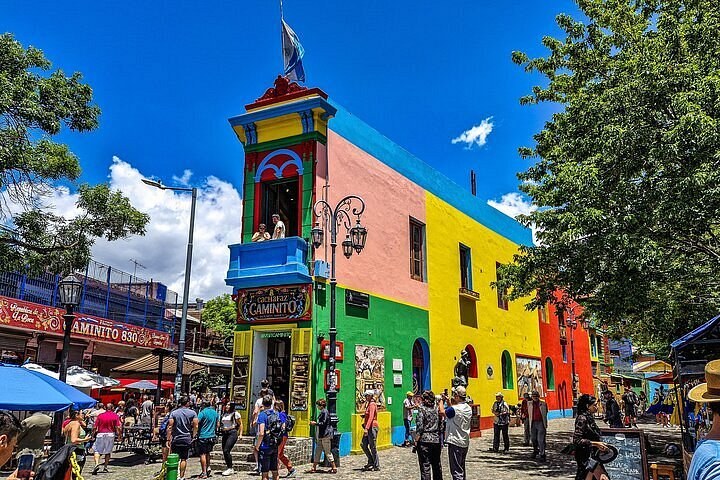
What you do Lose yourself in the kaleidoscopic corrugated-iron streetscape of Caminito before weaving through the cobblestoned artisan stalls and tango buskers of San Telmo's legendary Sunday fair — curated with a private guide who knows every back alley.
What to expect You arrive at Caminito as the morning light floods the vivid zigzag of zinc facades — Maria positions you for the photographs that don't appear on postcards. She introduces you to local artists selling in the street-level galleries and explains how this working-class barrio became Argentina's most painted neighbourhood. In San Telmo, the Sunday fair's hundreds of stalls overflow with silverwork, Art Deco porcelain and vintage leather; Maria steers you away from tourist trinkets to the antique dealers serious collectors frequent. The tour ends with a cortado and medialunas at a corner café that has served the neighbourhood for decades.
Good to know The Sunday San Telmo Fair operates 10:00–17:00 — this excursion is best on Sundays. Book directly via the Go Ask a Local website. La Boca has a concentrated tourist zone; staying with a local guide is both the safest and richest way to explore. Allow 4–5 hours; taxis back to the cruise terminal take approximately 15 minutes.
Versus the ship tour Maria is a lifelong Porteña whose insider knowledge transforms a walk through La Boca and San Telmo into a layered cultural narrative — from immigrant Italian dock workers painting their houses in leftover ship paint, to the milongas where tango evolved in tenement courtyards. You move at your own pace, off the tourist current.
book direct with Go Ask a Local – Maria's Private Buenos Aires Tours → · the full guide →
What you do Escape the city entirely on a private launch into the Paraná Delta — an Amazonian labyrinth of willow-shaded waterways, weekend villas and rowing clubs just 30 km from the capital. Lunch aboard or at a delta restaurant as the current does the work.
What to expect A private transfer north from Puerto Madero delivers you to the Tigre waterfront in under an hour. Your boat glides into channels shaded by ceibo trees and trailing willows, past brightly painted weekend houses accessible only by water. The captain points out native birds — kingfishers, herons, monk parakeets — as you drift deeper into the labyrinth. Lunch at a riverside restaurant means grilled river fish, provoleta and cold Torrontés as speedboats and kayakers pass in the dappled light. The return journey offers a completely different perspective of the channels as the afternoon light turns amber.
Good to know The Tigre Delta excursion takes approximately 6–7 hours return including transfer; confirm all-aboard time before booking. Apply sunscreen and bring a light layer — the delta breeze on the water can be cool even in summer. Book the private boat option directly by contacting Shore Excursions Group or a local Tigre operator for the most exclusive experience.
Versus the ship tour A private launch gives you total control of pace and itinerary — your captain navigates narrow channels the larger excursion boats cannot reach, and you stop where you choose: a riverside fruit vendor, a 19th-century rowing club, a vine-covered restaurant on stilts. The delta reveals an Argentina almost no cruise passenger sees.
book direct with Shore Excursions Group – Tigre Delta & River Cruise → · the full guide →
What you do Ride out to a working Pampas estancia for a full-day immersion in gaucho culture: watch expert horsemen perform, try a polo lesson, and feast on a traditional wood-fired asado with unlimited Malbec beneath an open sky.
What to expect A private transfer (approx. 90 minutes) delivers you through the flat, endless horizon of the Pampas to La Mimosa's white-painted colonial ranch house. Gauchos in traditional bombachas and berets demonstrate horsemanship with staggering precision, and guests are warmly invited to ride alongside. A polo introduction on gentle horses is led by an estancia instructor. The centrepiece is the asado: whole ribs, chorizo, morcilla and sweetbreads char-grilled over quebracho embers, served with chimichurri, salads and flowing Malbec at long communal tables. The afternoon slows to the rhythm of the Pampas — folk music, mate, and the longest horizon you've ever seen.
Good to know Transfer to La Mimosa takes approximately 90 minutes each way — this is a full-day excursion best suited to port days with a late-evening all-aboard. Book directly on the La Mimosa website and arrange private transfers through your concierge for maximum comfort. Wear closed-toe shoes for riding; bring sunscreen and a hat.
Versus the ship tour La Mimosa is a genuine working estancia — not a theatrical set piece — where third-generation gauchos demonstrate real skills honed over lifetimes: lazo work, doma (horse-breaking), and the intricate footwork of malambo. The wood-fired asado served in the open air under ombú trees is the finest meal most guests eat in Argentina.
book direct with Estancia La Mimosa (official) → · the full guide →
We don't hold nightly rates for Drake Passage yet, so the stay and the car are links rather than numbers. The flight is priced live.
After you step off · near Buenos Aires
You end in a different port — stay on, and add what is within reach before you fly home.